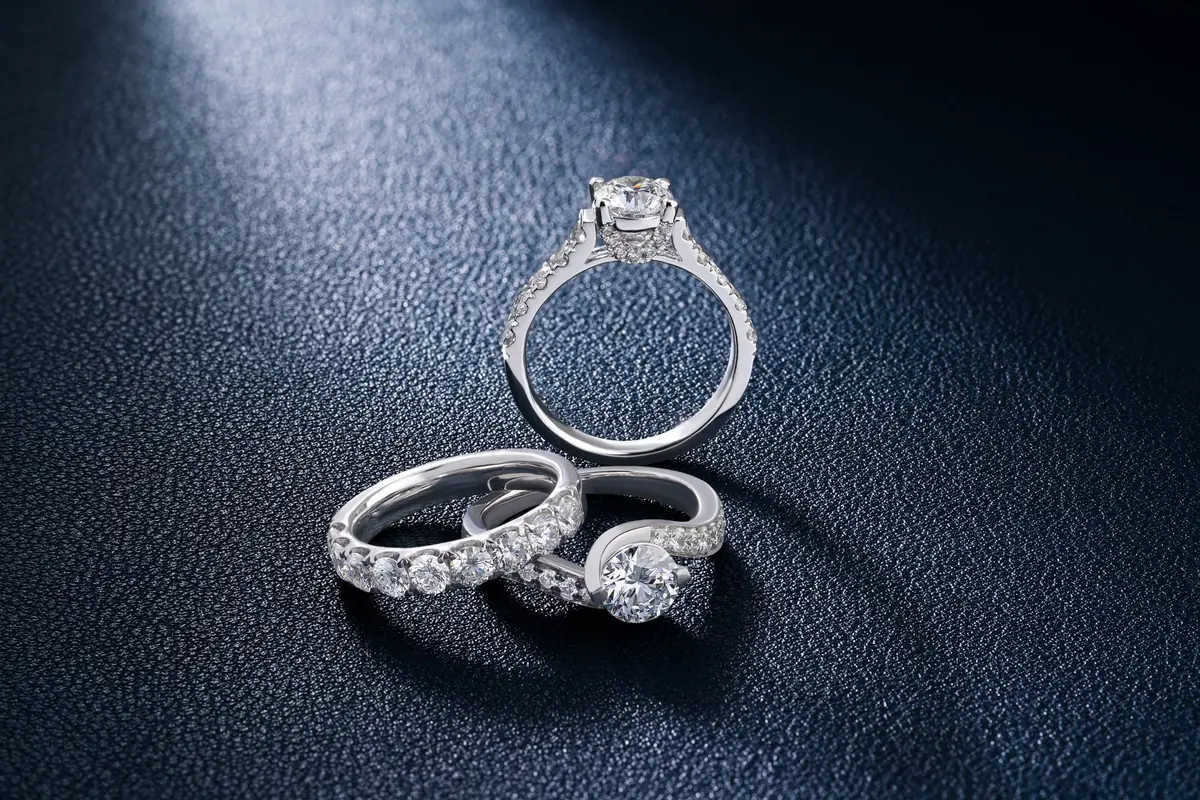
An engagement ring is not resold as one object. A buyer breaks it into three parts and prices each one on its own terms: the center stone at a wholesale diamond price, the side stones by the carat at small-diamond parcel rates, and the setting by the weight of its gold or platinum. Add the three together and you have the engagement ring resale value. A signed piece from a major house is the one exception, because the name can be worth more than the parts.
That split explains almost every surprise sellers have at the counter. The center stone usually carries most of the money. The pavé band that made the ring sparkle in the store often adds far less than people expect. The metal adds a modest, predictable amount that moves with the spot price. Once you see how each piece is measured, the number on the offer stops looking arbitrary.
Why a buyer takes the ring apart on paper
A finished ring was priced at retail as a design: labor, branding, the store’s rent and its margin are all folded into the tag. A buyer on the secondary market cannot resell that package at the same price, because the next customer can buy a new ring anywhere. What a dealer can resell, at a known price, is a graded diamond, a parcel of small diamonds and a weight of precious metal. So that is how the ring is valued.
At a professional counter the steps look like this. The gemologist checks the center stone under a loupe and a microscope, reads any grading report that came with it, and measures the stone in the setting. The side stones are counted and their total weight estimated. The mounting is tested for karat or platinum content and its weight estimated after allowing for the stones. Each figure goes on a sheet, and the offer is the sum. At Buyers of New York this is done at the counter in front of the seller, and the diamond evaluation page notes that the stone and the setting are assessed separately and paid for both.
The center stone carries most of the value
The center diamond is graded on the four Cs: carat weight, color (D to Z), clarity (Flawless down to I3) and cut. Natural white diamonds trade among dealers against a published benchmark, the Rapaport price list, which gives a per-carat figure for each combination of shape, size, color and clarity. Dealers then quote a percentage below or, rarely, above that list depending on the specific stone. Our post on how the Rapaport list works covers that system in detail.
Here is a worked example with round, clearly hypothetical numbers. Say a 1.20 carat round, G color, VS2 clarity, with an excellent cut. If the list price for that bracket were $8,000 per carat, the list value would be 1.20 x $8,000 = $9,600. A dealer then applies a discount that reflects how desirable this particular stone is: its fluorescence, how its proportions look, whether the inclusions sit under the table, and whether it comes with a respected report. The offer is that adjusted figure, not the list price and certainly not the original retail price.
Size thresholds matter
Diamond prices jump at round numbers. A 0.98 carat stone and a 1.01 carat stone look nearly identical on a hand, but the 1.01 sits in the one-carat bracket and is priced per carat at a higher rate. The same step happens at 1.50, 2.00 and 3.00 carats. If your stone sits just over a threshold, protect it: a chip that forces a recut below the line costs real money.
How a stone is weighed while still set
A diamond cannot be weighed accurately on a scale while it sits in prongs. For a round brilliant, buyers estimate weight from measurements: average diameter squared, times depth, times 0.0061, all in millimeters. A stone measuring 6.80 mm across and 4.20 mm deep works out to roughly 6.80 x 6.80 x 4.20 x 0.0061 = about 1.18 carats. A grading report removes the guesswork, which is one reason it helps. If there is no report and the stone is significant, a buyer may ask to unset it to weigh and grade it properly.
Reports and laser inscriptions
A GIA report lists the measurements, grades and often a report number laser-inscribed on the girdle. A buyer will read that inscription under magnification and match it to the paper. A matching report speeds up the valuation and removes doubt for the next buyer. It is not required to sell, and for a small stone the cost of a new report rarely pays for itself.
Side stones, halos and pavé: priced by the carat
Small diamonds, usually called melee in the trade, are bought in parcels and priced per carat of total weight, not stone by stone. A halo of thirty tiny rounds might total 0.25 carats, and that quarter carat is valued at a parcel rate that is a small fraction of the per-carat price of the center stone. Many rings carry a stamp inside the shank such as “0.50 TW” or “D.45”, which tells you the maker’s stated total weight of the accent diamonds.
Several things push melee value down. The stones are rarely graded individually. Removing them takes a jeweler’s time, and some will chip on the way out. Single-cut and older eight-cut stones are worth less per carat than modern full-cut rounds. Very small stones in a channel or pavé band may be priced simply as part of the mounting. Larger side stones are a different matter: a three-stone ring with a pair of 0.40 carat trapezoids or half-moons is valued stone by stone, much like the center.
The setting: metal weight and purity
Unless the mounting is signed or unusually well made, it is valued as precious metal. The inside of the shank usually tells the buyer what to expect: 14K or 585 means 58.5 percent gold, 18K or 750 means 75 percent, PT950 or 950 PLAT means 95 percent platinum. The buyer still tests it, by acid or XRF, because stamps are sometimes wrong and resized shanks can be patched with lower karat stock.
A worked example, again with hypothetical numbers. A 14K setting with the stones out weighs 3.5 grams. The pure gold content is 3.5 x 0.585 = 2.05 grams. If gold spot were $2,500 per troy ounce, that is $2,500 / 31.1035 = about $80.38 per gram of pure gold, so the melt value is roughly 2.05 x $80.38 = about $165. A buyer pays a percentage of that figure, which leaves room for refining. Platinum works the same way: 5 grams of PT950 holds 4.75 grams of platinum, priced against the platinum spot price. Spot prices change every trading day, so check a live quote rather than any number you see in an article. For more on how metal is priced, see the platinum page.
When the name on the ring changes the math
A ring signed by a house with real resale demand, such as Tiffany & Co., Cartier, Harry Winston or Van Cleef & Arpels, can be worth more as a finished ring than its parts. The signature is usually engraved inside the shank with a serial number, and many of these houses inscribe or document the center stone as well. Original boxes, receipts and the house’s own diamond certificate make the premium easier to support.
The premium is not automatic. It depends on the model, the condition, whether the ring has been resized or altered by an outside jeweler, and whether the center stone is still the original. A Tiffany setting holding a replacement diamond is valued as a Tiffany mounting plus a separate stone. A buyer checks the engraving style, the serial format and the construction against known examples before paying for the name.
Why the resale figure sits below the receipt
Most sellers compare the offer to what was paid or to an insurance appraisal, and both comparisons mislead. Retail jewelry prices include a markup over wholesale that covers the store’s costs and profit. When you sell, you are selling into the wholesale market, which is where any buyer has to resell. The Buyers of New York guide to diamond offers puts it plainly: no buyer anywhere pays retail value for a used diamond.
Insurance appraisals are written for replacement at retail, often with a cushion, so they routinely run well above what any buyer will pay. That does not make the appraisal wrong; it answers a different question. Our post on why appraisals are higher than offers explains the gap.
The three parts side by side
| Part of the ring | How it is measured | What moves the price | What helps the seller |
|---|---|---|---|
| Center diamond | Graded on the four Cs, weight measured or estimated | Size bracket, color, clarity, cut, fluorescence, report | Original grading report, matching girdle inscription |
| Side stones and pavé | Counted, total weight estimated or read from the TW stamp | Total carat weight, cut style, size of each stone | Original paperwork listing total weight |
| Setting | Metal tested, net weight estimated | Karat or platinum purity, weight, spot price that day | Nothing beyond the metal, unless signed |
| Signature | Engraved maker’s name and serial number checked | Brand demand, model, originality, condition | Box, receipt, house certificate |
Condition details that raise or lower the number
Several small things show up under the loupe and change the offer.
- Chips and abrasion. A chip at the girdle or a worn culet may mean the stone has to be repolished, which can drop it below a weight threshold.
- Clarity treatments. Laser drill holes and fracture filling are disclosed treatments. A filled stone is worth noticeably less than an untreated stone with the same apparent clarity, and a buyer will look for the flash effect that fillers show.
- Lab-grown center stones. These have a much weaker resale market than natural diamonds. A lab-grown stone is identified with testing equipment, and a report will say so on its face.
- Worn or rebuilt prongs. These matter little to a buyer valuing metal, but they matter to a buyer who would resell the ring whole.
- A missing report. Not a problem for small stones. For a stone over about a carat, the buyer must rely on their own grade, and conservative grading is normal when there is no paper.
Selling the stone and keeping the band, or the reverse
Because the parts are valued separately, you can split them. Some people keep the center diamond to reset in a new piece and sell only the mounting. Others keep a wedding band and sell the solitaire. A buyer can value each part on its own and give you the numbers before you decide. If the stone has to be removed, ask that it be done while you watch, and keep the grading report with whichever part it belongs to.
What to bring and how to get the ring valued
Bring the ring, a government photo ID (New York requires it for every purchase), and any paperwork you have: the GIA or other grading report, the original receipt, and the box for a signed piece. Clean the ring gently with warm water and a soft brush so the stone can be read clearly, but do not try to remove stones or polish the metal.
Buyers of New York is at 30 W. 47th Street, Suite 8006, in the Diamond District, open Monday to Friday from 10am to 6pm. Walk in, or call (212) 642-4345 first if the stone is large or you are bringing several pieces. Every part of the ring is graded and tested at the counter, and the evaluation is free with no obligation. For the full list of what is bought and how certified stones are priced, see the page on selling diamonds in NYC.
More questions sellers ask
Is it better to sell the diamond loose or still in the ring?
For a plain mounting it makes little difference, because the buyer values the stone and the metal separately either way. Leaving the stone set avoids the risk of damage during removal. For a large stone without a report, a buyer may ask to unset it to weigh and grade it accurately.
Does the original receipt raise the offer?
A receipt shows what was paid at retail, which is not what any buyer can resell for, so it does not set the offer. It is still useful because it can confirm the stone's specifications, the maker of a signed ring and when it was bought.
Can I sell the band and keep the diamond?
Yes. The stone can be removed and the setting valued for its metal content alone. Ask for the stone to be removed while you watch and keep any grading report with it.
Are wedding bands bought with engagement rings?
Yes. A plain band is valued by its metal weight and purity, and a diamond band is valued for its metal plus the total carat weight of its stones.
Does an engraving inside the band lower the value?
A personal engraving does not change the metal value or the diamond value. On a signed designer ring that would be resold whole, it can reduce the price slightly because it may need to be polished out.