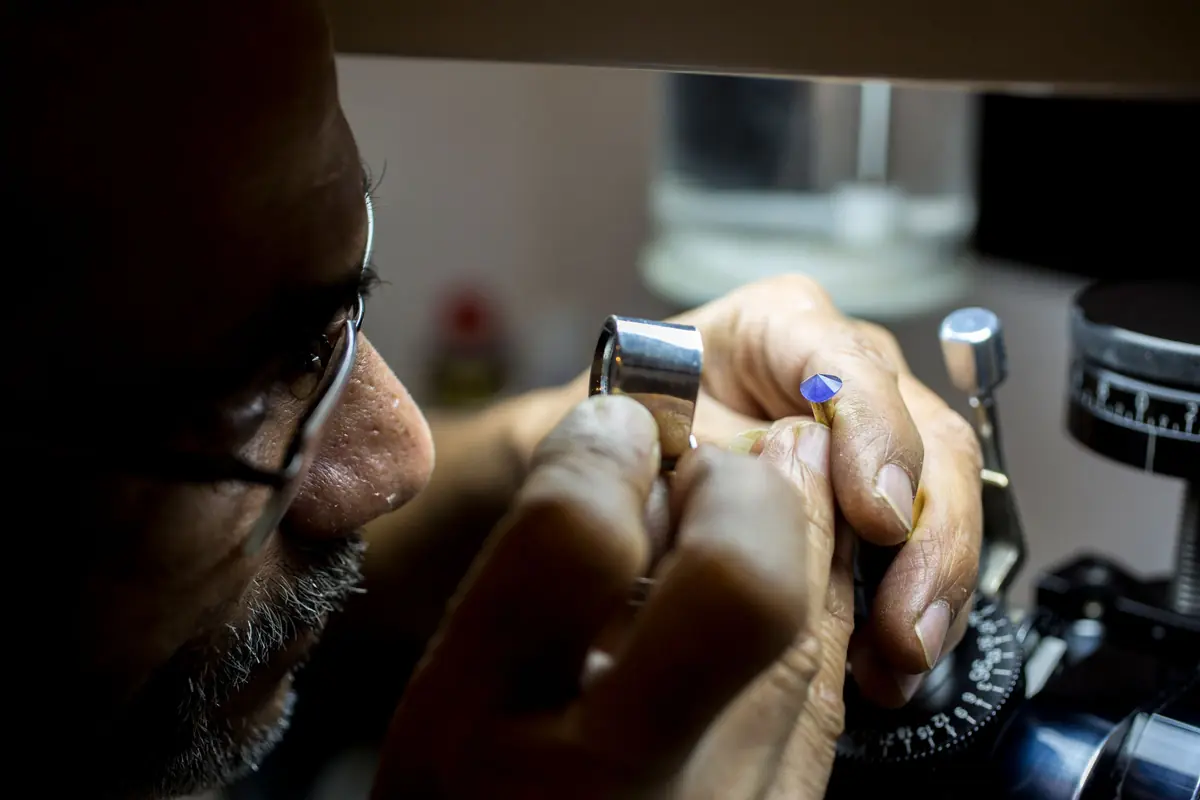
To tell if a gemstone is real, a gemologist does not rely on one trick. The first checks are a 10x loupe and a few basic instruments: what the inclusions look like, how the facet edges are worn, how the stone bends light on a refractometer, and whether it is singly or doubly refractive. Those few minutes usually separate natural gems from glass and most imitations. Separating a natural stone from a laboratory-grown one of the same mineral is harder, and for valuable stones it often needs a gem lab.
The word “real” also hides four different questions. Is the stone the mineral it is sold as? Is it natural or grown in a lab? Is it one piece, or an assembled doublet? And has it been treated? The answers set the value, so a good evaluation answers all four. This article goes through what a gemologist checks first, what each test shows, which home tests to skip, and the imitations that turn up most often in inherited jewelry.
Natural, synthetic, simulant, composite: four different things
- Natural gemstone. Formed in the earth. A natural ruby is corundum colored by chromium.
- Synthetic, or laboratory-grown. The same mineral with essentially the same chemistry and optical properties, grown in a factory. A synthetic ruby is still corundum. It is real corundum, but it is not a natural ruby, and the market prices it as a different product.
- Simulant, or imitation. A different material that looks similar: red glass for ruby, cubic zirconia for diamond, synthetic spinel for sapphire.
- Composite, or assembled stone. Pieces bonded together, such as a doublet with a thin natural top on a glass base, or a triplet with a colored layer sandwiched between colorless pieces.
A fifth category overlaps all of these: treated natural stones. A heated sapphire or an oiled emerald is natural and treated. Treatment does not make a stone fake, but it changes value. Our posts on heated and unheated ruby and on emerald fillers cover that side.
What a gemologist checks first
The loupe and the microscope
Under 10x magnification, nature and the factory leave different fingerprints.
- Natural stones usually show mineral crystals, irregular fluid-filled fingerprints, angular color zoning and silk. These are messy and varied.
- Flame fusion synthetics, the oldest and cheapest synthetic ruby and sapphire, often show curved growth lines, called curved striae, and round or elongated gas bubbles. Natural corundum grows with straight, angular zoning, so curved lines point strongly to a lab origin.
- Flux-grown synthetics can show wispy, veil-like flux remnants and platinum platelets from the crucible.
- Hydrothermal synthetics, common in emerald, can show chevron or wavy growth patterns and nail-head shaped inclusions.
- Glass shows round gas bubbles, swirl marks, and often a slightly orange-peel surface or mold marks on molded pieces.
Facet edges and surface wear
Hardness shows up in wear. Glass is much softer than corundum or diamond, so on a stone worn for decades its facet edges look rounded, nicked and scuffed, while the girdle of a sapphire set in the same ring stays crisp. Glass also breaks with a curved, shell-like chip. A gemologist reads this in seconds and it is one of the most useful first clues.
The refractometer
Each gem material bends light by a characteristic amount, its refractive index. A refractometer reads it on a flat facet using a contact liquid. Corundum reads about 1.76 to 1.77. Emerald reads about 1.57 to 1.58. Spinel reads about 1.72 with a single reading. Glass gives a single reading that varies widely by recipe. A stone sold as sapphire that reads 1.72 with no double refraction is spinel or glass, not sapphire. Synthetics read the same as their natural counterparts, which is why the microscope still matters.
The polariscope and dichroscope
A polariscope shows whether a stone is singly refractive, like glass, spinel, garnet and diamond, or doubly refractive, like corundum, beryl and tourmaline. A dichroscope shows whether a colored stone looks two different colors from different directions, which ruby and sapphire do and glass does not.
One ring at the counter, step by step
Here is how a typical check runs on an inherited piece: a yellow gold cocktail ring with a large oval red stone and small white stones around it, stamped 14K inside the shank.
- A first look under the loupe. The gemologist checks the facet edges of the red stone. They are sharp, with one small chip that broke in a jagged, grainy pattern rather than a smooth shell shape. That points away from glass.
- Inside the stone. Under the microscope there are short, straight needles crossing at angles and a few small crystals. No curved lines, no round bubbles. That pattern fits natural corundum.
- Refractive index. The table facet reads about 1.76 to 1.77 with double refraction. The stone is corundum, so it is ruby or a dark pink sapphire, not garnet or spinel.
- Dichroscope and UV. It shows two shades of red from different directions and glows red under long-wave ultraviolet. Both are consistent with ruby.
- Treatment clues. The needles look partly broken and one crystal has a small disc-shaped fracture around it, which suggests the stone was heated. No glass flashes in the fissures.
- The accent stones. A diamond tester and the loupe show the small white stones are diamonds, single cut, as expected in an older piece.
- The metal. An acid or XRF test confirms 14 karat gold.
The result is a heated natural ruby, small single-cut diamonds and a 14K mount, each valued separately. If the stone were large and of fine color, the gemologist would suggest a lab report to confirm natural origin and treatment before a final number. The whole check above takes a few minutes, which is why bringing the piece in is faster than trying to settle it at home.
A test-by-test comparison
| Test | What it shows | Separates natural from synthetic? | Safe to try at home? |
|---|---|---|---|
| 10x loupe | Inclusions, bubbles, wear, joins | Sometimes, with experience | Yes, to look, not to judge |
| Microscope with darkfield lighting | Growth lines, flux, fillers | Often | No |
| Refractometer | Refractive index and birefringence | No, identifies the material | No |
| Polariscope | Single or double refraction | No | No |
| Ultraviolet lamp | Fluorescence color and strength | Supporting evidence only | Yes, but hard to interpret |
| Chelsea color filter | Red response from chromium | No | Yes, but often misleading |
| Specific gravity | Density of a loose stone | No | No |
| Advanced lab spectroscopy and chemistry | Trace elements, growth history, treatments | Yes, for most stones | No |
Spotting doublets and triplets
Assembled stones were common in Victorian and early twentieth century jewelry, and they still turn up. The most common is the garnet-and-glass doublet: a thin slice of red garnet fused onto colored glass, which gives the stone garnet’s hardness on top with any color below. Laid table-down on white paper, many of these show a red ring around the edge from the garnet cap. Others show a visible join line around the girdle, flattened bubbles along the join, or a difference in luster between the top and the bottom. Soudé emeralds, two pieces of colorless material with a green layer between them, show their color in one plane when viewed from the side. Closed-back settings were often used to hide joins, which is one reason buyers look harder at stones in old closed-back mounts.
Common imitations by color
Inherited jewelry tends to repeat the same substitutes.
- Red stones sold as ruby: garnet, red spinel, synthetic ruby, red glass, garnet-and-glass doublets, and glass-filled ruby composites.
- Blue stones sold as sapphire: synthetic sapphire, synthetic blue spinel, blue glass, iolite, tanzanite and kyanite.
- Green stones sold as emerald: synthetic emerald, green glass, tourmaline, tsavorite garnet, green sapphire, chrome diopside and soudé emeralds.
- Clear stones sold as diamond: cubic zirconia, moissanite, white sapphire, colorless topaz, glass (paste) and rock crystal quartz.
Some of these are valuable gems in their own right. Red spinel and tsavorite can be worth a great deal. A mistaken name does not make a stone worthless, it only means it has to be valued as what it is. In a jewelry evaluation at Buyers of New York, colored stones are identified and checked for size and quality, then priced separately from the metal they sit in.
Why age does not prove a stone is natural
Flame fusion synthetic ruby has been produced commercially since the early 1900s, and synthetic blue sapphire followed soon after. Synthetic spinel came into wide use in the same era. That means a ring from a grandmother’s jewelry box, with an engraved date from the 1920s, can easily hold a synthetic ruby or sapphire. Jewelers of the time used synthetics openly in class rings, birthstone rings and fashion pieces.
The reverse is also true: modern mass market jewelry often holds natural stones that are heavily treated. The age of the piece, the quality of the gold mounting and the price someone paid tell you about the mounting and the purchase, not about the stone.
Home tests to skip
- The scratch test. Rubbing a stone on glass or a file tells you little, since many fakes are hard enough to scratch glass, and it can chip a real gem.
- The fog test. Breathing on a stone to see how fast the fog clears is sometimes suggested for diamonds. It is unreliable for colored stones and not conclusive for diamonds either.
- The water or float test. Gem density can be measured properly, but a cup of water cannot do it.
- Heat or flame. This can crack stones, burn emerald oil and ruin glass-filled rubies.
- Stamps on the mount. A “14K” or “PLAT” stamp is about the metal. It says nothing about the stone.
The one home step that helps is a gentle clean with warm water, mild soap and a soft brush so the stone can be seen clearly.
When a lab report is needed
A trained gemologist at a counter can usually identify the material, spot most imitations and assembled stones, and flag likely synthetics. For a stone that could be worth a significant amount, especially a large ruby, sapphire or emerald, separating natural from the best modern synthetics and identifying some treatments requires laboratory equipment. Labs such as GIA, GRS, Gübelin, SSEF and AGL use advanced spectroscopy and trace element analysis for exactly this. A buyer may give a provisional figure and suggest a report before a final one.
For costume pieces and fashion jewelry, the question is simpler: is the metal precious, and are the stones glass or something better? Our post on whether costume jewelry is worth anything covers that end of the market.
What to bring and how to have a stone identified
Bring the stone or the piece, any lab reports, receipts or appraisals, and anything you know about where it came from. A government photo ID is required to sell. Do not try to remove stones from their settings, and do not use heat or harsh cleaners.
Buyers of New York is at 30 W. 47th Street, Suite 8006, open Monday to Friday from 10am to 6pm. Its ruby, sapphire and emerald pages say stones are identified at no charge, natural, synthetic or a different gem altogether, with no obligation to sell. Call (212) 642-4345 with questions before you come. Each piece is valued for its metal, its stones and its maker, and the evaluation happens at the counter where you can watch.
More questions sellers ask
Is a lab-grown ruby or sapphire fake?
It is real corundum with the same chemistry as a natural stone, but it was grown in a factory. The market treats it as a separate, much less valuable product, so it must be disclosed.
Can a jeweler's diamond tester check colored stones?
No. Standard thermal diamond testers are made for diamonds and do not identify rubies, sapphires or emeralds. Colored stones need a loupe, refractometer and other gem instruments.
Does a stone's color under UV light prove it is natural?
No. Fluorescence is supporting evidence only. Many synthetic rubies fluoresce strongly, and some natural rubies barely fluoresce at all.
Are stones in antique jewelry always natural?
No. Synthetic ruby and sapphire have been made since the early 1900s, and glass and doublets were common long before that. Every stone is tested regardless of the age of the piece.
Does identification cost anything?
At Buyers of New York, stone identification is free and there is no obligation to sell, according to the firm's ruby, sapphire and emerald pages.