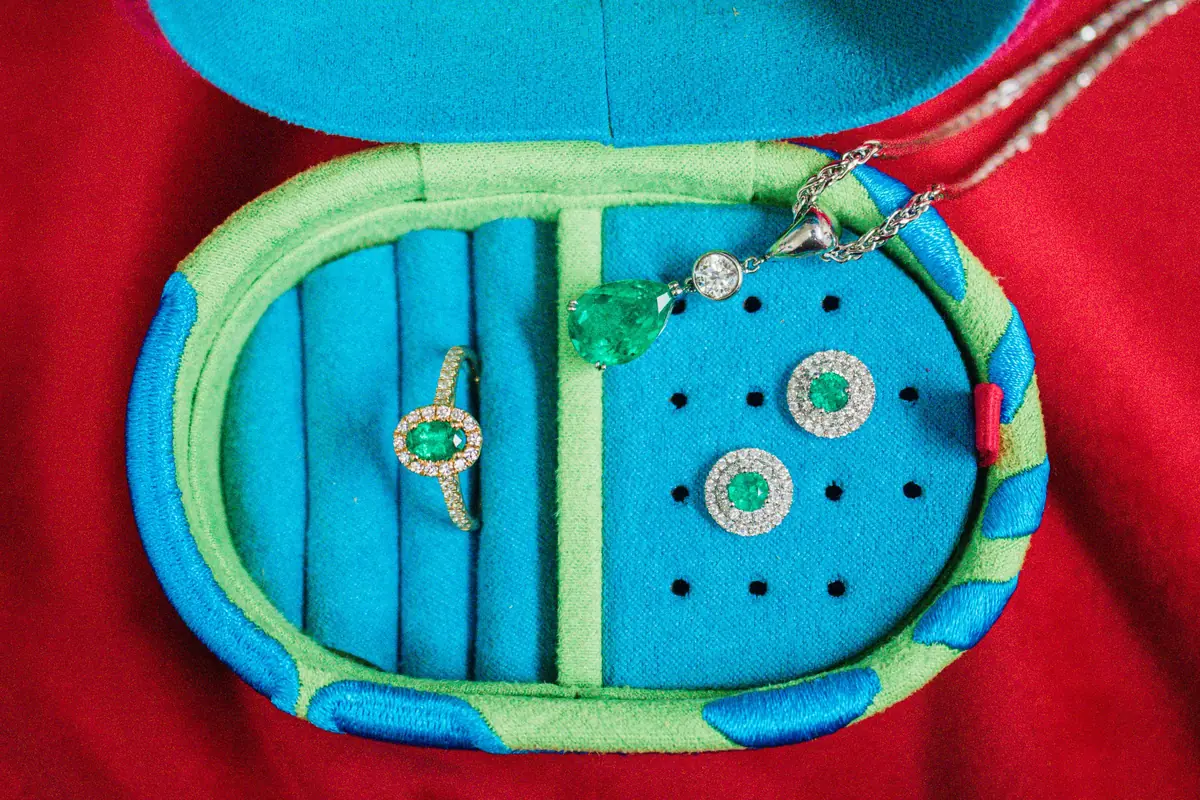
Nearly every emerald has surface-reaching fissures, and nearly every emerald on the market has had those fissures filled with oil or resin to make them less visible. That is accepted trade practice. What changes emerald treatment value is the amount of filler and its type: a stone with none or only a trace of oil is rare and sells at a strong premium, while a stone whose clarity depends on heavy resin filling is worth much less than its face-up look suggests.
A lab report puts those facts on paper. It says whether the stone is natural, how much clarity enhancement it shows, often what kind of filler, and in many cases where the stone was likely mined. Origin, with Colombia at the top, then interacts with treatment to set the price. This article explains what each part of an emerald report means, how a buyer reads it, and why two emeralds of similar color can be priced very differently.
Why emeralds are filled in the first place
Emerald is the green variety of beryl, colored by chromium, vanadium or both. It grows in conditions that leave it full of fractures, fluid inclusions and mineral crystals. The trade calls this inner world the jardin, French for garden, and accepts that almost no emerald is clean. Fissures that reach the surface show up as white or reflective lines, and they can make a stone look cloudy.
Filling those fissures with a substance whose refractive index is close to emerald’s makes them far less visible. The light passes through the filled crack instead of bouncing off it. Cutters have oiled emeralds for centuries, and it is now standard at the cutting stage, during trading, and sometimes again after a stone has been set.
Oil, resin and the difference between them
Fillers come in two broad groups, and labs often say which one they found.
- Oils. Cedarwood oil is the traditional filler. It is colorless, it does not harden, and it can slowly dry out or seep from fissures over years, making the stone look more included. It can be cleaned out and replaced.
- Resins and polymers. Synthetic resins, some hardened after filling, were adopted because they are more durable and can hide fissures more completely. Some can yellow or turn cloudy with age, and a hardened resin is harder to remove if a stone needs to be cleaned and refilled.
Many buyers in the high end of the market prefer oil to resin, partly because oil is reversible and partly from long habit. Colored fillers are a different matter. Green-tinted oil or resin adds color the stone does not have, which is a far more serious treatment, and stones filled that way are priced accordingly.
How labs grade the amount of filler
Labs describe clarity enhancement in degrees. Many of the labs that handle important emeralds, including the Swiss labs, use a scale of none, insignificant, minor, moderate and significant, and they usually name the filler type as oil, resin or both. GIA uses short codes: F1 for minor, F2 for moderate and F3 for significant. GIA explains the scale as a judgment of how much the treatment affects the face-up look, so minor means only a slight effect and significant means an obvious one.
| Report wording | What it means in practice | Typical effect on value |
|---|---|---|
| No indications of clarity enhancement | No filler detected | The rarest category; strong premium |
| Insignificant | A trace of filler with almost no effect on appearance | Near the top of the range |
| Minor (GIA F1) | Filler present with only a slight effect face up | Highly regarded; the target for fine stones |
| Moderate (GIA F2) | Filler visibly improves the look | The bulk of the good commercial market |
| Significant (GIA F3) | The stone’s apparent clarity depends on the filler | Steep discount, larger again if the filler is resin |
The scale reflects how much the face-up appearance changes, not simply the volume of filler. A small amount of filler in one large fissure under the table can matter more than more filler spread through tiny fissures near the girdle.
Origin: Colombia, Zambia, Brazil and others
Origin is the second big line on an emerald report.
- Colombia. Muzo, Chivor and Coscuez are the famous mining areas. Colombian emeralds are known for a warm, saturated, slightly bluish green and a soft glow. Under magnification many show jagged three-phase inclusions, cavities holding a liquid, a gas bubble and a tiny salt crystal. Colombia also produces the rare trapiche emerald, with a fixed six-spoke pattern.
- Zambia. The Kagem area produces emeralds that tend to be a cooler, bluish green with good clarity. They have built a strong reputation and are now a major part of the market.
- Brazil. Brazilian emeralds often run lighter and yellower, though fine stones exist. They usually trade at a discount to Colombian and Zambian stones of similar look.
- Afghanistan, Ethiopia and others. The Panjshir valley in Afghanistan produces stones that can resemble Colombian material closely. Ethiopia has become a newer source of attractive stones.
A Colombian origin adds value, and a Colombian stone with no or minor oil is the combination collectors look for. The Buyers of New York emerald page says that origin determination needs examination of inclusions under magnification, spectroscopic analysis and trace element evaluation, and that a GIA, GRS or Gübelin certificate confirming Colombian origin and treatment status will improve an offer.
A worked example: two emeralds that look alike
Picture two 3 carat emerald cut stones, both a rich green, both looking eye-clean across a table. The numbers here are hypothetical and only show the order of value.
- Colombian, minor oil, report from a major lab. The clarity you see is mostly natural. If the oil dried out tomorrow, the stone would still look good.
- Origin undetermined, significant resin, older report. The clean look depends on the filler. Under a microscope the buyer sees flattened bubbles and flash effects in large fissures. If the resin clouded or were removed, the stone would show white fractures across the table.
Across a table they look similar. At the counter stone 1 can be worth several times stone 2, because the next buyer is paying for what the stone will look like over decades, not just today.
How a buyer checks treatment at the counter
Even with a report, a buyer examines the stone. Under a microscope with darkfield and fiber-optic lighting, filled fissures can show a blue or orange flash as the stone is tilted, trapped gas bubbles, and dried or cloudy areas where filler has receded. Some fillers fluoresce under ultraviolet light. A buyer also checks that the stone’s measurements and weight match the report, because a stone can be re-cut, re-oiled or re-filled after the paper was issued.
That point matters. An emerald report describes the stone on the day it was tested. If the stone was later cleaned in an ultrasonic, set or repaired with heat, or re-oiled, the level of filler may have changed. For an important stone, a buyer may suggest an updated report before agreeing a final number.
Care mistakes that cost sellers money
Several common habits damage emerald value before the stone ever reaches a buyer.
- Ultrasonic and steam cleaning. Vibration and heat can drive oil out of fissures and can widen existing fractures. The stone then looks more included than it did.
- Jeweler’s torch. Repairing or resizing a ring with the emerald in place can heat the stone, burn the oil and even crack it.
- Solvents and household cleaners. Some can dissolve or cloud fillers.
- Hard knocks. Emerald is hard enough for daily wear but brittle along its fissures. The corners of an emerald cut are a common chip point.
The safest way to clean an emerald before an evaluation is warm water, a little mild soap and a soft brush, then a soft cloth.
Should an emerald be re-oiled before a sale?
Re-oiling is a normal service in the emerald trade. A stone that has dried out, or that was cleaned too hard, can look noticeably better after its fissures are cleaned and filled again with colorless oil. It is tempting to do this before selling. In most cases it is better to let the buyer see the stone as it is.
The reasons are practical. A buyer of a significant emerald will look for filler under the microscope regardless, and fresh oil does not change what a lab would report about the fissures. If the stone has a report describing minor oil and now carries more, the stone no longer matches its paper, which creates doubt rather than value. If the work is done badly, or with a tinted or hardened filler, the stone can drop into a lower category for good. And a professional buyer prices a dried-out stone knowing that re-oiling is cheap and routine; the improvement is already part of how they read it.
The exception is a stone you plan to wear for years before deciding anything. In that case a reputable cutter can clean and re-oil it with colorless oil, and you should keep a written note of what was done and when. Disclose any treatment you know of when you sell. It speeds up the evaluation and it is what the next buyer will ask about.
Natural, synthetic or another green stone
Synthetic emeralds have been grown by flux and hydrothermal methods for decades and are common in jewelry. They often look cleaner than natural stones and can show telltale growth patterns or flux inclusions under the microscope. Green tourmaline, tsavorite garnet, green sapphire, chrome diopside, green glass and assembled stones such as soudé emeralds (two pieces of colorless material with a green layer between them) are all sold or inherited as emerald by mistake. A buyer separates them with refractive index, specific gravity, spectroscopy and magnification. Our post on how a gemologist tells a real gemstone from a synthetic explains those tests in detail.
For the related question of how heat and origin set the value of the other two big colored stones, see sapphire origin and treatment.
Color still comes first
None of this replaces color. The most valued emeralds show a pure to slightly bluish green of medium to medium dark tone with strong saturation. A stone that is too pale tends to be called green beryl by some labs and is worth far less. A stone that is too dark looks black in low light. Yellowish or grayish greens are discounted. A buyer looks at color first, then reads the treatment and origin lines to decide how far the stone climbs from there.
What to bring and how to have an emerald evaluated
Bring the emerald or the jewelry, every lab report you have, and any receipts or notes on when the stone was last cleaned or repaired. A government photo ID is required to sell. Do not clean the piece in an ultrasonic or steamer, and do not have a jeweler work on it with heat before the evaluation.
Buyers of New York is at 30 W. 47th Street, Suite 8006, open Monday to Friday from 10am to 6pm. Identification is free, including whether a stone is natural emerald, synthetic or a different green gem, and there is no obligation to sell. For a significant Colombian or minor-oil stone, call (212) 642-4345 first. See how emeralds are bought and paid for before you visit, including loose stones, estate pieces and signed jewelry.
More questions sellers ask
Is an oiled emerald natural?
Yes. Oiling fills fissures in a natural stone to improve its appearance, and it is accepted trade practice when disclosed. The degree of oiling, not the fact of it, is what affects value most.
Does emerald oil wear off?
Oil can slowly dry out or be driven out by heat, ultrasonic cleaning and solvents, which makes fissures more visible. The stone can usually be cleaned and re-oiled, though this should be disclosed.
Is resin worse than oil in an emerald?
Many high end buyers prefer oil because it is reversible. Resin can be more durable but may cloud or yellow with age and is harder to remove, so heavily resin-filled stones are usually discounted more.
How old can an emerald report be and still count?
A report describes the stone on the day it was examined. An older report is still useful, but a buyer checks that the stone still matches it and may suggest an update for a significant stone.
Are Zambian emeralds as valuable as Colombian ones?
Colombian origin carries the strongest premium, but fine Zambian emeralds are highly regarded and widely traded. Color, clarity and treatment level matter more than origin for most stones.