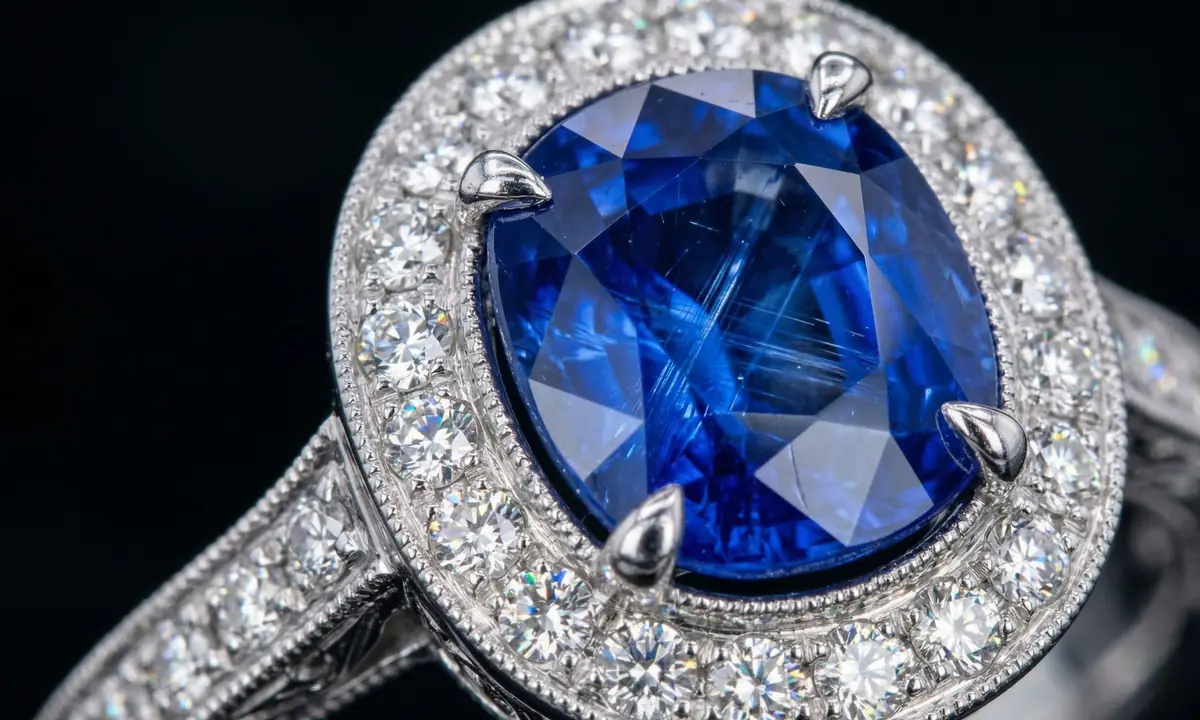
A sapphire’s origin changes its value because the market pays for reputation and rarity, and a few sources carry far more of both than others. Kashmir sits at the top for blue sapphire, followed by Burma (Myanmar) and Sri Lanka, the old Ceylon. Madagascar, Thailand, Australia, Montana and East Africa produce good and sometimes outstanding stones, but they rarely carry the same name premium. That is the core of sapphire origin value: two stones of matching color and size can be priced very differently because of what a lab says about where they came from.
Treatment works alongside origin. Most sapphires are heated, which the trade accepts. An unheated stone of fine color from a top source is rare, and a stone treated by diffusion or filled with glass belongs in a lower price class altogether. Below is how each origin tends to look, how labs decide origin, which treatments matter, and how all of it shows up at the counter.
Why origin matters at all
A gemologist judges a sapphire first by color, then clarity, cut and size. Origin should, in theory, add nothing to a stone’s beauty. In practice it does three things. It signals a particular look: Kashmir velvet, Ceylon brightness, Australian depth. It signals rarity, since some deposits are exhausted. And it gives buyers at auction and in the high jewelry trade a shorthand for quality, which they pay for.
That last point is why origin matters most at the top. A 1.5 carat commercial blue sapphire in a tennis bracelet is priced on color and size, and nobody pays extra for a lab’s origin opinion. A 6 carat stone of fine color is a different market, and there a Kashmir or Burma origin can change the price several times over.
The main sapphire origins and what they look like
| Origin | Typical look | Market standing |
|---|---|---|
| Kashmir (India) | Soft, velvety cornflower blue, light scattered by fine particles | The top of the blue sapphire market; very scarce |
| Burma (Myanmar) | Rich, saturated royal blue | Very high, especially unheated stones |
| Sri Lanka (Ceylon) | Bright, lively blues from light to medium; also pinks, yellows and padparadscha | Highly respected; a large supply of fine stones |
| Madagascar | Wide range; the best can resemble Ceylon or even Kashmir stones | Strong, valued on quality |
| Thailand and Cambodia | Darker, iron-rich blues, sometimes inky | Commercial to good |
| Australia | Deep, dark blue, often with green tints | Commercial; also known for parti-color stones |
| Montana, United States | Small, even cornflower blue from Yogo Gulch; other Montana deposits produce many colors | Collector interest, especially in Yogo stones |
| East Africa (Tanzania, Kenya, Ethiopia, Nigeria) | Varies widely by deposit | Valued on quality; newer sources |
Kashmir
The Kashmir deposit sits high in the Padar area of the Zanskar range. It was found in 1881, and most of its finest stones came out within the next several years. Later attempts to work it produced comparatively little. The classic Kashmir look comes from minute inclusions that scatter light, giving a soft, sleepy glow rather than sharp sparkle. Because the deposit has been effectively dormant for well over a century, almost every Kashmir sapphire on the market today came out of old jewelry or old collections, and each new one at auction gets attention.
Burma and Ceylon
Burmese sapphires, mostly from the Mogok area, are prized for saturated royal blues. Sri Lanka has produced sapphires for many centuries and remains one of the most important sources for fine blues as well as for pink, yellow and padparadscha. Sri Lanka is also home to geuda, a milky, pale corundum that turns a strong blue when heated. Much of the bright Ceylon material in commercial jewelry is heated geuda, so “Ceylon” on its own says nothing about treatment.
Basalt-related sources
Thailand, Cambodia, Australia and parts of Africa produce sapphires from deposits linked to basalt. These stones tend to be richer in iron, which darkens the blue and can add a green cast. They are an important part of the commercial market. A stone from these sources can still be beautiful, but the market applies no origin premium to it.
How labs decide origin
Origin is a professional opinion, not a measurement on a scale. Labs build it from three kinds of evidence:
- Inclusions. Mineral crystals, silk patterns, growth zoning and fluid inclusions differ between deposits. Kashmir stones, for example, often show fine milky zoning and particular crystal inclusions.
- Trace elements. Instruments such as laser ablation mass spectrometry measure small amounts of iron, gallium, titanium and other elements that differ between geological settings.
- Spectroscopy. Ultraviolet, visible and infrared spectra help separate metamorphic sapphires from basalt-related ones.
Most valuable stones go to GIA, GRS, Gübelin, SSEF or AGL. Some stones are hard to call, especially when deposits overlap in character, as some Madagascar sapphires do with classic sources. For that reason a lab may report an origin as undetermined, and buyers of very important stones sometimes want reports from two labs that agree. The Buyers of New York sapphire team describes using microscopic examination of silk patterns, spectroscopic analysis and UV fluorescence to assess origin indicators, and recommends GIA or GRS certification for significant stones.
Treatments: what is accepted and what is not
Heating
Heating is the standard sapphire treatment, and most sapphires on the market have been heated. It can dissolve silk, lighten overly dark stones, deepen pale ones and even out color. It is stable and accepted with disclosure. Lab reports say “indications of heating” or “no indications of heating”, and some note residue in healed fissures.
The premium for “no indications of heating” depends on quality. On a commercial stone it may be small. On a fine Kashmir, Burmese or Ceylon blue of several carats it is large, because unheated stones of that quality are scarce and collectors look for them.
Beryllium diffusion
Heating corundum together with beryllium lets the element enter the crystal and change its color, often producing orange, yellow or pinkish orange stones that imitate padparadscha, and lightening dark blues. It was identified widely in the early 2000s. Detection needs laboratory chemical analysis, and diffused stones sell at a fraction of conventionally heated stones.
Titanium surface diffusion
An older treatment adds blue color only in a thin layer near the surface. Immersed in liquid and viewed under diffused light, these stones show color concentrated along facet edges. Repolishing can remove the color. Their value is low.
Glass filling and other treatments
Glass filling, common in low grade rubies, is seen in some sapphires too. Star sapphires are sometimes made from diffusion-treated material, and some dark stones are coated or dyed. Each of these is priced as a treated product.
For the matching story on the red side of corundum, our post on heated and unheated ruby covers glass-filled ruby in detail.
Color comes first, even with a great origin
A Kashmir label does not rescue a stone with poor color. The market for blue sapphire still begins with hue, tone and saturation: a pure to slightly violetish blue, medium to medium dark, strongly saturated, with no gray or green. A pale, gray Kashmir stone with heavy inclusions can be worth less than a vivid Ceylon stone of the same size. Origin multiplies quality; it does not replace it.
Fancy color sapphires follow their own rules. Padparadscha, a pinkish orange named after the lotus flower, requires a balanced mix of pink and orange, and labs differ on how strict to be. Pink, yellow and purple sapphires are valued mainly on color strength and size, with origin playing a smaller role than in blue. Color-change sapphires, which shift between blue and purple in different light, are judged on the strength of the change.
A worked example: three blue sapphires, same weight
Take three hypothetical 4 carat cushion blue sapphires, each with strong, attractive color and only minor inclusions. These are examples of how a buyer ranks stones, not price quotes.
- Heated, Thailand origin, no report. A dark, slightly inky blue. The buyer values it on their own assessment as a good commercial stone.
- Heated, Sri Lanka origin, GIA report. Brighter, livelier color. Documented treatment and origin make it clearly more valuable than stone 1.
- Unheated, Burma origin, reports from two labs. Saturated royal blue. Scarcity, documentation and origin put it in a different tier, and the offer can be a multiple of stone 2.
Swap stone 3 for an unheated Kashmir stone of similar quality and the tier changes again. Swap it for a stone with beryllium diffusion and the value drops below stone 1.
Star sapphires and set stones
Star sapphires show a six-rayed star when light falls on a domed cabochon. The star comes from aligned rutile needles, the same silk that heating tends to dissolve, so natural star stones are often unheated by necessity. A buyer looks at how sharp and centered the star is, whether all six legs reach the edge, how transparent the body is and how good the body color looks. Sri Lanka and Burma produce the best known natural star sapphires. Synthetic star sapphires, made in large numbers from the middle of the twentieth century, tend to show an unnaturally perfect star and very even color, and they carry little value.
When a sapphire is set in a ring, brooch or bracelet, the buyer values the stone, any diamonds and the metal separately. Prongs and closed backs can hide inclusions and growth features that point to origin or treatment, so for a significant stone a buyer may ask to unmount it or send it to a lab before giving a firm number. Signed pieces from houses such as Cartier, Tiffany & Co. or Van Cleef & Arpels are judged for a designer premium on top of the stone, which can matter more than origin for mid-size stones.
Older pieces deserve a careful look. Many Art Deco and Edwardian rings hold good natural Ceylon or Burmese sapphires that were never heated, because modern furnace treatment was not yet in wide use. Others from the same period hold early synthetics. Age alone proves neither, which is why a buyer tests every stone.
Synthetics and look-alikes
Synthetic sapphire has been made in volume since the early 1900s and is common in older jewelry, class rings and watch crystals. Blue glass, synthetic spinel, iolite, tanzanite and kyanite can all pass for sapphire at a glance. A buyer separates them with a refractometer, loupe and other basic instruments; our article on telling a real gemstone from a synthetic walks through the tests.
What to bring and how to have a sapphire evaluated
Bring the sapphire or the jewelry, any lab report, and any original receipts, auction catalog pages or provenance notes. A family history that a ring was bought before the First World War, for example, is not proof of Kashmir origin, but it is worth mentioning. A government photo ID is required to sell. Avoid steam cleaning or heating the piece, and do not have it repolished before the evaluation.
Buyers of New York is at 30 W. 47th Street, Suite 8006, open Monday to Friday from 10am to 6pm. Identification is free, including whether a stone is natural, synthetic or a different gem altogether, and there is no obligation to sell. For a significant Kashmir, Burmese or unheated stone, call (212) 642-4345 before you come. You can read more on how sapphires of every color are valued, including padparadscha, pink and yellow stones, before your visit.
More questions sellers ask
Can a sapphire's origin be seen with the naked eye?
No. Origin is a lab opinion based on inclusions, trace element chemistry and spectroscopy. Some origins have a typical look, but appearance alone is not proof.
Is a Kashmir sapphire always worth more?
A fine Kashmir sapphire is among the most valuable gems in the market, but a pale, gray or heavily included Kashmir stone can be worth less than a vivid stone from another origin. Color comes first.
Do two labs ever disagree on origin?
Yes, especially for stones from deposits with similar geology. That is why owners of very important stones sometimes obtain reports from two labs.
Are Montana sapphires valuable?
Yogo Gulch sapphires from Montana have a loyal collector following and an even cornflower blue, but they are usually small. Other Montana deposits produce many colors and are mostly heated.
Is a sapphire with no report worth less?
For a commercial stone it makes little difference. For a large stone of fine color, the lack of a report means a buyer must price cautiously until origin and treatment are confirmed.