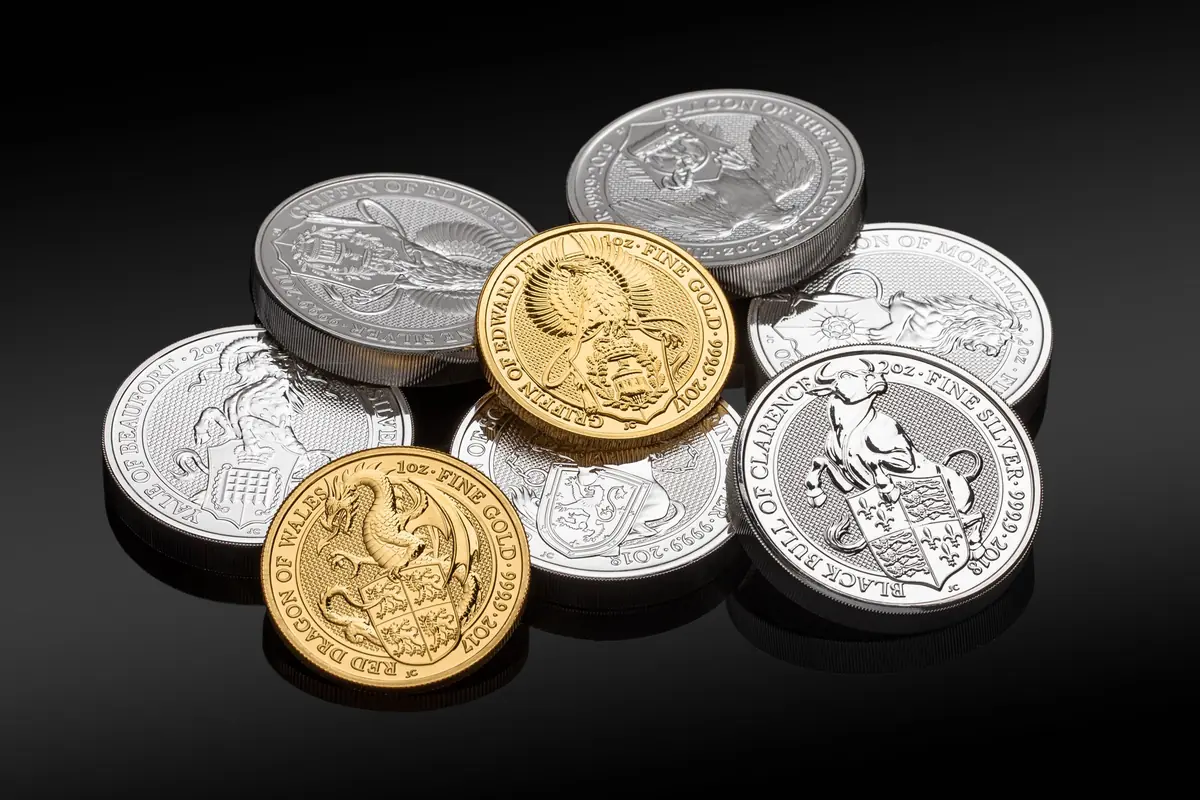
The numbers describe how much of an item is pure silver. Silver marked .999 is 99.9 percent silver, the standard for bullion bars, rounds and most modern bullion coins. Sterling, marked .925, is 92.5 percent silver with the rest usually copper, used for flatware, hollowware and jewelry. “90 percent” refers to coin silver, most often United States dimes, quarters, half dollars and dollars dated 1964 and earlier. So on 999 vs 925 silver, the difference in metal is 7.4 percentage points: a troy ounce of sterling holds 0.925 ounces of pure silver, a troy ounce of fine silver holds 0.999.
The payout difference is often larger than that gap, because the form matters as well as the purity. A recognized .999 bar can be resold as it is. Sterling flatware usually has to be refined. A bag of old dimes trades as its own product. This article explains each standard, shows the arithmetic with worked examples, and explains why two items with the same silver content can bring different offers.
What fineness means
Fineness is the share of pure silver in an alloy, written in parts per thousand. Pure silver is too soft for most uses, so it is alloyed, usually with copper, for strength. The number stamped on a piece, or known from the coin’s specification, tells you what fraction of its weight is silver.
The calculation is always the same: pure silver content = weight in troy ounces x fineness. Precious metals are weighed in troy ounces of 31.1035 grams, not the 28.35 gram ounce on a kitchen scale. A sterling piece weighing 311 grams is 10 troy ounces, not 11 ounces. Many dealers also use pennyweight, abbreviated dwt, which is one twentieth of a troy ounce, or about 1.555 grams.
The common silver standards side by side
| Fineness | Name | Where you see it | Pure silver per troy ounce of item |
|---|---|---|---|
| .9999 | Four nines fine | Canadian Silver Maple Leaf, some bars | 0.9999 oz |
| .999 | Fine silver | American Silver Eagle, most bars and rounds, Vienna Philharmonic, Mexican Libertad, current Britannia | 0.999 oz |
| .958 | Britannia standard | British silver of the higher standard; Britannia bullion coins before 2013 | 0.958 oz |
| .950 | First standard (France), Mexican 950 | French antique silver, some Mexican and Asian pieces | 0.950 oz |
| .925 | Sterling | Flatware, hollowware, jewelry; US and UK standard | 0.925 oz |
| .900 | Coin silver | US coins dated 1964 and earlier; older American “coin” flatware | 0.900 oz |
| .835 and .830 | Continental standards | Dutch, German and Scandinavian silver | 0.835 or 0.830 oz |
| .800 | Continental standard | German, Italian and other European silver | 0.800 oz |
| .400 | Forty percent silver | Kennedy half dollars dated 1965 to 1970 | 0.400 oz |
| .350 | Wartime nickels | US five cent pieces dated 1942 to 1945 with a large mintmark over Monticello | 0.350 oz |
The US and UK both restrict the word “sterling” to silver of at least 925 parts per thousand. If you are unsure what your pieces are, our post on reading sterling and silver plate marks explains the stamps.
Worked examples with hypothetical prices
Silver’s spot price changes throughout each trading day. To keep the arithmetic simple, the examples below assume a spot price of $30 per troy ounce. That is a round number for illustration, not a quote. Check a live price from a market data site or a dealer quote before doing your own sums.
A 10 ounce .999 bar
Pure silver content: 10 x 0.999 = 9.99 troy ounces. Melt value at $30: 9.99 x $30 = $299.70. Because the weight and purity are stamped by a known refiner, a buyer can check the bar quickly and offer close to that figure.
A sterling serving tray weighing 40 troy ounces
Pure silver content: 40 x 0.925 = 37 troy ounces. Melt value at $30: 37 x $30 = $1,110. The tray must be refined to be turned back into bullion, so a buyer’s offer leaves room for that cost.
Ten dollars face value in pre-1965 dimes, quarters and halves
US dimes, quarters and half dollars dated 1964 and earlier are 90 percent silver, and each dollar of face value contains about 0.7234 troy ounces of pure silver when the coins are new. Ten dollars face value holds about 7.23 ounces, worth about $217 at $30. Circulated coins have lost a little weight to wear, which is why the trade often uses a slightly lower figure. The Buyers of New York silver page uses approximately 715 troy ounces for a $1,000 face value bag.
A Morgan dollar
Morgan and Peace silver dollars are 90 percent silver and weigh 26.73 grams, so each holds about 0.7734 troy ounces of pure silver, worth about $23.20 at $30. Many Morgan dollars are worth more than their silver, though, which is covered below.
A 1966 Kennedy half dollar
Kennedy halves dated 1965 to 1970 are 40 percent silver, about 0.1479 troy ounces each, worth about $4.44 at $30. From 1971 on, circulating Kennedy halves contain no silver.
Why the same silver brings different offers
Two items can hold the same number of ounces and still be paid differently. The reasons are practical.
- Verification. A sealed or well-known .999 bar or a Silver Eagle can be checked in seconds. Sterling and unmarked items need testing.
- Refining. Sterling and lower standards are melted and refined before the silver can be sold as bullion. Refiners charge for that, and a buyer passes some of the cost on.
- Resale as is. Bullion coins and bars can be resold to other investors without processing, often at a premium. Junk silver also trades as a product, usually quoted against face value.
- Volume. Larger lots are cheaper to handle per ounce. The Buyers of New York silver payout page says higher volumes receive higher payouts.
Buyers of New York’s silver pages describe pricing each form at its silver percentage of live spot: sterling at 92.5 percent, fine silver at spot minus a small spread, and pre-1964 coin silver at 90 percent. Every piece is tested by XRF and weighed on certified scales in front of the seller, with the spot price, the weight and the calculation shown before the offer.
How purity is confirmed at the counter
A stamp or a coin’s specification is the starting point, not the end of the check. Buyers confirm purity because stamps can be wrong, worn or faked, and because counterfeit bullion exists.
- XRF analysis. An X-ray fluorescence analyzer reads the surface composition in seconds without marking the piece. It shows silver, copper and any other metals present, and it quickly exposes plated items, since the reading picks up the base metal near the surface on worn spots or edges.
- Acid testing. A small scratch on a touchstone or an inconspicuous spot, plus a drop of silver testing solution, gives a color reaction that varies with silver content. It is quick and cheap, but it marks the piece and only tests the surface.
- Weight and dimensions. Every bullion coin and many bars have a published weight, diameter and thickness. A counterfeit made of a cheaper metal rarely matches all three. Coins are checked on a precise scale and with calipers.
- Magnetism. Silver is not magnetic. A coin or bar that sticks to a magnet is not solid silver. A non-magnetic result alone proves little, since copper and many alloys are not magnetic either.
The Buyers of New York silver pages say items are XRF tested and weighed on DCA-certified scales in front of the seller. If a piece tests lower than its stamp, the offer is based on the tested purity.
Silver jewelry and mixed lots
Silver jewelry is usually sterling, but not always. Mexican and older Native American pieces may be sterling or coin silver, some Asian export silver is .900 or lower, and many costume pieces are plated base metal with a silver color. Jewelry also often contains stones, glass, enamel, clasps of other metals or steel springs. A buyer weighs only the silver, or estimates it when the parts cannot be separated.
Signed designer silver is a separate case. Pieces from houses such as Tiffany & Co., Georg Jensen or David Yurman can sell for more than their silver as jewelry, so they are assessed for resale value as well as melt. Separate them from scrap silver before a visit so they are looked at individually.
When a coin is worth more than its silver
Fineness tells you the melt value. It does not tell you a coin’s collector value. Some silver coins carry a numismatic premium well above melt because of their date, mint, condition or certification by PCGS or NGC. A few Morgan dollar dates are scarce, and many Walking Liberty halves, Barber coins and early commemoratives bring more than their silver in better grades. Proof sets and graded coins in holders should never be thrown in with melt silver without a check.
Our article on silver coin key dates lists dates worth looking for, and the page on pre-1964 junk silver coins explains how common date coins are priced.
Bullion coins: what the purity means in practice
Modern one ounce bullion coins contain one troy ounce of pure silver, whatever their fineness. A Silver Eagle at .999 and a Silver Maple Leaf at .9999 hold the same ounce; the Maple is simply refined further, so its gross weight is very slightly lower. The difference in purity has no practical effect on melt value. Price differences between them come from market premiums: what buyers will pay for each coin as a product, and how easily it can be resold.
Older and foreign coins vary more. Many pre-war European coins are .835 or .900, Mexican pesos of the mid twentieth century ranged widely in fineness, and British coins were .925 until 1920 and .500 until 1946. A buyer works out each coin from its known specification and weight.
Common mistakes when estimating silver value
- Using kitchen ounces. Weighing on a household scale in ounces overstates troy weight by about 10 percent. Use grams and divide by 31.1035.
- Counting gross weight of filled items. Weighted candlesticks and hollow-handle knives weigh far more than the silver in them.
- Treating silver plate as sterling. Plated items have only a thin surface layer and very little melt value.
- Assuming all old coins are 90 percent. US dimes and quarters dated 1965 and later are copper-nickel clad, with no silver.
- Expecting the full spot price. Every buyer works on a spread to cover refining, handling and risk. Compare offers by the percentage of melt value they represent.
What to bring and how to have silver weighed and tested
Bring the silver sorted roughly by type if you can: bullion, coins, sterling flatware and hollowware, jewelry, and anything you are unsure of. Keep graded coins in their holders and do not clean coins or polish silver. Bring a government photo ID, which is required to sell, and call (212) 642-4345 first for large lots or full monster boxes.
Buyers of New York is at 30 W. 47th Street, Suite 8006, open Monday to Friday from 10am to 6pm. Every item is tested and weighed in front of you, the live spot price and the calculation are shown before any offer, and there is no obligation to sell. Read how coins, bars, flatware and scrap silver are bought before your visit.
More questions sellers ask
Is .999 silver better than sterling?
It is purer, so a troy ounce holds more silver. Sterling is harder and better suited to flatware and jewelry. For a seller, the difference is the silver content and how easily the item can be resold.
How do I convert grams to troy ounces?
Divide the weight in grams by 31.1035. A 500 gram piece weighs about 16.08 troy ounces.
Are 1965 quarters silver?
No. US dimes and quarters dated 1965 and later are copper-nickel clad with no silver. Kennedy half dollars dated 1965 to 1970 contain 40 percent silver.
Do silver bullion coins with higher purity sell for more?
Not because of the purity itself. One ounce bullion coins contain one ounce of silver regardless of fineness, and price differences come from each coin's market premium.
Is the silver spot price the same everywhere?
Spot is a wholesale market price, so it is broadly the same across dealers at a given moment. What differs is the spread each buyer applies.