Gram for gram, 24K gold is worth about 9 percent more than 22K, a third more than 18K, and roughly 70 percent more than 14K, because its value tracks the share of pure gold it contains. 24K is 99.9 percent gold, 22K is 91.7 percent, 18K is 75 percent, 14K is 58.5 percent and 10K is 41.7 percent. Multiply any of those by the weight and the spot price and you have the melt value of the piece; the ratio between two karats never changes, whatever the gold price is doing.
The ratio is only the start. High karat jewelry raises practical questions that 14K rarely does: how much of a 22K wedding set is actually metal, whether stones and enamel are part of the weight, how testing works at very high purities, and why buyers often pay a higher percentage of spot on purer gold. Below is the arithmetic, then each of those questions in turn.
The value of each karat, side by side
The table uses a round, hypothetical spot price of $3,000 per troy ounce, which makes one gram of pure gold worth about $96.45. Real spot changes daily; check it on the day you sell. The final column shows the melt value of a 25 gram bangle in each karat at that hypothetical price.
| Karat | Fineness | Pure gold | Value relative to 24K | Melt per gram (spot $3,000) | 25 g bangle melt |
|---|---|---|---|---|---|
| 24K | 999 | 99.9% | 100% | $96.36 | $2,409 |
| 22K | 916 / 917 | 91.7% | 91.8% | $88.42 | $2,210 |
| 21K | 875 | 87.5% | 87.6% | $84.40 | $2,110 |
| 18K | 750 | 75.0% | 75.1% | $72.34 | $1,808 |
| 14K | 585 | 58.5% | 58.6% | $56.42 | $1,411 |
| 10K | 417 | 41.7% | 41.7% | $40.22 | $1,006 |
These are melt values, the worth of the pure gold before refining. A buyer’s offer is a percentage of melt, explained in detail in the arithmetic behind a gold offer. The percentage differs from buyer to buyer, but the relationship between karats in the table holds everywhere.
22K versus 24K: the 8 percent gap in practice
The difference between 22K and 24K is two parts in twenty four. 22K gold contains about 91.7 percent gold, with the remaining 8.3 percent usually silver and copper, added to make it hard enough to hold a shape and a stone. 24K is as close to pure as commerce gets, typically 999 or 9999 fineness.
For the same weight, 24K holds about 1.09 times the gold of 22K. On a 50 gram set at our hypothetical spot, that is roughly $4,818 of melt in 24K against $4,421 in 22K, a gap of about $400. On a single 8 gram ring, the gap is around $64.
Buyers of New York’s own answer to this question is short: 24K is 99.9 percent pure, 22K is 91.7 percent pure, and the payout reflects that purity difference applied to the current spot price. The site also states that the payout rate increases with purity, with 24K paid at the highest percentage of spot.
Why buyers often pay a better percentage on high karat
Refining costs are driven partly by how much non gold metal has to be removed. A kilo of 10K scrap is more than half copper, silver and zinc; a kilo of 22K scrap is less than a tenth. High karat lots are simpler to refine and the assay is more predictable, so many buyers quote a higher percentage of melt on 22K and 24K than on 10K and 14K. That makes the real gap between high and low karat slightly larger than the purity ratio alone suggests.
Where 18K, 21K, 22K and 24K jewelry comes from
The karat in a piece usually says something about where it was made, which in turn tells a buyer what else to look for.
- 18K is the standard for Italian, French and Swiss jewelry and for luxury watch cases. Most fine European pieces and most high end designer jewelry are 18K. It comes in yellow, white and rose versions; the color changes the other 25 percent, not the gold content.
- 21K is common in jewelry from Egypt, the Gulf states and parts of the Levant.
- 22K is the traditional standard for Indian, Pakistani and Bangladeshi jewelry and for much Gulf jewelry. It is also the alloy used for several bullion coins, including the American Gold Eagle and the South African Krugerrand.
- 24K is used for bars and some bullion coins such as the Canadian Maple Leaf. In jewelry it is most common in Chinese and Southeast Asian pieces, where very high purity is the tradition, often marked with Chinese characters for “full gold” rather than a number.
White, rose and green 18K are worth the same as yellow
Sellers sometimes assume rose or white 18K is worth less than yellow because it looks less “golden.” The color comes entirely from the other 25 percent of the alloy. Rose gold uses more copper, green gold uses more silver, and white gold uses palladium or nickel plus a rhodium plating on the surface. Every one of them is 75 percent gold if it is genuinely 18K, and every one is valued at the same rate per gram. The same holds for white and rose versions of 14K and 22K. A buyer tests the karat, not the color, and the color has no effect on the number.
Two-color and three-color pieces, such as the interlocking bands sold by several jewelry houses, are usually all one karat with different alloys. If they are all 18K, they are weighed and priced together.
The weight question with Indian and Gulf jewelry
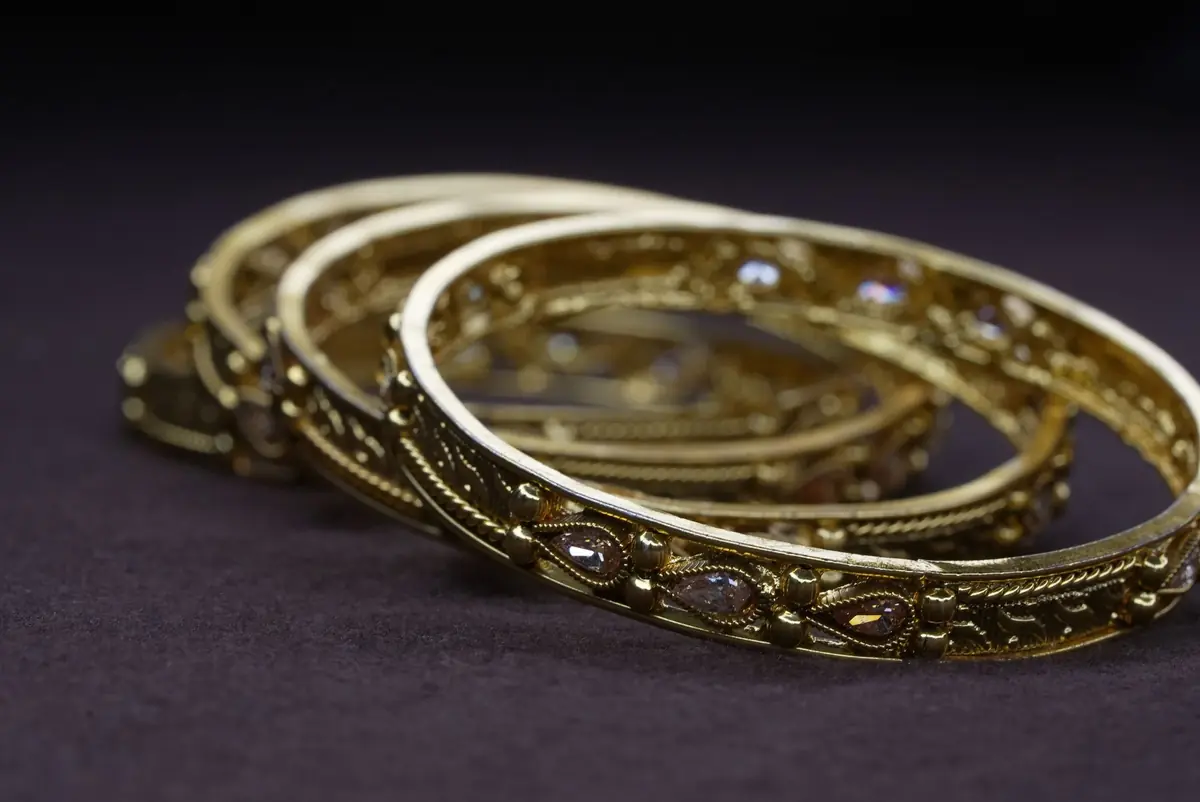
High karat jewelry from South Asia and the Middle East is beautiful and often heavily worked, and that is exactly what makes weighing it more involved than weighing a plain 14K chain. Several things can sit inside the gross weight that are not gold:
- Kundan and polki settings, where stones are set with gold foil over a lac or wax base. The lac inside can be a meaningful share of a heavy necklace’s weight.
- Meenakari enamel on the reverse of pendants and bangles.
- Pearls, beads and silk threads on traditional necklaces.
- Hollow bangles and beads that may be filled with wax or resin to resist denting.
- Glass, synthetic or natural stones, which are weighed out of the gold figure.
A buyer will either estimate these deductions or, for scrap, rely on the result after melting. Ask how the gold weight was arrived at. If you still have the original bill from the jeweler, bring it: Indian jewelers’ invoices often list gross weight, net gold weight and stone weight separately, which makes the conversation simple.
Also keep in mind that the price you paid for 22K jewelry in India or the Gulf usually included making charges and taxes on top of the gold value. Those are not recovered when the piece is sold as gold. The resale value starts from the net gold weight.
Solder and the KDM mark
Joints in any jewelry are made with solder, a slightly lower karat alloy that melts before the main metal. In 22K work, solder can pull the overall purity of a piece slightly below 91.7 percent. Older Indian pieces sometimes carry the letters KDM, which referred to cadmium based solder used to keep joints closer to 22K. Modern hallmarked 22K is tested as a whole, and a small solder allowance is normal at assay.
When 22K tests a little lower than marked
Older 22K pieces bought before hallmarking was routine sometimes test at 21K or slightly below once solder is taken into account. That is not unusual, and it is the reason a buyer tests rather than paying on the stamp. A piece marked 916 that tests at 20K or less is a different matter, and it is worth asking to see the reading.
Testing high karat gold
Testing 22K and 24K takes more care than testing 14K. Standard acid kits are built around common jewelry grades, and the stronger acids used at the top end need experience to read. A streak that resists 22K acid could be 22K, 23K or higher, and the buyer has to work up the scale.
That is where XRF analysis earns its place. It reads the alloy directly, showing for example 91.6 percent gold, 5.1 percent silver and 3.3 percent copper, which is a typical 22K yellow mix. Buyers of New York lists both acid testing and XRF analysis for high karat pieces, which gives a precise composition without damaging anything.
Very high purity also invites counterfeits. Tungsten has nearly the same density as gold, and gold plated tungsten bars and heavy plated chains do circulate. A careful buyer checks density or uses additional tests on anything that looks too good.
Wear, softness and dents do not change the value
The softness that makes 22K and 24K desirable to wear also makes them easy to dent, scratch and bend. Bangles go oval. Thin earrings fold. Chains stretch. None of that touches the value as gold: a dented 25 gram 22K bangle holds exactly as much gold as a perfect one, and a buyer pricing it as metal will pay the same. The site’s answer on broken gold applies here too: the payment is for the metal, not the condition. If a piece is worth more than melt because of its workmanship, as some antique and signed pieces are, damage can matter, but that is a different valuation.
Coins: 22K and 24K follow the same logic, with one twist
Bullion coins are struck to an exact gold content, which makes them easy to value. An American Gold Eagle is 22K and weighs about 33.9 grams so that it contains exactly one troy ounce of gold; the extra weight is the silver and copper alloy. A Canadian Gold Maple Leaf is .9999 fine and weighs one troy ounce. Both contain the same ounce of gold despite the karat difference, which is why they trade near each other. How those coins are priced, including premiums and condition, is covered in our post on the American Eagle and the Maple Leaf.
Is it ever worth converting 18K to 24K before selling?
Sellers sometimes ask whether they would get more by having lower karat jewelry refined into pure gold first. In almost every case, no. Refining costs money, takes time, and has minimums; the refiner keeps a share of the metal; and you would then sell a small pure bar at a bullion rate. The gold content stays the same. A buyer with direct access to refining has already priced that step into the offer.
What to bring, and how we price it
Bring the jewelry, coins or bars, any invoices that show net gold weight, and a valid government issued photo ID. At Buyers of New York each piece is tested with acid or XRF analysis and weighed on DCA certified scales in front of you, the karat and live spot price are shown, and the offer is calculated from them. There is no obligation to sell.
We are at 30 W. 47th Street, Suite 8006, New York, NY 10036, open Monday through Friday from 10am to 6pm, and walk-ins are welcome. For a large family set or an estate, call (212) 642-4345 so time can be set aside. Our gold buying page shows the current payout rates for each karat, and you can run your own estimate in the calculator on the same page before you visit.
More questions sellers ask
Is 22K gold real gold?
Yes. 22K gold is 91.7 percent pure gold, with silver and copper making up the rest for strength. It is the traditional standard for Indian and much Middle Eastern jewelry.
Why is 24K jewelry less common than 22K?
Pure gold is very soft and bends, dents and scratches easily. Most jewelry traditions add a little silver and copper to make pieces hold their shape and grip stones.
Are making charges from an Indian jeweler recovered when I sell?
No. Making charges and taxes paid at purchase are not part of the gold value. A resale offer starts from the net gold weight and purity.
Does 21K gold exist?
Yes. 21K, marked 875, is 87.5 percent gold and is common in jewelry from Egypt and the Gulf states. It is priced on its gold content like any other karat.