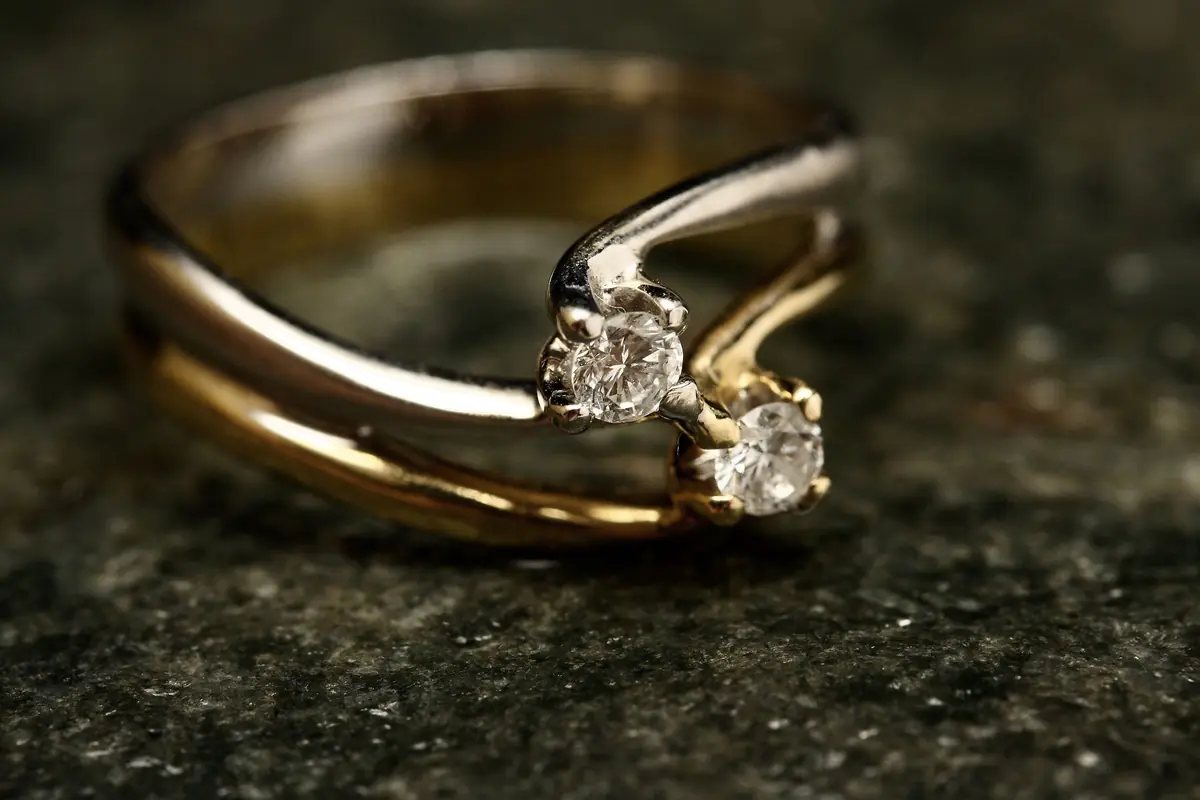
Most gold jewelry tells you its karat in a stamp no bigger than a grain of rice. Look inside the shank of a ring, on the tongue or the small tag beside the clasp of a chain or bracelet, on the post or the back of an earring, and on the bail of a pendant. The mark will read either as a karat number (10K, 14K, 18K, 22K, 24K) or as a three digit fineness number that says how many parts per thousand are pure gold (417, 585, 750, 916, 999). Both systems mean the same thing, and once you can read one you can read the other.
When there is no stamp, or the stamp is worn smooth, the karat has to be measured. A buyer does that with a touchstone and test acids, with an electronic tester, or with an X-ray fluorescence (XRF) analyzer that reads the alloy in seconds without marking the piece. Below is how to read the stamps you will find, why a stamp is a claim and not a guarantee, and what each test at the counter actually tells you.
Where the karat stamp hides on each type of jewelry
Stamps sit where they will not be seen while the piece is worn, so use good light and a 10x jeweler’s loupe or the zoom on a phone camera.
- Rings: inside the band, usually at the bottom of the shank opposite the stone. Resizing can cut straight through a stamp, so an older ring that has been sized more than once may have half a mark or none at all.
- Chains: on the flat tongue or the small oval tag next to the clasp, and sometimes on the clasp itself. A clasp stamp tells you about the clasp, not always about the chain, because replacement clasps are common.
- Bracelets and bangles: on the clasp box, the tongue, or the inside wall of a bangle.
- Earrings: on the post, the back of the earring face, or the butterfly back. Earring backs are often a different karat from the earring, or not gold at all.
- Pendants and charms: on the bail (the loop the chain runs through) or the reverse face.
- Watch cases: inside the caseback, often with a maker’s mark and sometimes a serial number.
Reading karat and fineness marks side by side
Karat is a measure out of 24. Pure gold is 24 karat, so 18 karat means 18 parts gold out of 24, which is 75 percent. The fineness system used across Europe and most of the world simply writes the same ratio out of 1,000. The table below covers the marks you are most likely to find on pieces bought in the United States, Europe, the Middle East and South Asia.
| Karat mark | Fineness mark | Gold content | Where you tend to see it |
|---|---|---|---|
| 8K | 333 | 33.3% | Older German and some Eastern European pieces |
| 9K or 9ct | 375 | 37.5% | British and Irish jewelry, some Australian pieces |
| 10K | 417 (sometimes 416) | 41.7% | American class rings, chains and mass market jewelry |
| 14K | 585 (sometimes 583) | 58.5% | The most common grade in American fine jewelry |
| 18K or 18ct | 750 | 75.0% | Italian, French and Swiss jewelry, luxury watch cases |
| 21K | 875 | 87.5% | Middle Eastern jewelry |
| 22K or 22ct | 916 or 917 | 91.7% | Indian and Middle Eastern jewelry, bullion coins such as the American Gold Eagle |
| 24K | 999 or 9999 | 99.9% or more | Bars, bullion coins, some Chinese and Southeast Asian jewelry |
Why 583 and 585 for the same grade? Fourteen divided by 24 is 0.5833, so some makers stamp 583. Others stamp 585, which gives a little margin over the true fraction. The same thing explains 916 and 917 for 22K. These small differences do not change what a buyer pays in any meaningful way; the test result does.
Marks that look like karat stamps but are not
Some marks look official and mean the piece is not solid gold at all. Learn these before you get your hopes up over a heavy looking chain:
- GP, GEP, HGE, HGP: gold plated, gold electroplate, heavy gold electroplate. A thin layer of gold over brass, copper or steel.
- GF, 1/20 12K GF, 1/20 14K GF: gold filled. A thicker gold layer bonded to a base metal core. Under the US Federal Trade Commission jewelry guides, the gold layer on a gold filled item must make up at least one twentieth of the item’s metal weight.
- RGP, 1/40 10K RGP: rolled gold plate. The same idea as gold filled with a thinner layer.
- Vermeil: gold plating over sterling silver. Often stamped 925 as well, which confuses people who read the 925 as a gold mark.
The full set of tests for telling plated from solid is covered in our post on gold plated, gold filled and solid gold, so here it is enough to say that a GF or GP mark next to a karat number is describing the thin outer layer, not the piece.
Foreign hallmarks and what they add
Jewelry made outside the United States often carries more than a fineness number, and those extra marks help with both karat and age.
- British pieces assayed by an official assay office carry a sponsor’s mark (the maker’s initials in a shield), a fineness mark such as 375 or 750, an assay office mark (a leopard’s head for London, an anchor for Birmingham, a rose for Sheffield, a castle for Edinburgh) and, on most pieces, a letter that dates the year of assay.
- Italian gold usually shows 750 next to a star inside a lozenge with a number and a two letter province code, for example AR for Arezzo or VI for Vicenza. That star mark identifies the registered maker.
- Indian jewelry made for the domestic market now carries a Bureau of Indian Standards hallmark: the BIS triangle logo, a purity grade such as 22K916 or 18K750, and a six character alphanumeric code called a HUID that has been required on newly hallmarked pieces since 2021. Older Indian pieces may carry the earlier four mark version, or only a 916 or 22K stamp from the jeweler.
A buyer who is used to these systems reads them quickly. Buyers of New York notes on its site that its team is familiar with older hallmarking systems, European karat stamps and the quality standards of different eras, which matters most with estate pieces.
A stamp is a claim, not a proof
Every working buyer has seen stamps that were wrong. Some are honest mistakes, but three situations come up again and again.
Underkarating. Some jewelry, particularly older pieces, tests below the stamped karat. A chain marked 14K may test at 13K. American law allows a small tolerance: under the National Gold and Silver Stamping Act, as reflected in the FTC guides, gold articles may test no more than 3 parts per thousand below the mark, or 7 parts per thousand when solder is included in the test. A piece that tests well below that is underkarated. Pieces stamped 14KP or with a P after the karat were sold as “plumb,” meaning full karat, as a marketing response to that problem.
Counterfeit marks. A 14K or 585 stamp costs nothing to strike onto brass. Fake stamped chains and rope bracelets are common, and many of them are heavily plated so they pass a quick look and even a careless scratch test.
Mixed parts. A real 14K chain can carry a base metal or gold filled replacement clasp. A real 18K ring can have a 14K head that holds the stone. A buyer tests the main body of the piece and the parts separately for exactly this reason.
So treat the stamp as a starting point. If it says 18K and the piece is heavy, you probably have 18K, but nobody pays on the stamp alone. Buyers of New York’s scrap gold page says every piece is tested, stamped or not.
How the karat gets measured when there is no stamp
An unstamped piece is not a lost cause. Plenty of handmade, antique and imported jewelry was never stamped at all, and resizing, polishing and wear remove marks over time. These are the methods a buyer uses, from the oldest to the newest.
Touchstone and acid
The buyer rubs the piece across a black stone so it leaves a thin streak of metal, then applies acids made up for specific karats. Nitric acid dissolves base metal and low karat streaks; a mix of nitric and hydrochloric acid (aqua regia, in testing strength) is used for high karats. If a 14K acid leaves the streak intact while a 18K acid dissolves it, the metal is somewhere from 14K up to just under 18K. The buyer narrows it from there.
Acid testing is cheap and reliable on solid metal. Its weakness is that it reads only the surface the buyer files into. A good buyer files a small notch in an inconspicuous spot first, so the streak comes from below any plating. Done properly that notch is tiny, but it is a mark, which is why buyers tend to file on a clasp tongue or under a shank rather than on a pendant face.
XRF analysis
An X-ray fluorescence analyzer fires X-rays at the piece and reads the energy that comes back, which identifies each element and its percentage: gold, silver, copper, zinc, nickel, palladium. The screen shows something like “Au 58.4%, Ag 7.2%, Cu 30.1%, Zn 4.3%,” which is a 14K yellow alloy. It is non destructive and takes seconds, which is why Buyers of New York lists XRF analysis alongside acid testing on its gold pages.
XRF has one limit worth knowing: it reads the outer layer of the metal, a few microns deep. Heavy plating over base metal can produce a reading that looks like solid gold. Experienced buyers know this and confirm a suspicious reading, often by filing a small spot or by checking density.
Density, the check nobody can fake easily
Gold is very dense, around 19.3 grams per cubic centimeter in pure form. Alloys get lighter as the karat drops: 18K yellow is roughly 15 to 16, 14K roughly 13 to 14.5, 10K roughly 11 to 12, depending on the exact alloy. Brass and copper sit near 8.5 to 9 and tungsten, the metal most often used to fake bars, sits at around 19.3, which is why bars get extra scrutiny. Weighing a piece in air and then suspended in water gives its specific gravity and catches most plated fakes. It is slower than XRF, so it is used when something does not add up.
Home checks that help, and the ones that mislead
You can learn a fair amount at the kitchen table before you take anything to a buyer, as long as you know what each check can and cannot prove.
| Check | What it can tell you | What it cannot tell you |
|---|---|---|
| Read the stamp with a loupe | The claimed karat, plating marks, maker’s marks | Whether the claim is true |
| Magnet | A strong pull usually means steel or iron underneath | No pull does not prove gold; brass, copper and many fakes are not magnetic either. Steel clasp springs pull on real gold chains. |
| Look for wear at edges | Plated pieces often show a different color metal at the high points and clasp | Solid low karat gold can also look pale at worn spots |
| Weight in hand | Real high karat gold feels heavy for its size | Hollow solid gold feels light; tungsten fakes feel heavy |
| Skin discoloration | Green or black marks suggest copper rich base metal under plating | Some low karat solid alloys also discolor skin |
Skip the old tricks. Biting a piece proves nothing and damages it. Rubbing it on unglazed ceramic leaves a streak that most people cannot read. Home acid kits work, but the acids are corrosive and hard to read without practice, and people regularly misjudge a 10K streak as fake or plated gold as solid. If you are curious, a stamp check and a magnet check are enough; leave the acid to someone who uses it every day.
Color is not a karat test
Sellers often guess karat from color: deep yellow must be high karat, pale must be low. Color depends on the alloy mix as much as the gold content. A 14K piece alloyed with more copper looks warm and rosy. A 14K piece alloyed with more silver looks greener and paler. White gold of any karat is usually plated with rhodium so it looks bright white, and that plating hides the yellowish tone of the alloy underneath. A deeply orange 22K bangle from India and a pale 18K Italian chain can sit next to each other and fool anyone guessing by eye. Only a test settles it.
Why the karat matters so much to the number you are offered
Karat is the purity term in the arithmetic that sets a gold offer: weight times purity times the gold price. A 10 gram piece at 18K holds 7.5 grams of pure gold; the same 10 grams at 14K holds about 5.85 grams; at 10K, about 4.17 grams. Mistaking 14K for 18K, in either direction, shifts the metal content by about a quarter. The full calculation, including pennyweights and troy ounces, is laid out in the arithmetic behind a gold offer.
This is also why a seller should always see the test result before the offer. At Buyers of New York, testing and weighing happen in front of the customer, and the site states that the spot price, karat and weight behind each offer are shown before anything is agreed. If a buyer will not tell you what karat they found, that is the moment to pick up your pieces.
Sorting your pieces before a visit
You do not have to sort anything; testing is the buyer’s job. But sorting gives you a clear picture of what you have and makes the visit faster.
- Lay everything out under a bright light and check each piece with a loupe.
- Make piles by stamp: 10K, 14K, 18K, 22K and higher, unstamped, and anything marked GF, GP, HGE, RGP or 925.
- Put any signed pieces (a maker’s name such as Cartier or Tiffany next to the karat mark) to one side. Those may be worth more than their metal and should not be valued as scrap.
- Keep broken pieces with their parts. A broken chain and its clasp belong in the same bag.
- Note anything with stones. Diamonds and gemstones are evaluated separately from the gold.
What to bring, and how the test is done at our counter
Bring the pieces, stamped and unstamped, and a valid government issued photo ID. If you are not sure what karat a piece is, Buyers of New York tests it at no charge and with no obligation to sell. Testing uses acid or XRF analysis, weighing uses DCA certified scales, and you watch every step. Most visits take 20 to 30 minutes.
We are at 30 W. 47th Street, Suite 8006, New York, NY 10036, open Monday through Friday from 10am to 6pm, and walk-ins are welcome. For a large or mixed lot, call (212) 642-4345 first so time can be set aside. You can read how scrap is weighed, tested and priced on our scrap gold page, and see the karat payout table and calculator on the same page before you come in.
More questions sellers ask
Is 585 gold the same as 14K?
Yes. 585 is the fineness mark for 14 karat gold and means 585 parts per thousand are pure gold. Some makers stamp 583 instead, which is 14 divided by 24 written out exactly. Both are treated as 14K and the test result decides the payout.
What does KP after the karat mean?
KP stands for karat plumb. It was used to signal that the piece meets its full stated karat, in response to underkarated jewelry. A 14KP piece is solid 14 karat gold.
Can a jeweler tell the karat without damaging my piece?
Yes. An XRF analyzer reads the alloy in seconds without touching the surface. Acid testing needs a small streak or a tiny filed notch, usually made in an inconspicuous spot such as a clasp tongue.
My ring was resized and the stamp is gone. Does that lower its value?
No. The stamp only identifies the metal. The ring is tested, and it is priced on the karat the test finds and its weight.
Is 9 karat gold real gold?
Yes. 9K, marked 375, is 37.5 percent gold and is common in British and Irish jewelry. It is real gold with a lower gold content than the 10K found in most American pieces, and it is priced on that content.