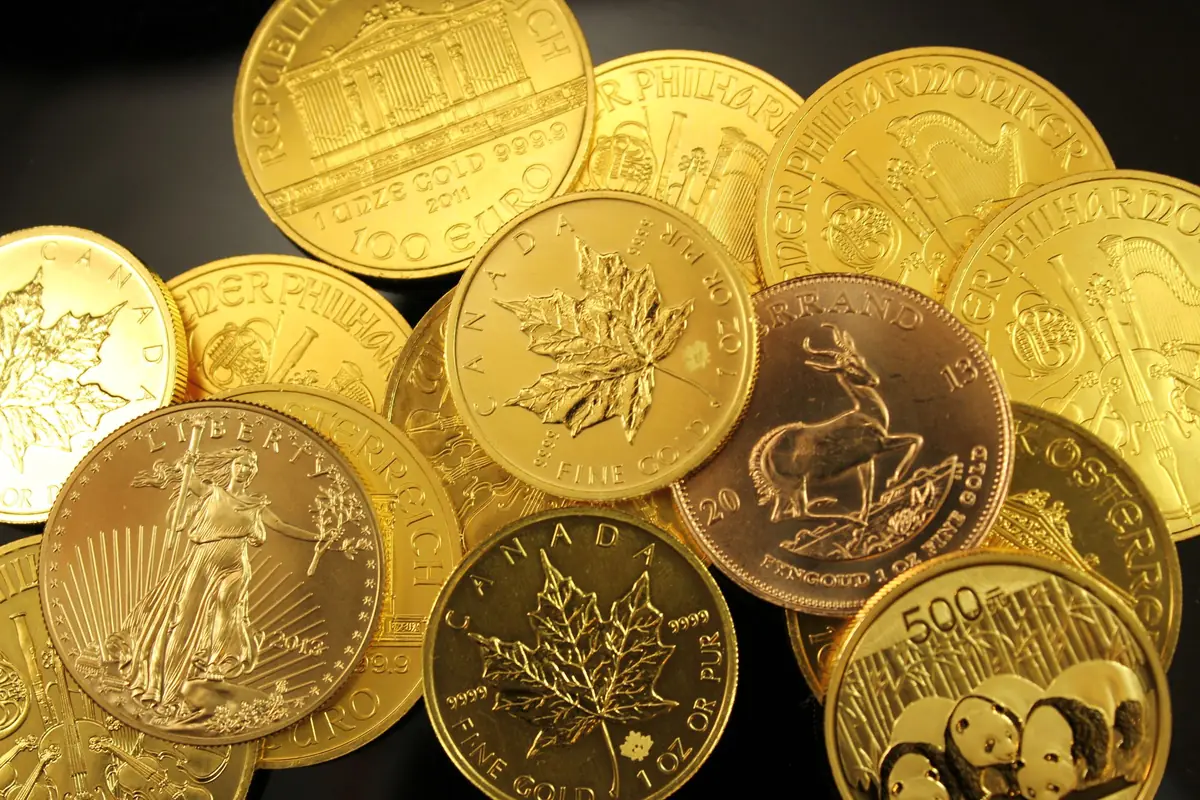
A 1 ounce American Gold Eagle and a 1 ounce Canadian Gold Maple Leaf contain exactly the same amount of gold: one troy ounce each. The Eagle is 22 karat (.9167 fine) and the Maple Leaf is 24 karat (.9999 fine), but the Eagle is made heavier to make up for its alloy, so the melt value of the two coins is identical at any spot price.
Where they differ is the premium over melt, the small amount above or below spot that dealers pay or charge. That premium depends on demand for each coin, where it is being sold, its condition and its size. For a seller, the difference between an Eagle and a Maple Leaf of the same weight is usually small compared with the daily movement of the gold price itself.
The two coins side by side
| Specification | American Gold Eagle (1 oz) | Canadian Gold Maple Leaf (1 oz) |
|---|---|---|
| Issuer | United States Mint | Royal Canadian Mint |
| First issued | 1986 | 1979 |
| Fineness | .9167 (22 karat) | .9999 (24 karat) |
| Total weight | 33.931 grams (1.0909 troy oz) | 31.11 grams (1.0000 troy oz) |
| Fine gold content | 1.0000 troy oz | 1.0000 troy oz |
| Diameter | 32.70 mm | 30.00 mm |
| Alloy | Gold with silver and copper | Essentially pure gold |
| Face value | $50 (US) | $50 (Canadian) |
| Fractional sizes | 1/2, 1/4, 1/10 oz | 1/2, 1/4, 1/10, 1/20 oz and others |
The Eagle’s color is a warmer, slightly deeper yellow because of the copper and silver in the alloy. The Maple Leaf is the bright, pale yellow of nearly pure gold. Side by side on a counter, the Eagle is visibly wider and thicker in the hand, and on a scale it is almost 3 grams heavier.
Why 22 karat still means a full ounce of gold
People often assume a 22 karat coin holds less gold than a 24 karat one. On jewelry that would be true for the same weight, but bullion coins are made to deliver a stated amount of fine gold, and the karat only tells you how much other metal was added.
The math is straightforward. A troy ounce is 31.1035 grams. The Eagle weighs 33.931 grams and is .9167 fine, so it holds 33.931 x 0.9167 = 31.104 grams of gold, which is one troy ounce. The Maple Leaf weighs 31.11 grams at .9999 fine, so it holds 31.107 grams of gold, also one troy ounce. The extra 2.8 grams in the Eagle is silver and copper, which add hardness, not value at gold prices.
The same principle applies to the fractional sizes. A 1/10 ounce Eagle contains one tenth of a troy ounce of gold, and so does a 1/10 ounce Maple Leaf, regardless of the different gross weights. Our piece on 18k, 22k and 24k gold value covers how karat math works on jewelry, where it does change value at a given weight.
How a buyer prices each coin
Bullion coin offers are built from three parts: the live spot price, the coin’s fine gold content and a premium or discount specific to that coin. Here is a worked example with round, hypothetical numbers.
Suppose gold spot were $2,500 an ounce. The melt value of a 1 oz Eagle and a 1 oz Maple Leaf is then $2,500 each. A dealer might quote a buy price for Eagles of spot plus a small amount, and for Maple Leafs of spot or spot plus a slightly smaller amount, because domestic demand for Eagles is stronger in the US. If those buy premiums were, say, $40 and $25, the difference between the two coins would be $15 per ounce, while a 1 percent move in the gold price that same afternoon would change the value of either coin by $25. That proportion is typical: the spot price matters far more than the brand of coin.
The direction and size of those premiums are not fixed. They depend on supply at wholesale, on how quickly each coin can be resold, and on where. In Canada and much of the world, Maple Leafs are the more familiar coin. In the US, Eagles are the most recognized gold coin, which is why they often carry a slightly higher premium both when bought and when sold. At Buyers of New York, gold coin offers are calculated from the live spot price and the coin’s fine gold content, and the spot figure and calculation are shown before you accept. You can see the coins and fineness figures we work from on our gold coin buying page.
Fractional coins and the premium per ounce
Fractional coins follow the same gold math but a different premium pattern. Making a 1/10 ounce coin costs the mint nearly as much labor as making a 1 ounce coin, so small coins are sold to the public at a noticeably higher premium per ounce of gold. When they are sold back, part of that premium is usually recovered, but not all of it, and the buy price per ounce on a 1/10 or 1/4 ounce coin is often a little different from the 1 ounce price.
A worked example with hypothetical numbers: ten 1/10 ounce Eagles contain exactly one troy ounce of gold, the same as one 1 ounce Eagle. If spot were $2,500, both lots melt at $2,500. The offer on the ten small coins can still differ by a modest amount from the offer on the single large coin, in either direction, depending on how much demand there is for fractionals at that moment. The difference between Eagle and Maple Leaf fractionals works the same way as for the 1 ounce coins: same gold, slightly different premiums.
For sellers holding a mix of sizes, the practical advice is to bring everything and let each size be priced on its own line, rather than assuming every coin is worth an equal share of spot.
Durability, scratches and condition
The alloy in a 22 karat coin is there for a reason. Pure gold is very soft, and .9999 coins pick up marks easily from handling, from sliding in a tube, or from being dropped on a hard counter. Maple Leafs that have been handled loose often show fine scratches and rim dings. Eagles resist this much better.
For ordinary bullion, light handling marks rarely change the price much, because the coin is valued on its gold content. Heavier damage is different. A bent coin, a coin with a hole or a solder mark from jewelry use, or a coin with heavy scratches can trade at a discount, since the next buyer can only treat it as scrap gold. Coins in original mint tubes, or in the Mint’s sealed packaging, are the easiest to resell and are best left that way.
Do not try to polish marks out. Even on bullion coins, cleaning leaves hairlines and makes a coin look worse, not better.
Security features on each coin
Both mints have added anti-counterfeiting features in recent years, and these are part of how a buyer checks a coin quickly.
- Maple Leaf. Since 2013 the Royal Canadian Mint has added a small laser micro-engraved maple leaf on the reverse, with the last two digits of the year inside it, visible under magnification. From 2015 the background of the coin carries fine radial lines that give a distinctive light pattern. The Mint also runs a registry system, called Bullion DNA, that records the micro-engraving of individual coins so dealers with the equipment can verify them.
- Eagle. The US Mint introduced a redesigned reverse in 2021, a close-up of an eagle’s head, replacing the family of eagles design used since 1986. The Mint described the new design as including anti-counterfeiting features. Collectors call the two versions Type 1 and Type 2.
One detail that confuses many owners: Gold Eagles dated from 1986 through 1991 show the year in Roman numerals, such as MCMLXXXVI for 1986. Those coins are genuine and are priced like any other bullion Eagle, unless they are proofs or graded.
Other bullion coins at the same two purities
The Eagle and the Maple Leaf are the best known examples of the two standard bullion purities. Most other government bullion coins follow one or the other.
| Coin | Issuer | Fineness | Fine gold (largest size) |
|---|---|---|---|
| American Gold Eagle | United States | .9167 | 1 oz |
| South African Krugerrand | South Africa | .9167 | 1 oz |
| British Sovereign | United Kingdom | .9167 | 0.2354 oz |
| Canadian Gold Maple Leaf | Canada | .9999 | 1 oz |
| American Gold Buffalo | United States | .9999 | 1 oz |
| Austrian Philharmonic | Austria | .9999 | 1 oz |
| Pre-1933 US $20 double eagle | United States | .900 | 0.9675 oz |
Pre-1933 US gold is the odd one out. It is 90 percent gold and was made as circulating money, not bullion, and most dates carry a collector premium over their gold content. Those coins should never be priced as plain melt.
Proofs, burnished coins and graded coins are different
Everything above applies to bullion strikes. Both mints also make proof coins, with mirror backgrounds and frosted designs, and the US Mint makes burnished uncirculated Eagles with a W mint mark from West Point. These were sold to collectors at higher prices, often in presentation boxes with certificates, and they can carry premiums over bullion coins, especially when the original box and certificate are kept together.
Coins graded by PCGS or NGC are priced by grade. A bullion Eagle or Maple Leaf graded MS-69 usually trades close to an ungraded coin, while MS-70 or PF-70 examples can carry a real premium that depends on the year. How grading changes value, and when it does not, is covered in PCGS and NGC grades explained.
How coins are checked at the counter
Because the specifications are published, checking a bullion coin is quick and precise. At Buyers of New York, coins are weighed on DCA-certified scales in front of you, and metal content can be confirmed with XRF analysis, which reads the composition of the surface without harming the coin. Diameter and thickness are compared with the published specification, and the design details and security features are checked under magnification.
A counterfeit Eagle made from a tungsten core plated with gold, or a gold-plated brass copy, fails at least one of those tests. An Eagle that weighs 31.1 grams instead of 33.9 is wrong, and so is a Maple Leaf that weighs 33.9. That simple fact catches more fakes than anything else, and it is why knowing the right weight for each coin matters.
What to bring and how to reach us
Bring the coins as they are, in their original tubes, capsules, mint boxes or assay packaging if you have them, along with any certificates for proof or burnished issues and any purchase invoices. Do not break open sealed mint packaging before coming in. Mixed lots of Eagles, Maple Leafs, Krugerrands and other bullion are fine, and each coin is priced on its own gold content. Larger lots can also be priced as gold bullion, together with bars.
Buyers of New York is at 30 W. 47th Street, Suite 8006, in the Diamond District, with an elevator to the 8th floor. Walk-ins are welcome Monday through Friday, 10am to 6pm, and payment is made the same day. For large lots, call ahead at (212) 642-4345. You can read more about how bullion and numismatic gold is evaluated on our gold coins page.
More questions sellers ask
Is a 24 karat Maple Leaf worth more than a 22 karat Eagle?
Not in gold content. Both 1 oz coins contain exactly one troy ounce of fine gold, because the Eagle is made heavier to make up for its alloy. Any price difference comes from the premium each coin carries, which depends on demand and where it is sold.
Why does my Gold Eagle weigh more than one ounce?
The 1 oz Eagle weighs 33.931 grams, about 1.0909 troy ounces, because it is .9167 gold alloyed with silver and copper. The fine gold inside is exactly one troy ounce. A 1 oz Eagle that weighs only about 31.1 grams is a warning sign.
Are Krugerrands priced like Eagles or like Maple Leafs?
The 1 oz Krugerrand is .9167 fine like the Eagle and also contains one troy ounce of fine gold, so its melt value is the same as both. Its premium is set by its own demand, which in the US is often a little lower than for Eagles.
Do scratches lower the value of a bullion coin?
Light handling marks rarely change the price much, because bullion is valued on gold content. Heavy damage, holes, solder from jewelry mounts or bending can lead to a discount, since the coin might only be resold as scrap gold.
Do I need the original tube or capsule to sell gold coins?
No. Loose coins are bought every day. Original tubes, capsules and mint packaging make coins easier to resell and are worth bringing if you have them, but coins are priced on their gold content and condition either way.