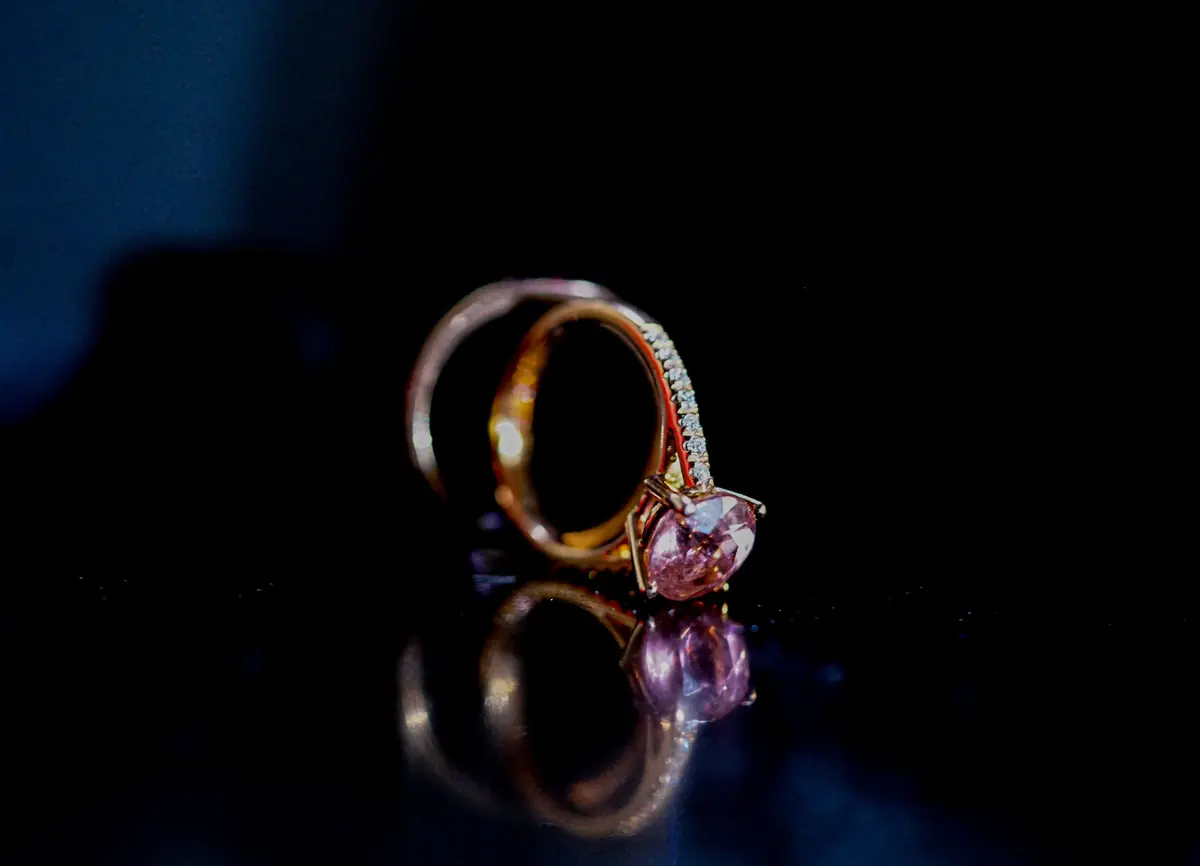
Fancy color diamond grades describe how strong and how dark a diamond’s color looks face up. On a GIA Colored Diamond Grading Report the scale runs, in order of increasing color, from Faint, Very Light and Light through Fancy Light and Fancy to Fancy Intense, Fancy Vivid, Fancy Dark and Fancy Deep. The grade sits next to a color description such as “Fancy Intense Purplish Pink”, and together those words set most of the value.
The grade is only half the story. Two diamonds can both be graded Fancy Intense and be worth wildly different amounts, because a Fancy Intense blue and a Fancy Intense yellow belong to different markets. Hue, the modifying colors, whether the color is natural, and how evenly it is spread through the stone all move the price. This article walks through each of those, with what a buyer actually checks at the counter.
How the GIA fancy color scale is built
White diamonds are graded on the D to Z scale, face down, by how little color they show. Colored diamonds are graded the opposite way: face up, by how much color they show and what kind. GIA describes the color of a fancy diamond in three dimensions:
- Hue: the basic color, such as pink, blue, yellow, green or orange, plus any modifier.
- Tone: how light or dark the color looks.
- Saturation: how strong or pure the color is.
The grade words are shorthand for regions of tone and saturation. Faint, Very Light and Light are used for colors other than yellow and brown at the low end of the range. For yellow and brown, those weakest grades overlap the normal D to Z scale, so a pale yellow stone is simply graded on D to Z, near the bottom of that scale, rather than given a fancy grade. A yellow diamond only becomes a fancy color once it shows more color than a Z.
What each fancy grade looks like
| Grade | What you see face up | Where it sits in value |
|---|---|---|
| Faint, Very Light, Light | A hint of color, often visible only beside a white stone | Modest premium over white, depends heavily on hue |
| Fancy Light | Color clearly visible but soft | The entry point to the fancy market |
| Fancy | Moderate, obvious color | A step up, often the most common commercial grade |
| Fancy Intense | Strong, saturated color at a medium tone | Much higher, widely sought by collectors |
| Fancy Vivid | The strongest saturation at a medium tone | Usually the top of the price range for a given hue |
| Fancy Deep | Strong saturation at a darker tone | Can rival Intense or Vivid in some hues, depends on how rich the color looks |
| Fancy Dark | Dark tone with weaker saturation, often brownish or grayish | Generally lower than Deep or Vivid of the same hue |
The ladder is not perfectly linear. A buyer reads the grade together with the hue: a Fancy Deep yellow with a warm orange cast can be more desirable than a pale Fancy yellow, while a Fancy Dark brown with a gray modifier sits near the bottom of the colored market.
Why hue matters more than the grade
Different colors come from different causes in the crystal, and that controls how rare each one is.
- Yellow comes from nitrogen. It is the most common fancy color, so even Fancy Vivid yellows trade at a fraction of comparable pinks or blues.
- Brown is common and is usually priced as a commercial stone, often marketed under trade names like champagne or cognac.
- Pink is linked to distortion of the crystal structure deep in the earth. The Argyle mine in Western Australia, which closed in late 2020, was reported to have supplied roughly 90 percent of the world’s pink diamonds, and its closure tightened supply.
- Blue comes from boron, in diamonds classed as Type IIb. Natural blues of strong color are among the most expensive gems in the world.
- Green is caused by natural radiation exposure. Many natural greens are colored only near the surface, which makes them hard to cut without losing color.
- Red is so rare that a stone described as pure red, without a modifier, appears on reports only occasionally and is graded simply as Fancy Red.
Modifiers: reading the full color description
A GIA color description can hold several words, and their order matters. The last word is the dominant hue. Words in front of it are modifiers. “Fancy Intense Purplish Pink” is mainly pink with a purple influence. “Fancy Brownish Pink” is pink with a brown influence. “Fancy Orangy Yellow” is yellow with orange.
Some modifiers add value and some take it away. Purplish tends to help a pink. Orangy can help a yellow. Brownish and grayish usually reduce the price, because they dull the color. A worked example with hypothetical numbers shows the effect: if a dealer were paying a certain amount per carat for a 0.50 carat Fancy Pink with no modifier, a Fancy Brownish Pink of the same size and grade could be offered at a clear discount, while a Fancy Purplish Pink might bring a premium. The grade word is the same in all three; the modifier changes the market.
Natural color, treated color and lab-grown stones
Colored diamonds can be treated to produce or strengthen color. The common methods are high pressure, high temperature (HPHT) processing, irradiation followed by heating, and surface coatings. Treated stones are legal to sell with disclosure, but they are priced as a different product, far below natural color. Lab-grown diamonds can also be produced in pink, blue and yellow.
A GIA colored diamond report states the origin of color: natural, treated, or undetermined. That line matters more than any grade on the report. A natural Fancy Pink and a treated Fancy Pink can look similar to the eye and still be priced worlds apart. A buyer at the counter checks for signs of treatment and lab growth, and for any significant stone without a report, recommends lab testing before a firm number. The Buyers of New York diamond pages say they assess natural versus treated color, intensity grade from Faint through Vivid, and secondary hues for colored diamonds.
Color distribution and cut
A colored diamond is graded face up as a whole, so the way color is spread through the stone matters. GIA reports note color distribution as even or uneven. Uneven color, such as a stone that looks pink in the center and nearly colorless at the edges, can still earn the same grade but is usually valued lower.
Cut works differently than with white diamonds. White stones are cut for brilliance. Fancy colored stones are usually cut to concentrate color, which is why radiants, cushions, ovals and pears are so common in the colored market. A rough piece of light pink may be cut as a radiant because the facet pattern makes the color look deeper face up, sometimes moving it up a grade. A buyer looks at how well the cut serves the color, not at how it scores on a white diamond chart.
Clarity, size and the rest of the report
Clarity matters less in colored diamonds than in white ones, because the color draws the eye. An SI1 Fancy Intense pink is still a very valuable stone. Large inclusions that are visible face up or that threaten durability still reduce value.
Size has a stronger effect. Fancy colored diamonds of strong color become scarce quickly as size goes up, and pinks and blues over a carat are uncommon. Many fancy colored stones are small, and a ring with a half carat natural pink center and white side stones is a far more typical piece than a multi-carat vivid.
Fluorescence is also listed. In some colored diamonds, notably certain yellows and pinks, strong fluorescence can make the stone look slightly hazy in daylight, which a buyer will check.
How colored diamonds are priced without a list
White diamonds have a weekly benchmark price list that dealers use as a starting point. Fancy colored diamonds do not have an equivalent public list for every grade. Prices are set by dealer trading, specialist colored diamond houses and public auction results for comparable stones, which is why two experienced buyers can quote different numbers on the same pink.
For that reason a GIA colored diamond report carries more weight here than almost anywhere else in jewelry. It fixes the grade, the hue description and, above all, the origin of color, so that a buyer can find good comparables. Without a report, a buyer must stay conservative until the color origin is confirmed. GIA also offers a lighter document, the Colored Diamond Identification and Origin Report, which confirms natural or treated color and gives a color description without the full grading.
The Buyers of New York diamond page adds that for significant colored diamonds the firm may ask for additional time to reach collector buyers. That is normal in this part of the market, where the right buyer for a particular pink or blue may not be the first one in line.
Common mix-ups sellers bring to the counter
- A “pink diamond” that is a pink sapphire. Pink sapphires and pink spinels are common in vintage rings. A refractometer and loupe settle it in minutes.
- A yellow stone graded on D to Z. A “canary” diamond in an old ring may be a Z or below, which is not a fancy color and is priced as a tinted white stone.
- Color reflected from the setting. A pale stone in a rose gold or yellow gold bezel can look pinker or warmer than it is. Fancy color is graded loose, and a buyer allows for the mounting.
- Old reports from other labs. Grades from different labs are not always interchangeable, and a stone graded Fancy Intense elsewhere may come back a grade lower at GIA.
For a broader look at whether a report is worth getting before a sale, see our article on whether you need a GIA certificate. If the stone turns out to be lab-grown, our post on lab-grown versus natural resale explains how that market differs.
What to bring for a colored diamond evaluation
Bring the stone or the ring, any lab report (GIA colored diamond reports carry the most weight), and the original receipt if you have it. A government photo ID is required to complete any sale. Do not soak or heat the stone, and do not have it recut or repolished before it is evaluated.
Buyers of New York is at 30 W. 47th Street, Suite 8006, open Monday to Friday from 10am to 6pm. For a significant pink, blue or other natural colored diamond, call (212) 642-4345 ahead so a senior gemologist is available. You can read more about how the firm handles pink and other fancy colored diamonds, including the mail-in option for sellers outside New York, or see the wider diamond buying process. The evaluation is free and there is no obligation to sell. If you are unsure whether your stone is a natural pink at all, the pink diamond page lists the grades the firm sees most, from Fancy Light Pink to Fancy Deep Pink.
More questions sellers ask
Is a Fancy Vivid always worth more than a Fancy Intense?
Within the same hue and size it usually is, but not always by a fixed amount. A Fancy Intense stone with an attractive modifier and even color can be worth more than a Fancy Vivid with an unattractive modifier or uneven color.
Do fancy colored diamonds have a Rapaport style price list?
Not in the way white diamonds do. Colored diamond prices come from dealer trading, specialist houses and auction comparables, which is why a lab report and a buyer with colored diamond experience matter so much.
Can a colored diamond be graded while set in a ring?
A buyer can give an opinion on a set stone, but labs grade colored diamonds loose because metal reflects color into the stone. For a significant stone, unmounting it for a report is common.
What does 'origin of color: treated' mean on a report?
It means the lab found that the color was produced or changed by a treatment such as HPHT processing, irradiation or a coating. Treated colored diamonds are priced far below natural ones of the same appearance.
Are champagne and cognac diamonds fancy colors?
They are brown diamonds described with trade names. GIA grades them as brown with the usual intensity terms, and they sit in the commercial part of the colored diamond market.