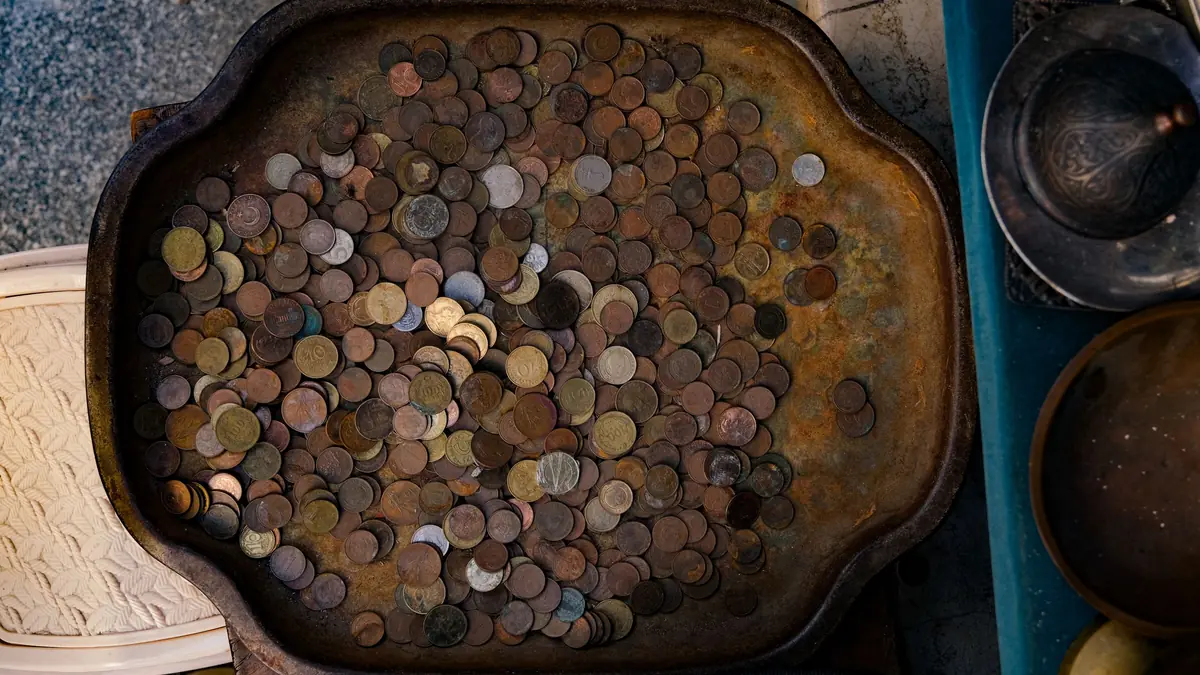
No, you should not clean coins before selling them, and you should not clean or polish antique jewelry either. Cleaning cannot add value to a coin, but it can take a large share of value away, sometimes most of it, because collectors and grading services pay for original surfaces. Old jewelry follows the same logic: its finish, patina and marks are part of what makes it collectible, and home cleaning or a polishing wheel removes them for good.
There is a narrow exception for ordinary modern gold jewelry that will be priced on metal weight. Wiping off dust does no harm there, but it also adds nothing, since the buyer tests and weighs the metal regardless. In every case, the safest and most profitable choice is to bring things exactly as they are.
What cleaning actually does to a coin’s surface
A freshly struck coin has a surface that cannot be recreated. When the dies strike the blank, metal flows outward in microscopic lines. Those flow lines scatter light and produce what collectors call cartwheel luster: the band of brightness that rotates around the coin as you tilt it under a lamp. Luster is one of the main things a grader scores, and it lives in the top few microns of metal.
Almost every household method of cleaning removes that layer or scratches it. Baking soda, toothpaste, metal polish, pencil erasers, jewelry cloths, wire brushes and even rubbing with a soft towel all act as abrasives at the scale that matters. The result is a pattern of fine parallel scratches called hairlines, visible as soon as a coin is turned under a single light source. Chemical dips are the other common route. An acid silver dip strips toning in seconds, but repeated or careless dipping eats into the luster and leaves a flat, washed-out look that experienced eyes spot from across a counter.
None of this can be reversed. Once the original surface is gone, the coin is permanently a cleaned coin.
How cleaning shows up on a grading label
The two major grading services, PCGS and NGC, do not assign a straight numeric grade to coins with significant surface problems. Instead they certify the coin as genuine and add a details description. PCGS labels describe the coin as Genuine with a reason such as cleaning, along with a details grade like XF Details. NGC uses a Details grade with a qualifier such as Improperly Cleaned. In practice, the market treats details coins as a separate, lower tier and prices them well below straight graded coins of the same date.
That gap is where cleaning does the most damage. A common date Morgan dollar that would have graded in the mid MS-60s can lose most of its collector premium and sell close to its silver value once it is cleaned. A key date suffers even more, because the premium was the whole value to begin with. Put round, purely hypothetical numbers on it: if an original coin would sell for $400 as a straight graded MS-64 and the silver inside is worth $25, a cleaned example of the same coin might land somewhere between the two, often much closer to the bottom. The $375 gap is what a few minutes with a cloth puts at risk. How certification works, and when it is worth paying for, is covered in our article on PCGS and NGC coin grades.
Toning is not dirt
Silver reacts slowly with sulfur in the air and in old paper and cardboard, and over decades that produces toning: anything from a light golden haze to deep blues, magentas and greens. Owners often see a dark coin and assume it needs cleaning. Collectors see it differently. Even, natural toning is accepted as original, and attractive rainbow toning on Morgan dollars and some commemoratives can bring a premium over a brilliant coin of the same grade.
Dark, uneven or spotty toning is less desirable, but it is still better than a stripped surface. The decision about whether any surface treatment is worth trying on a valuable coin belongs to a professional conservator, not to a kitchen sink. Both major grading services operate or are affiliated with conservation services that remove harmful residues such as PVC film without abrading the coin, and that work only makes sense for coins valuable enough to justify the fee.
Artificial toning is the reverse problem. Coins that were heated or chemically treated to look old or colorful are flagged by graders and usually refused a numeric grade, so a coin that looks too vivid gets a careful look at the counter.
The green film and other things that are really damage
Some surface problems are worth knowing about, even though the answer is still not to treat them at home:
- PVC residue. Older soft plastic flips contain PVC, which breaks down and leaves a green, sticky film. It keeps eating at the coin, so it is worth moving the coins into paper envelopes or inert holders, but leave the residue for a professional to assess.
- Verdigris on copper. Green corrosion spots on cents. Scrubbing it off leaves pitting and bright metal around it.
- Fingerprints. Skin oils etch into fresh surfaces over time. Handle coins by the edges only.
- Bag marks and rim nicks. Contact marks from storage and handling. These are part of the grade, and no cleaning removes them.
When old coins arrive in a sock, a coffee can or a cigar box, the right move is to stop the damage and stop there: separate them, put them in envelopes, and bring them in.
Why it does not pay even on bulk silver
A common argument is that junk silver is priced on weight anyway, so cleaning cannot hurt. It is true that a cleaned common date Washington quarter still holds 0.1808 ounces of silver and will be priced the same as a dirty one. But that also means the cleaning earned nothing. The real risk is the coin nobody identified. A cleaned 1916-D dime or 1932-D quarter is still worth something, but far less than it would have been, and owners usually clean an entire jar before anyone has checked which coins in it are key dates. Our guide to silver coin key dates lists the coins to set aside before anything else happens to a lot.
Gold coins are no different. Gold is soft, and pre-1933 US gold such as Saint-Gaudens and Liberty double eagles shows hairlines from a cloth just as quickly as silver does. Those coins usually carry a collector premium over their gold content even in common dates, and cleaning is one of the fastest ways to lose it.
The time is better spent sorting. Separating coins by series and date, and pulling the possible key dates, helps the evaluation far more than polishing ever could.
Antique jewelry: original finish is part of the value
With antique and period jewelry, value comes from four things together: metal, stones, period and craftsmanship, and maker. Cleaning and polishing threaten the last three. Several finishes in older jewelry are easy to destroy and impossible to restore cheaply:
- Bloomed gold. A matte, textured surface produced in the Victorian era by treating gold alloy so the surface becomes richer in gold. A polishing wheel or abrasive cloth replaces it with a modern shine.
- Patina on engraved and chased work. Darkening in the recesses gives engraved patterns their contrast. A silver dip or polish leaves the design flat and harder to read.
- Enamel and niello. Vitreous enamel can craze and chip, and harsh cleaners attack both enamel and niello inlay.
- Foil-backed stones in closed-back settings. Georgian jewelry often has foil behind the stones to brighten them. Water that gets into a closed setting can tarnish the foil and darken the stone permanently.
- Hallmarks and signatures. Maker’s marks, assay marks and signatures are shallow stamps. Every polishing session softens them, and a signature that can no longer be read can cost more than anything else on this list, since signed pieces from major houses sell for a multiple of unsigned ones.
Restoration carries similar risks. Re-plating antique white gold or platinum with rhodium, re-tipping prongs with modern solder, or replacing old-cut stones with modern ones all remove evidence of period manufacture. If a piece needs repair, it is worth having it assessed first. The antique jewelry page covers how periods, makers and materials are evaluated.
Stones and materials that home cleaning can ruin
Even modern jewelry has materials that do not survive common cleaning methods. Ultrasonic cleaners and steamers, which are fine for a solid diamond ring in good condition, can do real harm to others:
| Material | Risky cleaning method | What can happen |
|---|---|---|
| Emerald | Ultrasonic, steam, solvents | Oil or resin in fractures is pushed out, so fractures become visible and the stone looks worse |
| Opal | Ultrasonic, heat, chemicals | Cracking or crazing; doublets and triplets can separate |
| Pearls, coral, amber | Ultrasonic, jewelry dip, alcohol, vinegar | Nacre and organic surfaces dull, etch or dissolve |
| Turquoise, lapis, malachite | Soaking, chemicals | Porous stones absorb liquid and stain or lose color |
| Fracture-filled diamond | Ultrasonic, steam, heat | Filler can cloud or be damaged, making fractures visible |
| Glued stones, marcasite | Soaking, ultrasonic | Adhesive loosens and stones drop out |
Even for a diamond in a solid setting, an ultrasonic cleaner can shake loose a stone held by worn prongs. Buyers inspect and clean stones themselves under controlled conditions before grading them, so the owner gains nothing by doing it first.
What a buyer sees when something was cleaned
Cleaning is rarely invisible. On coins, an evaluator tilts the coin under one light and looks for hairlines running in the same direction, for unnatural brightness on an old coin, for luster that does not cartwheel, and for residue or polish trapped around the letters and date. A coin with dark recesses and bright fields often tells the story of a cloth or eraser. On jewelry, the signs are rounded edges on engraving, softened hallmarks, fresh shine in places where wear would normally darken, and white residue from polishing compound around settings.
A cleaned item is still bought; it simply gets priced as what it now is. That is why the honest advice from almost any reputable buyer is the same: do not do it.
What is fine to do before a visit
A few steps help without risk:
- Handle coins by the edges, over a soft surface.
- Move coins out of crumbling PVC flips, rubber bands and loose sacks into paper envelopes or inert holders, without wiping them.
- Keep sets, proof coins and Mint packaging intact.
- For jewelry, a dry, soft cloth can remove loose dust. Skip dips, pastes, polishing cloths and ultrasonic machines.
- Keep paperwork, old receipts, appraisals and boxes together with the pieces they belong to.
- Sort coins by type and date if you like, and set aside anything that looks old, unusual or unworn.
What to bring and how to reach us
Bring coins and jewelry exactly as they are, dirty, toned or tarnished. At Buyers of New York, coins are sorted and identified in front of you, with key dates and certified coins priced separately from silver content, and antique pieces are assessed on period, maker and materials as well as metal. You can read more about how coins are sorted and priced on our silver coins page.
We are at 30 W. 47th Street, Suite 8006, in the Diamond District, with an elevator to the 8th floor. Walk-ins are welcome Monday through Friday, 10am to 6pm. For large collections or estate lots, call (212) 642-4345 first so we can set aside time, or see our guide to how silver coin collections are evaluated before you come.
More questions sellers ask
Can a cleaned coin be restored to its original look?
No. Cleaning removes or scratches the thin surface layer that produces luster, and that metal cannot be put back. Professional conservation can remove harmful residues such as PVC film, but it cannot undo abrasion or the effects of a harsh dip.
Will a buyer still buy coins that have been cleaned?
Yes. Cleaned coins are bought every day; they are simply priced as cleaned coins. For common dates that usually means silver or gold value, and for key dates it means a collector price well below what an original example brings.
Is it safe to use a silver polishing cloth on old coins?
No. Polishing cloths contain a mild abrasive and chemicals designed to remove tarnish from flatware, and on a coin they leave hairlines and strip toning. Keep them away from coins and from antique silver jewelry with engraved detail.
Should I remove coins from old plastic flips before selling?
If the flips are soft, greasy or leaving a green film, moving the coins into paper envelopes or inert holders stops further damage. Do not wipe the coins while doing it. Leave any residue for a professional to assess.
Does dirty gold jewelry get a lower price?
Not in any meaningful way for ordinary gold priced on metal weight. The buyer tests the karat and weighs the piece, and surface dirt has almost no effect on that. Antique or signed pieces are different, because cleaning and polishing can damage finish and marks that carry value.