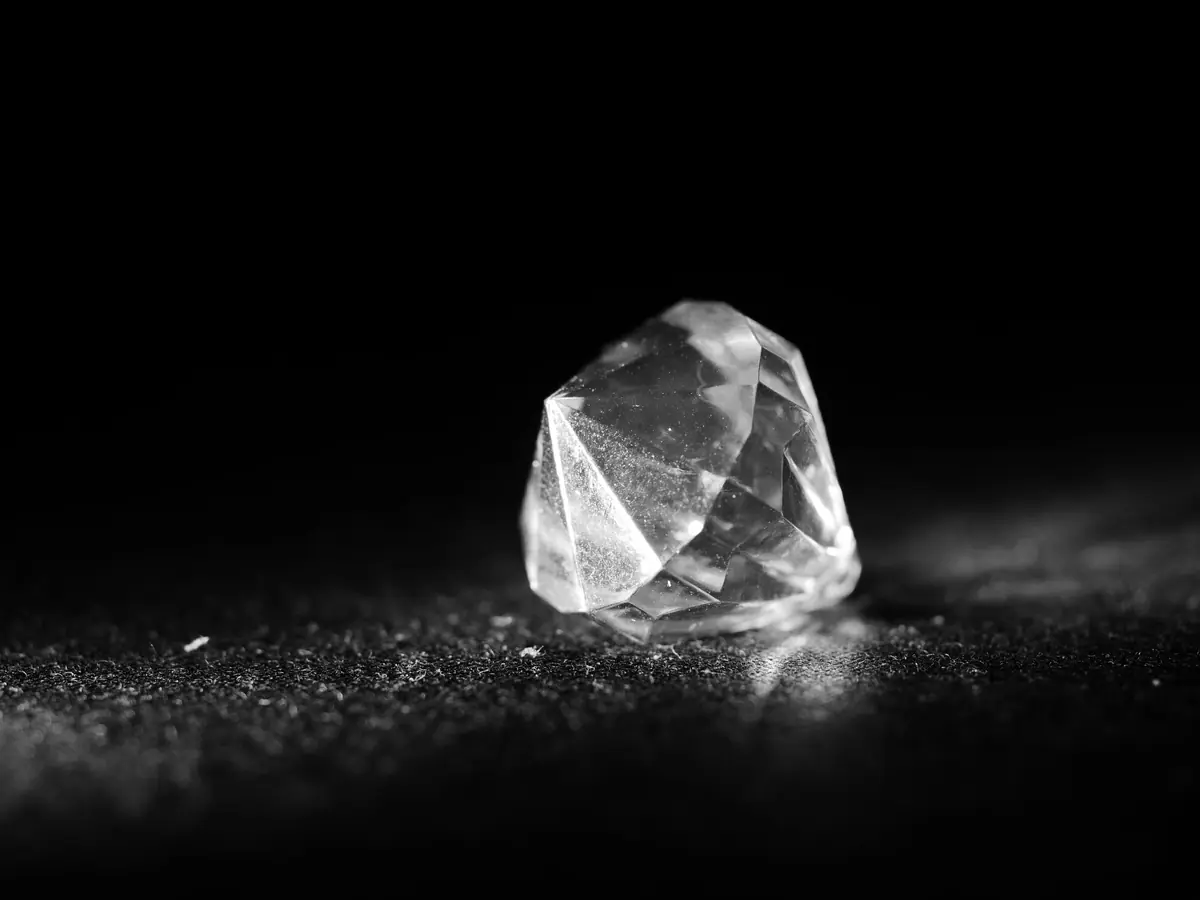
Lab-grown diamonds have a low resale value, usually a small fraction of what they cost new, and far below a natural diamond of the same size and grade. The reason is not that they are fake: a laboratory-grown diamond is real diamond, with the same crystal structure and hardness as a mined one. The reason is that the cost of producing them has dropped steeply and keeps dropping, so new stones keep getting cheaper, and a used stone can only be worth less than a new one.
Natural diamonds resell below retail too, but they resell against an established wholesale market with published benchmarks and steady trade demand. This article explains how the two are made, how buyers tell them apart at the counter, what each is worth secondhand, and what to bring if you have a stone and are not sure which kind it is.
What a lab-grown diamond is
A laboratory-grown diamond is carbon crystallized into diamond in a factory instead of deep in the earth. Two methods dominate:
- HPHT (high pressure, high temperature), which recreates the crushing pressure and heat under which natural diamonds form, using a press and a metal solvent.
- CVD (chemical vapor deposition), which builds diamond layer by layer from a carbon-rich gas onto a seed plate in a vacuum chamber.
Many CVD stones are treated after growth to improve their color. GIA has reported that roughly 80 percent of the CVD-grown diamonds submitted to it had been given a post-growth HPHT treatment. Once cut and polished, both kinds look like natural diamonds to the eye and under a jeweler’s loupe.
What sellers must be told, and what the words mean
Under the Federal Trade Commission’s Jewelry Guides, revised in 2018, a lab-grown stone can be called a diamond, but its laboratory origin must be disclosed clearly and conspicuously. The FTC lists “laboratory-grown,” “laboratory-created” and “[manufacturer name]-created” as appropriate terms, and cautions against using words such as “real,” “genuine,” “natural” or “synthetic” in a way that implies a lab-grown diamond is not actually a diamond.
For sellers, the practical point is that a stone sold to you as lab-grown should be described that way on your receipt, your grading report or both. If you bought a diamond in the last several years and do not know which kind it is, check the paperwork first.
How buyers tell them apart
Lab-grown and natural diamonds cannot be told apart by eye, by a loupe or by a standard handheld diamond tester. Thermal and electrical testers confirm diamond versus simulants such as cubic zirconia or moissanite, but read lab-grown diamond as diamond, because it is. Separating the two takes other tools. (Telling diamonds from simulants and synthetic colored stones is a wider subject, covered in our article on real gemstones, synthetics and glass.)
The usual sequence at a well-equipped counter or laboratory:
- Paperwork and inscriptions. GIA laser inscribes laboratory-grown diamonds it grades with the words “Laboratory-Grown” and the report number on the girdle. Other laboratories inscribe lab-grown stones too. A buyer reads the girdle under magnification.
- Screening devices. These check properties that differ statistically between natural and grown diamonds, such as how the stone transmits short-wave ultraviolet light and whether certain nitrogen-related features are present. Most natural diamonds pass straight through as natural; anything else is referred for further testing.
- Fluorescence imaging. Instruments that excite the stone with deep ultraviolet light reveal its growth pattern. GIA describes HPHT-grown stones as often showing a cross-shaped pattern, and CVD-grown stones as showing striations seen through the pavilion facets. Natural diamonds grow in a different way and show different patterns.
- Spectroscopy. Photoluminescence and infrared spectroscopy, used in gemological laboratories, identify growth method and post-growth treatment.
No single quick test is perfect. GIA has stated that there is no cost-effective or rapid screening tool that can definitively identify all laboratory-grown diamonds, which is why a stone that fails a screening test is sent for laboratory analysis rather than judged on the spot. GIA has also documented lab-grown diamonds carrying counterfeit GIA inscriptions, so buyers test the stone as well as reading the girdle.
Why lab-grown resale value is so low
Several forces push in the same direction:
- Cheaper production. As growers have improved their equipment and scaled up, the cost of producing a stone has dropped, and retail prices have followed. Buyers of New York’s own diamond page attributes the low resale value of lab-grown stones to rapidly declining production costs.
- Supply that can grow to meet demand. A factory can make more stones. That removes the scarcity that supports natural diamond prices.
- No wholesale benchmark. The Rapaport price list, the main wholesale reference for natural diamonds, does not cover lab-grown stones. Rapaport’s members voted in 2019 against it publishing a lab-grown list, and the group has since reaffirmed a natural-only policy.
- New is always available. A dealer who can buy a new lab-grown stone, freshly graded, at a low and declining price has little reason to pay much for a used one.
The result is that a lab-grown stone’s resale value is often a small share of what it cost, and the setting’s gold or platinum can be a large part of what a lab-grown ring is worth secondhand.
What a natural diamond is worth secondhand
A natural white diamond is priced against the wholesale market for its weight, color, clarity and cut. Many buyers benchmark against the Rapaport list and recent dealer trades, offering a percentage of the list figure that reflects the stone’s quality and how easily it will resell. How that works, and why it sits below retail, is explained in the Rapaport price list explained.
Natural diamonds also lose the retail markup when resold, but the floor under them is far firmer, because there is a large global trade that buys and sells natural stones every day at known reference prices.
The two side by side
| Factor | Natural diamond | Lab-grown diamond |
|---|---|---|
| Material | Diamond | Diamond |
| Detectable by eye or loupe | No difference visible | No difference visible |
| Standard handheld diamond tester | Reads diamond | Reads diamond |
| Wholesale benchmark | Rapaport list and dealer trades | No Rapaport list; separate market |
| Price direction of new stones | Moves with market demand | Has dropped as production costs dropped |
| Typical resale relative to purchase | Below retail, against a firm wholesale market | A small fraction of purchase price |
| Value of a laboratory report | Often raises and firms up the offer | Mainly confirms identity; fee can exceed the gain |
| Typical report girdle inscription | Report number, if inscribed | “Laboratory-Grown” plus report number on GIA stones |
Reading a lab-grown grading report
Lab-grown stones are commonly sold with reports from IGI and other laboratories, and GIA also grades them. GIA changed its approach in 2025: instead of the D-to-Z color and Flawless-to-Included clarity grades it uses for natural diamonds, it now describes lab-grown diamonds as “Premium” or “Standard” based on an overall assessment of color, clarity and cut, with stones below the Standard threshold not given an assessment. GIA said most lab-grown diamonds sit within a very narrow range of color and clarity, and that existing GIA lab-grown reports remain valid.
For a seller, the useful part of any lab-grown report is the identification: it states clearly that the stone was grown in a laboratory, which settles what it is. The grades on a lab-grown report have far less effect on resale price than grades on a natural diamond report.
A worked example with round numbers
Take two hypothetical engagement rings that look the same across a table. Each has a two-carat round center stone in a 14K white gold setting weighing 3.5 grams. One center is natural; the other is lab-grown.
The settings are worth the same. At a hypothetical spot gold price of $2,000 per troy ounce, 3.5 grams of 14K holds about 2.05 grams of pure gold, worth about $132. That part of each offer is pure arithmetic.
The center stones are where the two rings part ways. The natural stone is graded and priced against the wholesale market for a two-carat diamond of its color, clarity and cut, a market where per-carat prices climb steeply with size. The lab-grown stone is priced against the current market for new lab-grown stones of that size, which is far lower and has been moving down. It is entirely possible for the lab-grown ring’s offer to be dominated by the gold in its setting, while the natural ring’s offer is dominated by its center stone.
Nobody at the counter is penalizing the lab-grown ring. It is being priced against what an identical new stone costs today.
Keep, reset or sell
Because resale is low, many owners of lab-grown jewelry decide it is worth more to them worn than sold. Others reset the stone into a new design and sell only the old setting for its metal. If you do sell, get the setting’s metal value spelled out separately, so you can see what share of the offer comes from the gold or platinum and what share from the stone.
If you are not sure which you have
Many people find out at the counter. A ring bought a few years ago at an attractive price, a pair of large studs received as a gift, or a stone reset into a new setting can all turn out to be either kind. Signs that a stone might be lab-grown, none of them conclusive:
- A receipt or report with the words laboratory-grown, lab-created, man-made or similar.
- A girdle inscription including “LG,” “Lab Grown” or “Laboratory-Grown.”
- A large, very white, very clean stone bought for a price that seemed low for a natural diamond of that size.
Do not try to test it yourself with a home tester; it will say diamond either way. Bring it to a buyer with screening equipment, and ask them to show you the result.
What Buyers of New York says about lab-grown stones
Buyers of New York’s pages say it does buy lab-grown diamonds, but that their resale value is significantly lower than natural diamonds of comparable grade, and that it prices them at current market rates for lab-grown stones. Natural diamonds are graded by its gemologists in front of the seller and priced against Rapaport and recent comparable sales, with laboratory reports checked where available. In either case, the setting’s metal is valued separately, which for a lab-grown ring is often a significant share of the total.
What to bring
Bring the stone or the jewelry, any grading report, the original receipt, and a government photo ID to 30 W. 47th Street, Suite 8006. Walk-ins are welcome Monday through Friday from 10am to 6pm; for a large stone, call (212) 642-4345 first. You will learn which kind of diamond you have, how it grades and what the setting is worth before anything is decided. Read more about how stones are graded on the business’s diamond evaluation page, and when you are ready, bring the diamond in to be identified and graded.
More questions sellers ask
Can a jeweler tell if a diamond is lab-grown by looking at it?
Not by eye or with a loupe. Separating lab-grown from natural takes screening devices, fluorescence imaging or laboratory spectroscopy, or a report and girdle inscription that identify it.
Will a home diamond tester detect a lab-grown diamond?
No. Standard thermal and electrical testers identify diamond versus simulants, and a lab-grown diamond is diamond, so it reads as diamond.
Is it worth getting a lab-grown diamond graded before selling?
Usually not for resale purposes. The fee can take a large share of the stone resale value, and the main thing a buyer needs to know is that it is lab-grown.
Do lab-grown diamonds count as real diamonds?
Yes. The FTC Jewelry Guides allow them to be called diamonds as long as their laboratory origin is clearly disclosed, using terms such as laboratory-grown or laboratory-created.
Is the gold in a lab-grown ring worth the same as in any other ring?
Yes. The setting is tested and weighed like any gold or platinum, and for a lab-grown ring it can be a large part of the total offer.