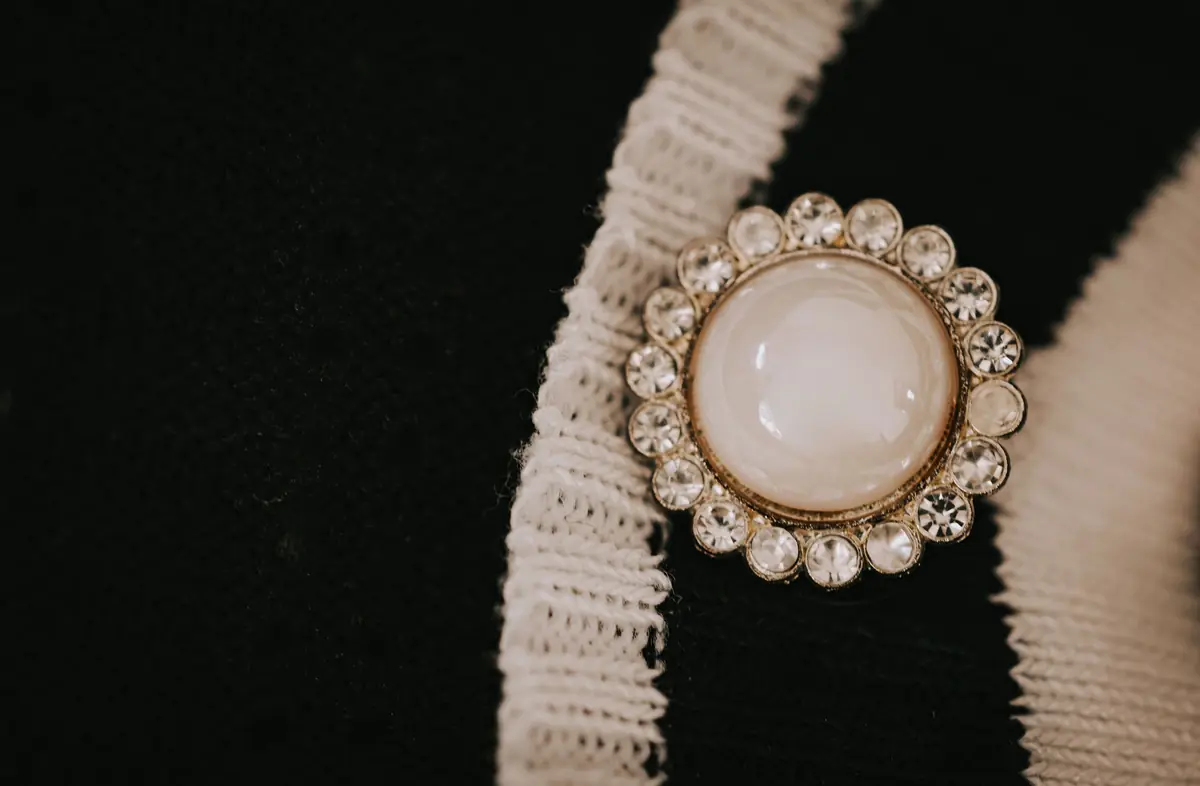
Most costume jewelry is worth little on resale. Plated base metal, glass and plastic have almost no material value, and mass produced fashion pieces have no collector following. But “most” leaves a lot of room. Signed pieces from collected makers such as Miriam Haskell, Trifari, Coro, Eisenberg, Schiaparelli and Hattie Carnegie have an active collector market, some materials like Bakelite and wartime sterling are sought in their own right, and a surprising number of pieces in a “costume” drawer turn out to be gold, silver or real pearls once someone tests them.
The useful question is not whether costume jewelry is worth anything, but which of your pieces are. This guide shows how to sort a box of costume jewelry the way a buyer would: first find anything that is not costume at all, then look for signatures, materials and quality that collectors pay for.
Step one: make sure it really is costume jewelry
Family jewelry boxes mix everything together, and fine pieces end up in the costume pile all the time. Before anything else, check every piece for marks with a magnifier, looking on clasps, inside rings, on the back of pendants and on the tags near necklace clasps.
| Mark | What it means | Value implication |
|---|---|---|
| 10K, 14K, 18K, 417, 585, 750 | Solid karat gold | Worth at least its gold content. Not costume. |
| STERLING, 925, .925 | Sterling silver | Has silver value, and signed sterling pieces can be collectible too. |
| PLAT, PT950, PT900 | Platinum | Valuable metal. Not costume. |
| GF, 1/20 12K GF, RGP | Gold filled or rolled gold plate: a layer of gold bonded over base metal | Small gold content; generally valued as a finished piece rather than as gold. |
| GP, HGE, GE, EP | Gold plated or electroplated | Negligible metal value. |
| Vermeil | Gold plating over sterling silver | Valued mainly for the silver. |
No mark does not mean no gold. Older gold pieces and many pieces made abroad were never stamped, which is why a professional tests the metal instead of relying on marks. Our post on telling plated from solid gold walks through those tests.
Pearls and stones
The same goes for what is set in the metal. Rub a pearl gently along the edge of your front teeth: natural and cultured pearls usually feel slightly gritty, while glass and plastic imitations feel smooth. It is a rough screen, not a test, so let a gemologist confirm. Clear stones can be glass, cubic zirconia, white sapphire or diamond; a jeweler’s tester and a loupe settle it in seconds. Antique “paste” set in silver or gold is its own category: Georgian paste jewelry is collected as antique jewelry, not as costume.
Step two: look for a signature
After the metal check, the signature is the single biggest factor. Collected costume makers usually stamped their name on the back of a brooch, on a clasp, or on a small oval plate attached to a chain. Buyers of New York’s antique and estate jewelry page names the makers it buys: Miriam Haskell, Schiaparelli, Coro Duette, Eisenberg, Trifari and Hattie Carnegie, among others.
| Maker | What to look for |
|---|---|
| Miriam Haskell | Hand wired seed pearls, glass beads and rhinestones on filigree backings, often with the name on an oval plate or on the hook. Early Haskell pieces are often unsigned, which makes them harder to attribute. |
| Trifari | The Trifari name, often with a small crown above the T. Known for high quality rhinestone work and “jelly belly” figural pins with a clear Lucite center. |
| Coro and Corocraft | Coro made huge quantities, so most Coro is modestly priced. The exception is the Coro Duette, a brooch that separates into two dress clips on a patented frame. |
| Eisenberg | Large, brilliant rhinestone pieces; early work marked Eisenberg Original, later work Eisenberg Ice. |
| Schiaparelli | Script signature; bold colored glass stones, often with an iridescent finish. |
| Hattie Carnegie | Signed pieces with strong, theatrical designs and figural animals. |
| Marcel Boucher | Finely made pins, early pieces marked MB with a small cap. |
Other names collectors look for include Hobé, Weiss, Kenneth Jay Lane and couture houses that issued costume lines. Within a signed maker’s output, value still varies a great deal: a rare figural pin in perfect condition can be worth many times a common signed pair of earrings.
Signed costume is not the same as signed fine jewelry
A famous fashion name on a costume piece is a different market from a signed piece by a fine jewelry house. Our post on signed designer jewelry covers the fine jewelry side, where gold, platinum and important stones are part of the value.
Materials that collectors pay for
- Bakelite. An early plastic made from phenol formaldehyde resin, popular for bangles, pins and buttons in the 1930s and 1940s. Carved bangles and figural pins are the most sought after. Two common home screens: run the piece under hot tap water and sniff for a sharp chemical smell, or rub it with a metal polish called Simichrome and see if the cloth turns yellow. Neither is foolproof, and modern resin copies, sometimes called “fakelite”, are made to fool both.
- Wartime sterling. During the Second World War, restrictions on base metals led several American costume makers to use sterling silver instead, so pieces from those years are often marked Sterling alongside the maker’s name. They carry both silver value and collector interest.
- Celluloid and Lucite. Collected in some forms, such as the clear Lucite bellies of Trifari figurals, but generally less valuable than Bakelite.
- Good quality rhinestones. Well cut, foil backed glass stones from top makers sparkle in a way cheap molded stones do not, and collectors notice.
Clues that help date a costume piece
Age alone does not create value, but it helps identify what you have.
- The copyright symbol. A mid 1950s court ruling confirmed that jewelry designs could be copyrighted, after which many makers added a © to their marks. A © on a piece generally points to the mid 1950s or later.
- Patent numbers. Stamped patent numbers, or “PAT. PEND.”, can be looked up and give an earliest possible date for the design.
- Findings. Clip backs on earrings point to the middle decades of the 20th century; modern lobster clasps usually mean a later piece or a replacement.
- Construction. Prong set stones in good pieces; glued in stones in cheaper ones. Hand wiring, as on Haskell work, is labor intensive and a sign of quality.
For fine jewelry, dating follows its own rules, covered in Buyers of New York’s notes on period jewelry on its estate jewelry page.
Condition: what lowers costume jewelry value
Because costume pieces have little material value, condition decides most of the price. Collectors discount heavily for:
- Missing stones, or replacements that do not match.
- “Dead” stones, where moisture has damaged the foil backing and the stone looks dark or cloudy.
- Green corrosion, often called verdigris, around stones and on metal.
- Worn plating, where base metal shows through on high points.
- Broken or replaced clasps, pin stems and earring backs.
- Cracks in Bakelite, Lucite or enamel.
Resist the urge to clean pieces in water or jewelry dip. Moisture is what kills foil backed stones, and harsh cleaners strip plating. Bring them as they are.
Why prices vary so much between similar pieces
Two signed brooches by the same maker can be far apart in value. The reasons are the same ones that drive any collector market:
- Rarity of the design. Some patterns were made in a single short run; others stayed in production for years. Collectors know which is which.
- Subject. Figural pieces, such as animals, insects and people, and strongly designed pieces often draw more interest than simple floral sprays.
- Sets. A matching necklace, bracelet, earrings and brooch, called a parure, or a smaller matching set, called a demi parure, is generally worth more together than the pieces sold one by one. Keep sets together.
- Original packaging and tags. Boxes and hang tags from the maker help, just as they do with fine jewelry.
- Condition. Covered below, and often decisive.
Collector tastes also shift. A maker or style that is in demand now may be quieter later, so a price from an old guidebook is a rough guide at best.
Couture costume lines
Several fashion houses have sold costume jewelry under their own names for decades. These pieces can be collectible, and recent designs from the best known houses can have a strong secondhand market, but they are still costume jewelry: plated metal, glass, resin and imitation pearls. Authenticity matters as much as it does with fine jewelry, since popular logo pieces are widely copied. The house name on the back is where value starts, not where it ends.
What is usually not worth selling
To set expectations honestly: unsigned plated chains, mass produced fashion jewelry from chain stores, broken base metal pieces, single costume earrings and most plastic beads have little or no resale value. Buyers of New York’s FAQ says it buys signed costume jewelry from the major makers, and that unsigned costume jewelry in base metal is generally not purchased. Many families find that the real value in a costume box sits in the two or three pieces that turn out to be gold, sterling or signed.
Where costume value is realized
Signed and collectible costume jewelry sells mainly to collectors, vintage dealers and specialist shops, and the price a collector pays at retail is well above what any dealer can pay to buy the piece, for the same reasons a dealer’s offer on a watch sits below retail: time to sell, photography, listing costs and the risk that a piece sits for months. That gap is wider for costume than for gold, because there is no metal value underneath to rely on. If you have one exceptional piece, it is worth getting more than one opinion. If you have a mixed box, the practical route is to have it sorted by someone who can pick out the gold, silver, real pearls and signed pieces in one visit, so nothing of value is thrown away with the rest.
A quick sorting routine at home
- Lay everything on a towel in good light with a magnifier.
- Pull out anything marked with a karat number, 925, sterling or platinum. That is your first pile.
- Pull out anything signed by a maker. That is your second pile.
- Pull out unmarked pieces that feel heavy for their size, look like real pearls, or have unusually crisp stones. Those need testing.
- Leave the rest together; it is worth showing a professional once, but expect most of it to have little value.
Bringing a costume jewelry collection in
Bring the first three piles, the rest of the box if you are unsure, any original boxes or tags, and a photo ID. At Buyers of New York the metal is tested, stones are checked by GIA certified gemologists, and signatures are identified in front of you; the site says the evaluation is free with no obligation to sell. If something turns out to be gold or silver, broken pieces still count: the site says it buys broken and scrap jewelry too.
The shop is at 30 W. 47th Street, Suite 8006, open Monday to Friday from 10am to 6pm, and walk ins are welcome. For a large estate box, call ahead at (212) 642-4345. You can also read how the shop assesses signed costume pieces alongside fine estate jewelry on its vintage and antique jewelry page.
More questions sellers ask
Is gold filled jewelry worth anything?
Gold filled pieces, marked GF or 1/20 12K GF, carry a thin layer of gold bonded over base metal. The gold content is small, so they are generally valued as finished pieces rather than for their gold.
Does Buyers of New York buy costume jewelry?
Its FAQ says it buys signed costume jewelry from major makers such as Miriam Haskell, Schiaparelli, Coro Duette, Eisenberg, Trifari and Hattie Carnegie, and that unsigned costume jewelry in base metal is generally not purchased.
How can I tell if a bangle is Bakelite?
Common home screens are smelling the piece after running it under hot water and rubbing it with Simichrome polish to see if the cloth turns yellow. Neither is foolproof, and modern resin copies exist, so a specialist should confirm.
What does a copyright symbol on costume jewelry mean?
After a mid 1950s court ruling confirmed that jewelry designs could be copyrighted, many makers added a copyright mark. A piece with one was generally made in the mid 1950s or later.
Should I separate a matching costume set?
No. A matching parure or demi parure is generally worth more together than as separate pieces, so keep sets and their boxes together.