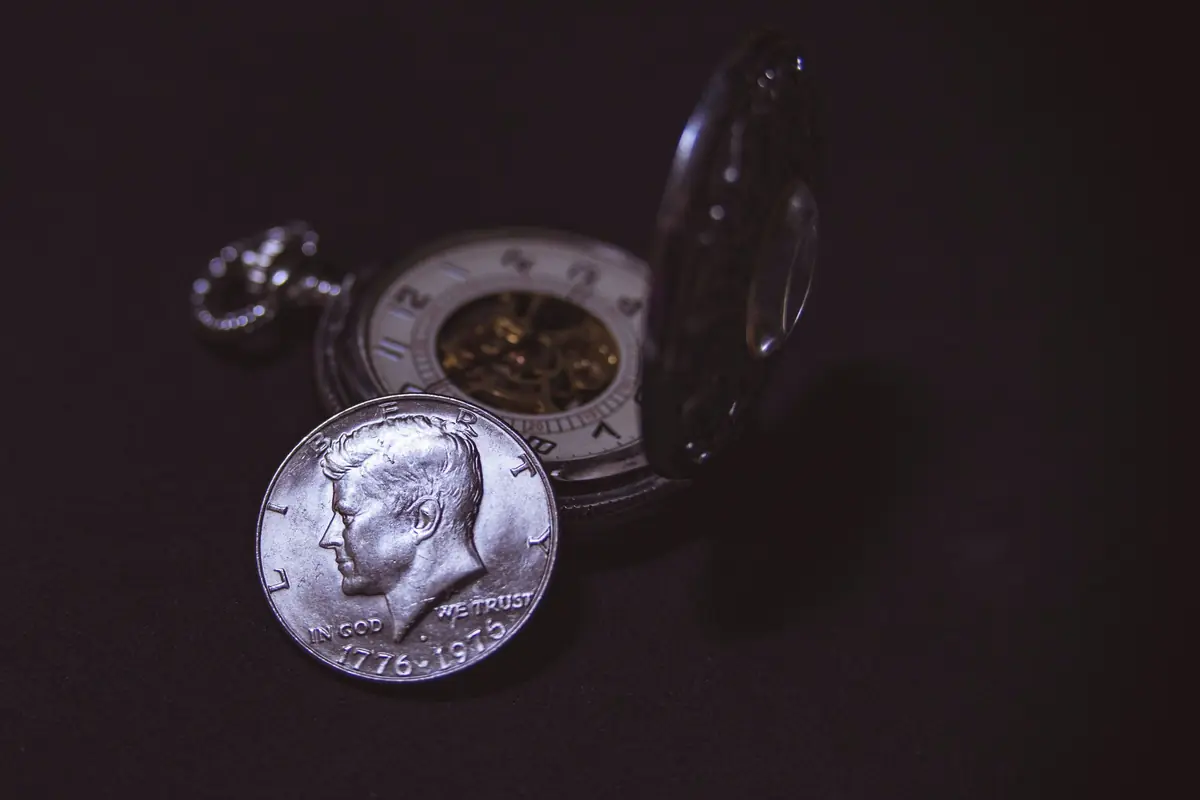
A silver coin is worth more than its melt value when its date and mint mark combination is scarce, when it survives in an unusually high grade, or both. Those scarce combinations are called key dates. Most pre-1965 dimes, quarters, halves and dollars are common and trade on their silver content alone, but a short list of coins in every series carries a collector premium that can run from a few dollars over melt to many times it.
The practical answer for anyone holding a jar, a roll or an inherited album is simple: before anything is priced as bulk silver, every coin should be checked for date, mint mark and condition. The check takes minutes with a loupe and a reference list, and the rest of this article explains exactly what that check looks for.
Melt value and collector value are two different numbers
Every pre-1965 US dime, quarter, half dollar and silver dollar is 90 percent silver. The silver weight is fixed by the coin type, so melt value is just arithmetic. A Morgan or Peace dollar holds 0.7734 troy ounces of pure silver. If silver spot were $30 an ounce, that is about $23.20 of metal in every dollar coin, whether it is a common 1921 Philadelphia strike or an 1893 San Francisco rarity.
Collector value, often called numismatic value, sits on top of that. It is set by how many collectors want a particular date and mint mark in a particular grade, and how few exist. For common dates in worn condition, collector value is close to zero, which is why dealers call them junk silver. For key dates, the collector premium is the whole story and the silver is almost a rounding error.
| Coin type | Years (90% silver) | Pure silver per coin |
|---|---|---|
| Mercury and Roosevelt dime | 1916 to 1964 | 0.0723 oz |
| Washington quarter | 1932 to 1964 | 0.1808 oz |
| Walking Liberty, Franklin, 1964 Kennedy half | 1916 to 1964 | 0.3617 oz |
| Morgan dollar | 1878 to 1904, 1921 | 0.7734 oz |
| Peace dollar | 1921 to 1935 | 0.7734 oz |
The figures above are the same ones used on our pre-1964 silver coin reference. Once those numbers are known, the only open question for each coin is whether it belongs in the melt pile or the collector pile.
Why a date and mint mark become a key date
Mintage is the starting point. The US Mint struck coins at several branch mints, and in some years one branch made very few of a denomination. The 1916 Denver Mercury dime is the classic case: 264,000 were struck, against more than 22 million at Philadelphia the same year. Same design, same silver, wildly different value.
Low mintage is not the only route. Some coins were struck in normal numbers but most were melted later. Large quantities of Morgan dollars were melted under the Pittman Act of 1918, which is part of why certain dates are scarcer today than their original mintage suggests. Other coins are common in worn condition but rare in mint state, a situation collectors call a condition rarity. The 1884-S Morgan dollar is the textbook example: millions were struck and worn examples are easy to find, but an uncirculated one is a serious coin.
It also works the other way. The 1903-O Morgan was once considered a great rarity, until bags of them came out of Treasury vaults in the early 1960s and the price collapsed. A coin’s status depends on surviving supply, not on what a grandparent was told decades ago, so old price notes in an album are a starting point, not a valuation.
Where the mint mark sits on each series
The mint mark is a small letter: no letter (or P on some later issues) for Philadelphia, D for Denver, S for San Francisco, O for New Orleans, CC for Carson City. It is usually small enough to need a loupe, and it is never in the same place across series. These are the spots to check:
- Morgan dollar: reverse, below the wreath, just above the letters DO in DOLLAR.
- Peace dollar: reverse, lower left, under the word ONE and near the tip of the eagle’s wing.
- Mercury dime: reverse, at the base of the fasces, to the left.
- Walking Liberty half: on 1916 and some 1917 coins, on the obverse below IN GOD WE TRUST; from later 1917 onward, on the reverse at the lower left near the rim.
- Washington quarter (1932 to 1964): reverse, below the wreath.
- Franklin half: reverse, above the beam that holds the Liberty Bell.
- Roosevelt dime (1946 to 1964): reverse, to the left of the torch base.
- 1964 Kennedy half: reverse, to the left of the eagle’s claw holding the olive branch.
A coin with no mint mark is not automatically less interesting. The 1921 Mercury dime, the 1928 Peace dollar and the 1921 Walking Liberty half are all Philadelphia coins with no letter, and all three are keys.
The key dates worth checking first
Every series has longer lists of semi-keys and varieties, but these are the coins that most often turn up in family collections and change the value of a lot when they do. Mintages are the published Mint figures used by the major grading services.
| Series | Key dates | Why they matter |
|---|---|---|
| Morgan dollar | 1893-S, 1889-CC, 1893-CC, 1895 (Philadelphia), 1892-S, 1884-S in mint state | 1893-S mintage was 100,000; 1889-CC was 350,000; the 1895 Philadelphia coin is known essentially only as a proof |
| Peace dollar | 1921, 1928, 1934-S | 1921 is the one-year high relief design; 1928 mintage was about 360,000 |
| Mercury dime | 1916-D, 1921, 1921-D, 1942/1 overdate | 1916-D mintage was 264,000, the lowest in the series |
| Walking Liberty half | 1916-S, 1921, 1921-D, 1921-S, 1938-D | 1921-D mintage was about 208,000 |
| Washington quarter | 1932-D, 1932-S | Each was struck in the low 400,000s in the first year of the series |
| Barber coins (1892 to 1916) | 1901-S and 1913-S quarters, 1896-S and 1904-S dimes, among others | Many Barber pieces carry some premium in any grade; the 1894-S dime is a famous rarity with a reported 24 struck |
Franklin halves and Roosevelt dimes have no true rarities in circulated grades. Their premiums live almost entirely in high mint state grades and in strike designations such as Full Bell Lines on Franklins.
Carson City is its own category. Any Morgan dollar with a CC mint mark draws collector interest because the Nevada mint operated for a limited period, and even the common CC dates sell above melt in most grades.
Condition can matter more than the date
Coins are graded on the 1 to 70 Sheldon scale. Worn coins sit in the Good, Fine and Very Fine ranges, lightly worn coins in Extremely Fine and About Uncirculated, and coins with no wear from circulation from MS-60 up to MS-70. A common date Morgan in MS-65 can be worth many times melt even though the same date in worn condition is pure bulk silver. The jump between MS-63 and MS-65 on a popular series is often larger than the entire melt value of the coin.
At the counter, the things that move a grade are visible with a 5x or 10x loupe: wear on the high points (Liberty’s cheek and hair above the ear on a Morgan, the eagle’s breast feathers on the reverse), the amount of original cartwheel luster when the coin is tilted under a light, bag marks in the open fields, rim nicks and hairline scratches. Strike matters on some series too. Mercury dimes with fully split bands on the fasces earn a Full Bands designation, and Morgans with deeply mirrored fields can earn a DMPL designation, both with real premiums.
If a coin looks like a strong mint state example of a valuable date, third-party certification is often worth discussing. That decision has its own costs and trade-offs, which are covered in our article on PCGS and NGC grades and when grading adds value.
Altered dates and added mint marks
Because key dates are worth so much more than common ones, they are the coins most often faked. The most common tricks are well known in the trade:
- Added mint marks. A D glued or soldered onto a 1916 Philadelphia dime to imitate a 1916-D, or an S added to an 1893 Philadelphia Morgan. Under magnification, an added letter often shows a seam, a slightly different color or a shape that does not match genuine dies.
- Removed mint marks. A 1928-S Peace dollar with the S scraped off to pose as the scarcer 1928 Philadelphia coin. Tooling marks in the field where the letter should be give it away.
- Altered dates. A digit reshaped to turn a common year into a key year.
- Cast and struck counterfeits. Modern fakes of entire coins, some made of base metal. Weight, diameter and a close look at the edge reeding catch most of them.
None of this means a seller has done anything wrong. Plenty of altered coins were bought in good faith decades ago. It does mean that a key date without certification gets a slow, careful look before anyone pays a premium for it, and a seller should expect that.
Proofs, varieties and other non-bulk silver
Some coins in a silver lot are not junk silver even though they are common dates. Proof coins, made with polished dies for collectors, have mirror fields and frosted designs and should be kept out of bulk weight. Mint and proof sets in their original government packaging are usually worth more intact. Die varieties, such as the 1878 Morgan with eight tail feathers versus seven, or doubled dies and overdates like the 1942/1 Mercury dime, can carry premiums that only show up under magnification.
Coins that are not 90 percent silver also turn up mixed in: 1965 to 1970 Kennedy halves at 40 percent silver, wartime nickels from 1942 to 1945 at 35 percent, and pre-1967 Canadian coins at 80 percent. These are priced on their own silver content, not as 90 percent coins. A 40 percent half holds 0.1479 ounces of silver, well under half of what a 90 percent half holds, so mixing the two in one count overstates the lot.
How to sort a jar of old coins at home
A first pass at home saves time and helps a seller understand the offer when it comes. A reasonable method:
- Hold coins by the edges, over a soft cloth. Fingerprints and drops cost money on high grade pieces.
- Separate by denomination and series: Mercury dimes, Roosevelt dimes, Washington quarters, Walking Liberty halves and so on.
- Within each series, sort by date, then check the mint mark of each coin with a loupe and good light.
- Pull every coin that matches a key date or semi-key list, every CC Morgan, every Barber coin and every coin that looks unworn, and keep those apart in a labeled envelope.
- Leave the rest, the common circulated dates, as bulk silver.
Free reference data helps: the grading services publish mintage figures and price guides online, and the long-running annual guide book of US coins lists dates and mintages for every series. Do not try to improve a coin’s look before showing it. Cleaning removes original surface and can turn a premium coin into a problem coin, a topic covered in detail in why cleaning coins before selling can cost you.
What happens when a coin is evaluated at the counter
At Buyers of New York, coins are sorted by type, date and mint mark in front of the seller. Key dates and certified coins are pulled for separate pricing, and the common coins are priced on silver content against the live spot price, with the spot figure shown before any offer is made. Coins with collector value are priced against current dealer and auction data rather than melt. The result should be an itemized offer where a seller can see which coins were treated as bullion and which were treated as collectibles, and why.
That split is the whole point of checking key dates. Two jars with the same face value and the same silver weight can produce very different totals if one holds a 1916-D dime or a Carson City dollar. The silver coin page lists the series and key dates we watch for most closely.
What to bring and how to reach us
Bring the coins exactly as they are, in whatever they are stored in: rolls, tubes, albums, flips, bags or loose in a jar. Keep any original Mint packaging, certification holders and old receipts or inventory lists, since they help identify proofs and sets quickly. If you have already pulled possible key dates, keep them in their own envelope so they can be looked at first.
Buyers of New York is at 30 W. 47th Street, Suite 8006, in the Diamond District, with an elevator to the 8th floor. Walk-ins are welcome Monday through Friday, 10am to 6pm, and large collections are best announced with a call ahead to (212) 642-4345 so the right person is free when you arrive. You can read more about how we evaluate dates, grades and silver content on our silver coins page.
More questions sellers ask
Is a coin with no mint mark worth less?
Not necessarily. Coins struck in Philadelphia usually carry no mint mark, and several important key dates are Philadelphia coins, including the 1921 Mercury dime, the 1928 Peace dollar and the 1921 Walking Liberty half. Value depends on the specific date and mint combination, not on the presence of a letter.
Are all Carson City Morgan dollars valuable?
Morgan dollars with the CC mint mark draw collector interest in nearly every grade because the Carson City mint operated for a limited period. Some CC dates are much scarcer than others, with 1889-CC and 1893-CC at the top, but even the more common CC dates usually sell above melt.
How can I tell if a mint mark was added to a coin?
Under a 10x loupe, an added mint mark often shows a thin seam where it meets the field, a slightly different color, or a letter shape that does not match genuine dies for that year. Key dates such as the 1916-D dime and the 1893-S dollar are common targets, so they get a slow, careful look before any premium is paid.
Do 1965 and later quarters and dimes contain silver?
No. US dimes and quarters dated 1965 and later are copper-nickel clad and contain no silver, apart from special collector issues. Kennedy half dollars from 1965 to 1970 are 40 percent silver, and 1971 and later circulating halves have none.
Should I sell key dates separately from the rest of my silver?
They should always be priced separately, even if they are sold in the same visit. Common dates are priced on silver weight, while key dates and high grade coins are priced on collector demand, so mixing them into a bulk weight figure means the premium is never counted.