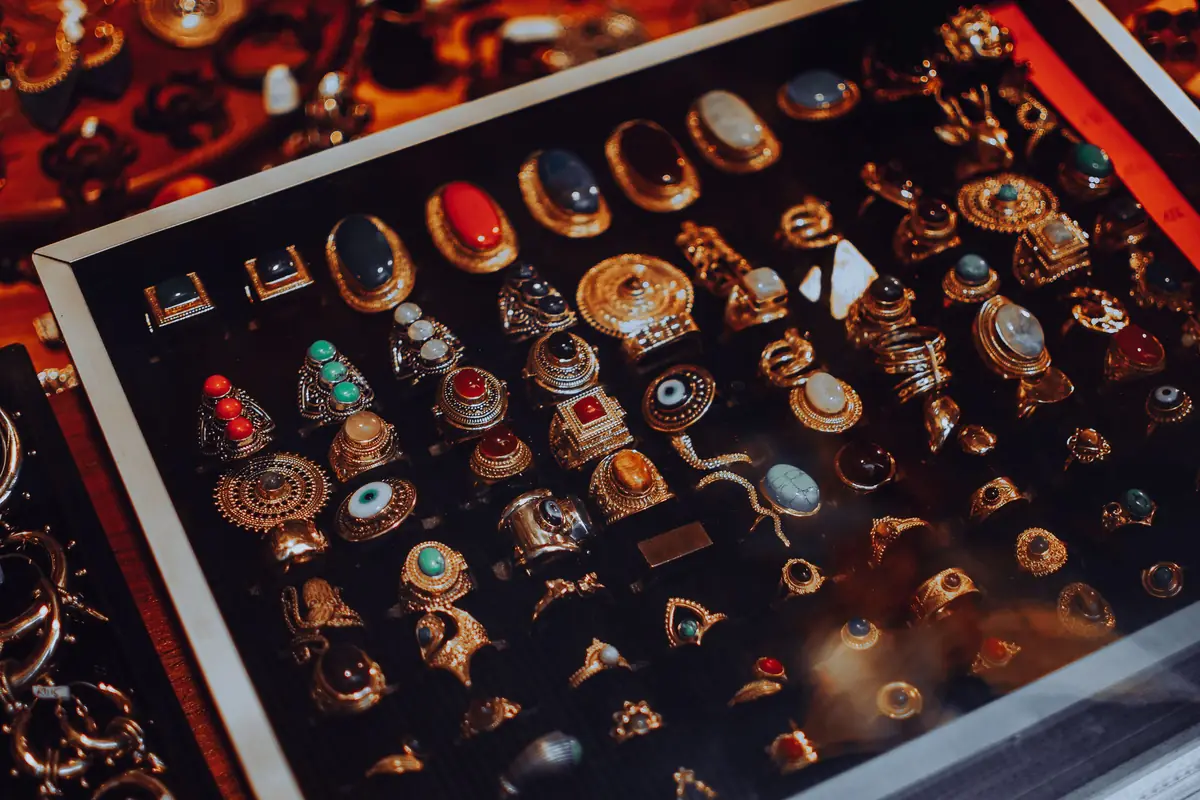
Jewelry is dated by reading the evidence on the piece itself: how it was made, what metal it is, how the stones are cut and set, what marks are stamped on it, what kind of clasp or catch it uses, and how it has worn. No single clue is proof. A specialist looks for several that agree, and a piece is called antique when that evidence points to an age of 100 years or more. Vintage, in the trade, usually means a piece that is at least a couple of decades old but not yet antique, and estate jewelry simply means previously owned, of any age.
Reproductions are where the money is lost or saved. An Edwardian style ring made last decade can look right in a photo. Under a loupe, the back of the setting, the cut of the stone and the clasp usually tell a different story. This guide walks through the clues in roughly the order an experienced buyer checks them.
Antique, vintage, estate and “in the style of”
These words get used loosely, and the differences matter for value.
| Term | What it normally means |
|---|---|
| Antique | At least 100 years old. United States customs rules use the same 100 year line for antiques. |
| Vintage | Older pieces that are not yet antique; a common trade rule of thumb is 20 years or more. |
| Estate | Previously owned. Says nothing about age by itself. |
| Period | Made during the period it resembles, for example a genuinely Art Deco bracelet. |
| Revival, “style” or reproduction | Made later in the look of an earlier period. Can be well made, but priced as a later piece. |
The main periods and what they look like
Each period had its own materials, techniques and motifs. The date ranges overlap because styles did not change overnight. Buyers of New York’s antique jewelry page uses these broad divisions:
| Period | Approximate dates | Typical signs |
|---|---|---|
| Georgian | 1714 to 1837 | Handmade throughout, closed back settings often with foil behind the stones, rose cut and table cut diamonds, paste, hairwork, early mourning rings |
| Victorian | 1837 to 1901 | Yellow gold, sentimental and mourning themes, seed pearls, garnet, coral, jet, lockets with hair compartments, archaeological revival work |
| Art Nouveau | about 1890 to 1910 | Flowing organic lines, insects, flowers, female profiles, plique-à-jour enamel, opals and moonstones |
| Edwardian | 1901 to about 1915 | Platinum, often over gold; lacy garland designs; milgrain edges; knife edge wire; old European and old mine cut diamonds; pearls |
| Art Deco | about 1915 to 1935 | Geometric symmetry, platinum, calibré cut sapphires, rubies, emeralds and onyx fitted tightly against diamonds |
| Retro | about 1935 to 1960 | Large, sculptural yellow and rose gold, bows, scrolls and ribbons, big citrines and aquamarines |
Style is a starting point, not a verdict. Every one of these looks has been revived since, so the next sections are about the physical evidence that a reproduction usually cannot copy.
Construction: handmade, cast or die struck
Turn the piece over first. The back of a jewel shows how it was made far more honestly than the front.
- Hand fabrication. Georgian and much Victorian work was built from sheet, wire and tube, soldered together. Expect slight irregularities, hand cut openings, and tool marks from files and gravers.
- Die striking. From the later 19th century, many parts were stamped from sheet metal in steel dies. Die struck work is crisp and thin, and identical repeats are a clue.
- Casting. Lost wax casting is everywhere in modern jewelry. Cast reproductions of old designs often show a slightly soft, grainy surface under magnification, tiny pits, and detail that is rounded rather than sharp. Cast “filigree” is a frequent giveaway: real filigree is made of fine twisted wires you can follow with your eye.
- Edwardian platinum work. Genuine pieces often have pierced galleries cut by hand with a saw, fine millegrain beading applied by a wheel, and a lightness that cast copies rarely match.
Metals and what they reveal
The metal can rule a date in or out.
- Platinum came into wide jewelry use around the start of the 20th century, which is why it defines the Edwardian and Art Deco looks. Before that, diamonds were often set in silver backed by gold, so the stones looked white while the gold kept the silver from touching skin. A silver topped, gold backed setting is a strong sign of 19th century work.
- White gold became commercially established around the time of the First World War and spread through the 1920s. A white gold ring sold as Georgian has a problem.
- Rose and green gold were favored in some periods, including the Retro era.
- Pinchbeck, a copper and zinc alloy that imitates gold, appears in Georgian and early Victorian pieces and can be collectible in its own right.
- Rhodium plating on white gold is modern. A bright, very white surface over a yellowish metal suggests a later piece or later refinishing.
Marks, hallmarks and what each tells you
Many antique pieces carry no marks at all, especially American and British jewelry made before marking rules tightened. When marks are present, they are some of the best dating evidence there is.
British hallmarks
A full British hallmark includes a standard mark, an assay office mark (for example the anchor of Birmingham or the leopard’s head of London), a maker’s mark, and often a date letter that identifies the year of assay. The gold standards themselves help too: before 1854 the only legal standards for British gold were 22 and 18 carat. 15, 12 and 9 carat were added in 1854, and in 1932 the 15 and 12 carat standards were replaced by 14 carat. A British piece hallmarked 15 carat was therefore assayed between 1854 and 1932.
French marks
France has used an eagle’s head mark for 18 karat gold since the 19th century, alongside a lozenge shaped maker’s mark. Imported pieces received different marks, so a French mark also helps place where a piece was sold.
American marks
American law did not require a quality mark, but under the federal stamping law that dates to 1906 any karat or sterling mark that is used must be accurate. A 1961 amendment added the requirement that a quality mark be accompanied by a registered trademark of the maker or the party responsible for the mark. Metric marks such as 585 and 750 on American pieces are generally later still. Patent numbers and “PAT. PEND.” stamps can be looked up to give an earliest possible date. Platinum pieces from the early 20th century are often marked PLAT or IRIDPLAT, for the iridium platinum alloy that was standard then.
A mark that is wrong for the claimed period is more useful than a mark that is right. A “925” stamp on a supposedly Victorian silver brooch, for example, points to a later piece or a later marking.
Stone cuts and settings
Diamond cutting changed steadily, and an old stone in an old setting is one of the most persuasive combinations.
- Rose cut: flat base, domed top covered in triangular facets. Common in Georgian and earlier work.
- Old mine cut: cushion shaped outline, high crown, small table and a large culet (the flat at the bottom). Look straight down and you often see the culet as a small circle in the center.
- Old European cut: round, with the same high crown and visible culet; dominant from the late 19th century into the 1930s.
- Modern round brilliant: a flatter crown, larger table and pointed culet; standard in later 20th century pieces.
- Calibré cut colored stones: small stones cut to fit a precise shape, typical of Art Deco.
Be careful with colored stones. Synthetic ruby and sapphire, made by flame fusion, were in commercial production from the early 1900s, so an old mount does not guarantee natural stones. Curved growth lines under magnification are a classic sign of the synthetic. Replacement stones and modern cubic zirconia also turn up in old mounts, which is why a gemologist tests every stone separately.
Findings: clasps, catches and earring backs
The small working parts, called findings, are easy to replace but also easy to date.
- Brooch catches. Older brooches typically use a simple C shaped catch, often with a pin that extends past the edge of the brooch. Safety catches and later rotating catches appeared in the 20th century. A C catch is consistent with an early piece; a modern rotating catch on a supposedly Georgian brooch means a replacement at best.
- Earring backs. Shepherd’s hook and other wires for pierced ears are old. Screw backs became popular in the early 20th century and clip backs later, which is why many Art Deco and Retro earrings have them. Many antique earrings were converted later; conversions reduce collector value.
- Necklace and bracelet clasps. Box clasps with a tongue and safety are long established. A modern lobster clasp on an old chain is almost always a replacement.
Wear, repairs and alterations
A century of wear leaves patterns that are hard to fake. Edges are softened where they touch skin, ring shanks thin at the bottom, engraving fades on the high points, and prongs show retipping. Repairs tell their own story: old repairs often use grey lead solder, while laser welds are modern. Conversions are common too: a brooch turned into a pendant, a stickpin top made into a ring, a watch chain made into a bracelet. They do not make a piece a fake, but they change what it is worth to a collector.
It is tempting to clean an old piece before showing it. Don’t. The shop’s FAQ advises bringing antique jewelry exactly as it is, because cleaning can strip original patina and restoration can destroy the evidence of period manufacture. Our post on why cleaning before selling can cost you explains the damage in detail.
Common reproduction giveaways
- Cast detail that is rounded and grainy where hand work would be crisp.
- Machine made, perfectly uniform filigree or millegrain.
- Rhodium plated white gold standing in for platinum.
- Modern findings throughout, with no sign of replacement.
- Diamonds that are all modern brilliants in a design claimed to be from the 1900s.
- Marks that did not exist in the claimed period, or marks that are too fresh and sharp for the wear on the rest of the piece.
Signed pieces add one more layer, because a maker’s signature can be faked as easily as a style. That subject has its own post on signed designer jewelry.
How this works at the counter
According to Buyers of New York’s antique page, its specialists identify the period, attribute the maker, grade the gems and test the metal in front of you, and for significant pieces they compare recent auction results. The site describes appraisers with more than 100 years of combined experience and GIA certified gemologists, and says the evaluation is free with no obligation to sell. Their FAQ gives an example of the kind of distinction that matters: genuine Whitby jet in Victorian mourning jewelry is worth considerably more than French jet, which is black glass.
Bring each piece as it is, along with any boxes, receipts, old appraisals or family history you have, and a photo ID. The shop is at 30 W. 47th Street, Suite 8006, open Monday to Friday from 10am to 6pm; for larger estate collections the site asks you to call ahead at (212) 642-4345. You can read more about how the shop assesses period pieces on its estate and antique jewelry page.
More questions sellers ask
How old does jewelry have to be to count as antique?
The usual standard is 100 years or more, the same line United States customs rules use for antiques. Vintage is a looser term for older pieces that are not yet antique.
Does a lack of hallmarks mean my jewelry is fake or new?
No. A great deal of genuine antique jewelry, especially American and smaller British pieces, was never marked. The metal is tested and the piece is dated from its construction, stones and findings instead.
Can a reproduction be valuable?
Yes, a well made revival piece in gold or platinum with good stones has real value. It is priced as a later piece, though, without the collector premium that a genuine period piece carries.
What is Whitby jet?
Whitby jet is a fossilized wood from the English coast used widely in Victorian mourning jewelry. Buyers of New York notes that genuine Whitby jet is worth considerably more than French jet, which is black glass.
Should I clean antique jewelry before having it looked at?
No. Cleaning can strip original patina and restoration can destroy evidence of period manufacture. Bring pieces exactly as they are.