PCGS and NGC are the two grading services the coin market trusts most, and a coin in either holder is easier to price and to resell than the same coin raw. For most series the two are accepted on close to equal terms, though for some classic US coins a PCGS holder can bring a modest premium over NGC in the same grade, and the size of that gap changes from series to series. The real value question is not which holder, but which grade, because a single point on the 70 point scale can change a gold coin’s price by more than its gold content.
Grading adds value to a gold coin when the coin is good enough, or rare enough, that the grade premium is larger than the grading fee, shipping and time. That is usually true for pre-1933 US gold in better grades and for modern coins that reach a perfect 70. It is usually not true for common bullion coins in ordinary condition, which sell on their gold weight with or without a holder.
What PCGS and NGC actually do
Professional Coin Grading Service (PCGS) was founded in 1986 and Numismatic Guaranty Corporation (NGC) in 1987. Both do the same four things. They authenticate the coin, assign a grade on the Sheldon scale from 1 to 70, add any designations for strike or surface, and seal the coin in a tamper-evident plastic holder, often called a slab, with a label showing the date, denomination, grade and a unique certification number.
That certification number is the backbone of the system. Each service runs a free online lookup where anyone can enter the number and confirm the coin’s description and grade, and for many coins see images taken at grading. Both services also publish population reports, which count how many coins of each date have been graded at each level, and price guides that collect retail and auction data. Those three tools, cert lookup, population and price history, are what make a certified coin faster to price than a raw one.
Both services also stand behind their work with a guarantee covering authenticity and grade, under the terms each publishes. That backing is a large part of why a dealer or collector on the other side of the country will buy a certified coin sight unseen from a photo and a cert number, something almost nobody does with a raw gold coin. The holder does not make a coin rarer or better. It makes the coin easier to trust, and in a market where a counterfeit double eagle can look convincing at arm’s length, trust is worth money.
The 1 to 70 grade scale in plain terms
The scale was built around early Morgan dollar pricing, which is why the numbers are not evenly spaced. What matters for a seller is the broad band a coin sits in.
| Grade range | Name | What it looks like |
|---|---|---|
| 1 to 3 | Poor, Fair, About Good | Heavily worn, date can be partly worn away |
| 4 to 10 | Good, Very Good | Design outlined, most detail worn flat |
| 12 to 35 | Fine, Very Fine | Moderate to light even wear, major details clear |
| 40 to 45 | Extremely Fine | Light wear on the highest points only |
| 50 to 58 | About Uncirculated | Trace wear on high points, much luster left |
| 60 to 70 | Mint State (MS) | No wear from circulation; grade set by marks, luster, strike and eye appeal |
| 60 to 70 | Proof (PR at PCGS, PF at NGC) | Specially struck collector coins, graded on the same numbers |
Within mint state, the steps are where money moves. An MS-62 coin has obvious bag marks, an MS-65 has only small scattered marks and full luster, and an MS-70 shows no post-production flaws under 5x magnification. On a popular series, the difference between MS-63 and MS-65 is often a multiple, not a percentage.
PCGS vs NGC: where the differences are real
The two services grade to broadly the same standards, and a coin graded MS-64 by one would often grade MS-64 by the other. Where they differ:
- Market pricing by series. For many classic US coins, including some pre-1933 gold, dealers and auction results show PCGS coins bringing somewhat more than NGC coins of the same grade. For modern bullion and many world coins, the difference is often small or zero. The only reliable way to know for a specific coin is to compare recent sales of that date and grade in each holder.
- Label language. PCGS writes proof grades as PR, NGC as PF. Deep mirrored proofs are DCAM at PCGS and Ultra Cameo at NGC.
- Plus and star. Both services use a plus for coins at the top of a grade. NGC also adds a star for exceptional eye appeal.
- Early release labels. For modern coins, PCGS uses First Strike and NGC uses Early Releases for coins submitted within roughly 30 days of an issue’s release. The coin itself is no different, and the premium for these labels varies widely and fades for many issues.
- Older holders. First generation PCGS holders and older thick NGC holders have their own collector following, because the coins inside were graded before later grade changes. A coin in an early holder should not be cracked out without advice.
For a seller, the practical point is that both holders are fully liquid at Buyers of New York. Certified coins are priced by grade against current population data and recent auction results, not by the name on the label alone. The PCGS coin page shows the kind of certified coins we see most.
When grading adds value to a gold coin
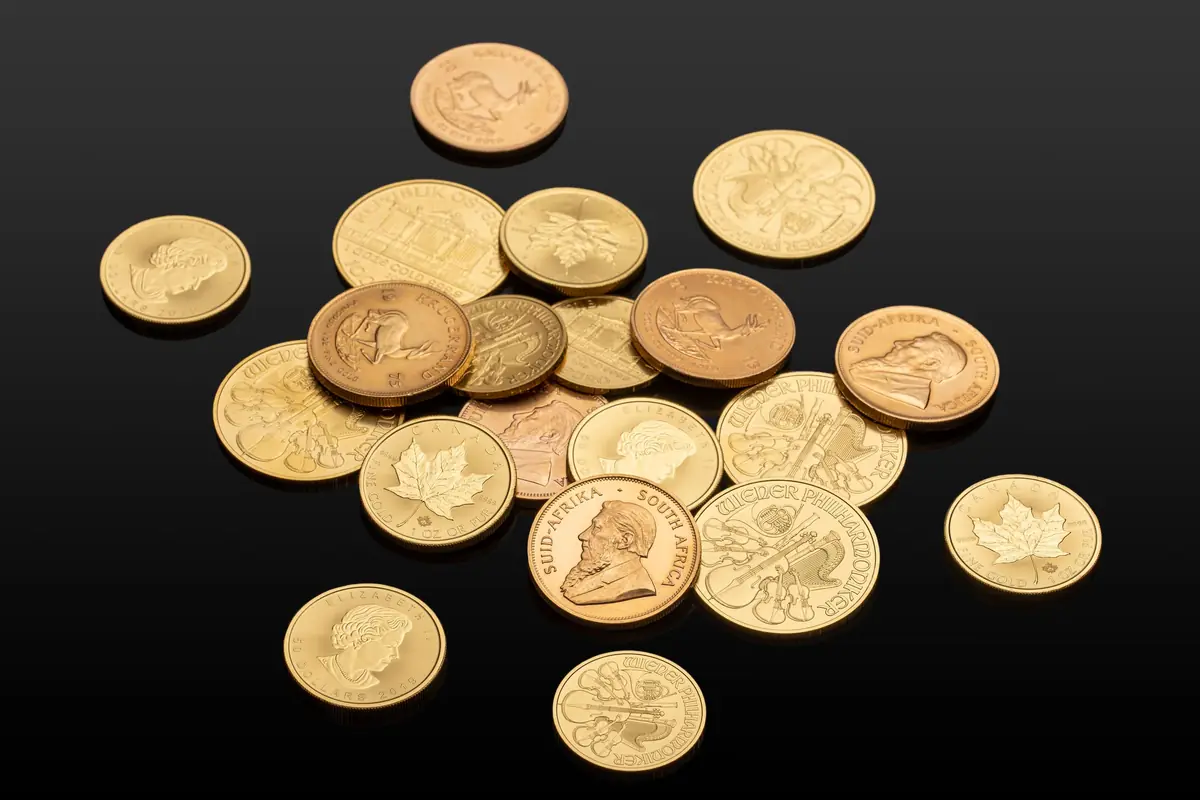
Gold coins split into two groups. Bullion coins, such as American Gold Eagles, Maple Leafs and Krugerrands, are priced on gold content plus a small premium. Numismatic gold, especially pre-1933 US gold, carries a collector premium that depends heavily on date and grade.
A worked example with round, hypothetical numbers shows how the math works. A $20 Saint-Gaudens double eagle contains 0.9675 troy ounces of gold. If gold spot were $2,000 an ounce, the gold inside would be worth about $1,935. A common date raw Saint usually trades a modest amount above melt, because the buyer cannot be sure of the grade, has to check for cleaning and counterfeits, and has to allow for the cost of certification. If the same coin is certified MS-65, it might trade meaningfully higher than an MS-63, because the population thins out at each step up, and because it can be sold to a collector immediately without any of those risks.
For scarce dates, the gap is larger still. Some Saint-Gaudens and Liberty double eagle dates are common in lower grades and scarce at MS-64 or MS-65, which is exactly where certification earns its keep. Our gold coin page lists the pre-1933 types we assess for numismatic value.
When grading does not pay
For modern bullion coins, the arithmetic usually goes the other way. A current year Gold Eagle graded MS-69 typically trades close to an ungraded coin, because most freshly minted bullion coins come out of the tube in that range. Only MS-70 and PF-70 coins carry a dependable premium, and that premium varies by year and type.
Here is the expected value math with hypothetical numbers. Say grading, shipping and insurance cost $60 per coin all in, and an MS-70 would sell for $150 over a raw coin while an MS-69 sells for about the same as raw. If one coin in four comes back MS-70, the average gain is $37.50 per coin, against a certain cost of $60. The submission loses money on average, before counting the weeks the coins are away. The numbers only work for issues where the 70 premium is much larger, or where the submitter has reason to think the coins are unusually clean.
Circulated common dates, cleaned coins, and anything that will clearly receive a details grade are also poor candidates. Coins with surface problems come back in a details holder rather than with a straight grade, and the market discounts them heavily, as explained in our piece on why cleaning coins before selling costs money.
Fake holders and how certified coins are checked
Because certified coins sell easily, counterfeit holders exist, some with counterfeit gold coins inside. They often copy a real certification number. A careful buyer checks several things before paying a grade premium:
- The cert number is looked up on the issuing service’s site, and the date, denomination, grade and, where available, the photographs are compared with the coin in hand.
- The holder is examined: label printing, fonts, the hologram and the way the plastic edges are sealed.
- The coin itself is looked at through the plastic for the right design details, color and luster for its type and grade.
- Weight and dimensions are compared with the specification for the coin plus the known holder weight, where that is practical.
Expect this to take a few minutes per coin. It protects both sides, and a genuine coin passes quickly.
Raw coins: should you send them in before selling
For most people with a handful of coins, sending them in before selling is not worth it. Submitting directly usually requires a paid membership or going through a dealer, fees rise with the coin’s value and the speed of service, and the coins are away for weeks. More importantly, a seller often does not know which grade a coin will get, and a coin submitted in hope of a 65 that comes back 63 has cost money.
A better first step is to have the coins looked at by someone who handles certified gold every day. An experienced buyer can tell which coins are strong candidates for a top grade, which are clearly circulated or problem coins, and which are bullion. If a coin is a strong candidate, the offer can reflect that potential, or the owner can choose to grade it first. Either way, the decision is made with information rather than hope.
How a certified gold coin is priced at the counter
At Buyers of New York, offers on gold coins start from the live gold spot price and the coin’s fine gold content. Certified coins are then priced by grade against current population data and recent auction results for that exact date and grade, rather than at melt. Graded modern coins at MS-69, MS-70, PF-69 or PF-70 are assessed on their certified grade premium. Every part of the calculation is shown before you accept anything.
The same logic explains why two coins with identical gold weight can bring very different numbers. A 1 ounce bullion coin and a certified pre-1933 double eagle are not competing on the same scale. For more on how fine gold content is calculated for the common bullion coins, see American Eagle vs Maple Leaf.
What to bring and how to reach us
Bring certified coins in their holders exactly as they are, and do not crack any coin out of a slab, old or new. Bring raw coins in whatever flips, tubes or boxes they are in, plus any purchase receipts, invoices or old inventory lists, since they help identify dates and proofs quickly.
Buyers of New York is at 30 W. 47th Street, Suite 8006, in the Diamond District, with an elevator to the 8th floor. Walk-ins are welcome Monday through Friday, 10am to 6pm, and for larger collections or significant numismatic pieces, calling ahead at (212) 642-4345 makes sure a specialist is free. You can read how we evaluate bullion, pre-1933 and certified coins on our gold coins page.
More questions sellers ask
Is a PCGS coin always worth more than an NGC coin?
No. For some classic US series, PCGS coins often bring a modest premium over NGC coins in the same grade, but for many modern and world coins the difference is small or absent. The way to know for a specific coin is to compare recent sales of that date and grade in each holder.
Can I verify a graded coin myself?
Yes. Both PCGS and NGC offer free online certification lookups. Enter the number from the label and compare the date, denomination, grade and any photographs with the coin. A mismatch is a warning sign, though a matching number alone does not rule out a copied holder.
Should I crack a coin out of its holder to resubmit it?
Not without expert advice. Once a coin leaves its holder, the certification and guarantee are gone, and there is no promise of a higher grade on resubmission. Coins in early generation holders can also carry a collector premium of their own that cracking destroys.
What does a details grade mean on a label?
It means the coin is genuine but has a problem, such as cleaning, damage or environmental effects, that keeps it from receiving a straight numeric grade. The label gives an approximate wear level, for example XF Details, and the market prices these coins well below straight graded examples.
Are First Strike and Early Releases coins worth more?
Sometimes, but the premium varies widely. The labels only mean the coin was submitted within about 30 days of the issue's release; the coin is not struck differently. For many issues the label premium is small, and the grade remains the main driver of value.