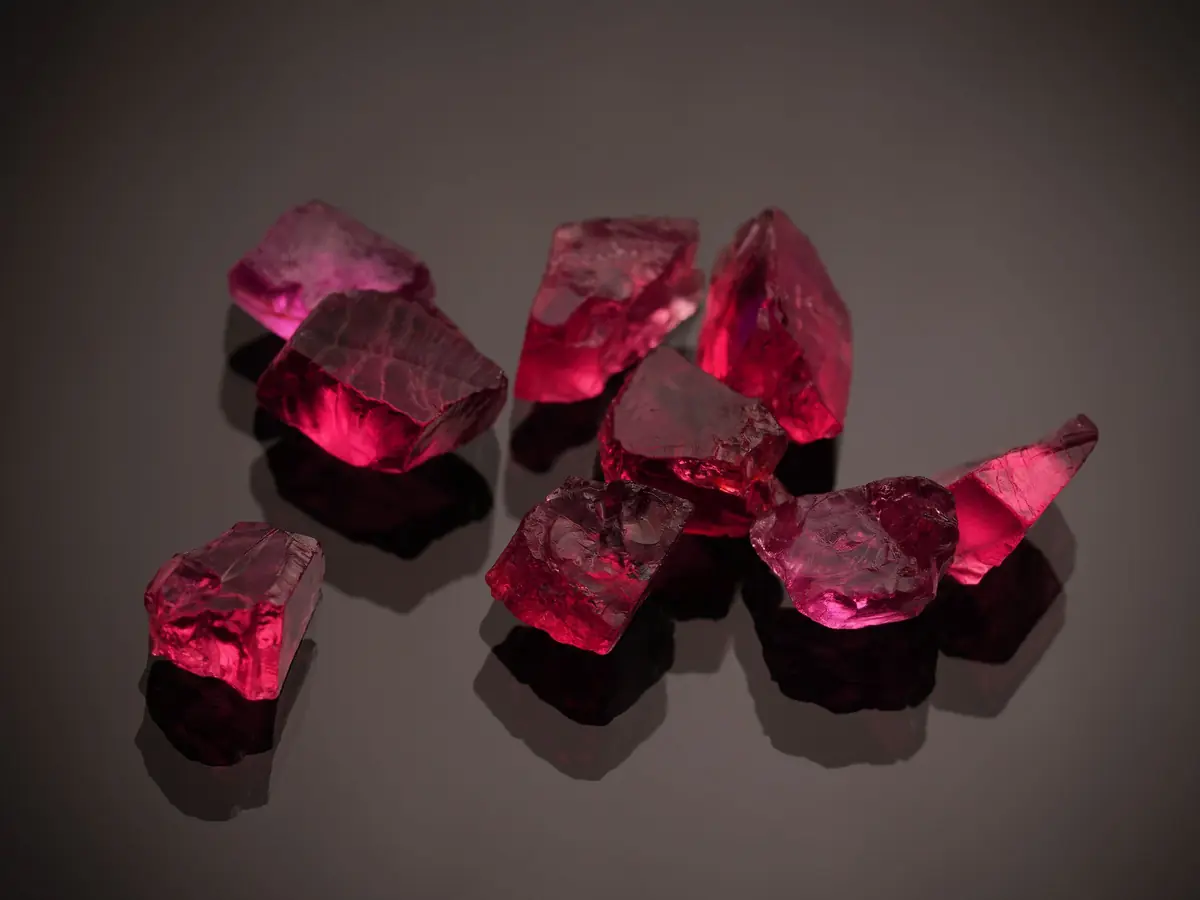
Most rubies on the market have been heated, and the trade accepts heating as a routine, stable treatment. An unheated ruby of the same color, size and clarity is far scarcer, so it sells for a clear premium, and that premium widens sharply as quality and size go up. On heated vs unheated ruby value, the short answer is that heat alone does not make a ruby cheap, but proof of no heat can make a fine ruby much more valuable.
The other large factor is origin, with Burmese stones from the Mogok area holding the strongest reputation. Origin and treatment are judged together, from inclusions and lab testing, and the words on a lab report carry most of the weight when a significant ruby changes hands. This article explains what heating does, how it is detected, what the report wording means, and which treatments move a stone into a very different price class.
What heating does to a ruby
Ruby is the red variety of the mineral corundum, colored mainly by chromium. Many rough rubies come out of the ground with a purplish or bluish cast, cloudy patches, or fine needles of rutile, which the trade calls silk. Heating the rough in a furnace, at temperatures well above those of any household oven, can dissolve some of that silk, reduce the blue component and brighten the red. A stone that looked dull and milky can come out cleaner and redder.
Simple heating of this kind is permanent under normal wear and is accepted across the industry with disclosure. It is not the same thing as filling a stone with glass, which is covered below. When a dealer says a ruby is “heated”, they usually mean this ordinary furnace treatment, sometimes with a small amount of residue left in healed fissures.
How a gemologist tells heated from unheated
The evidence is mostly inside the stone. Under a microscope, a gemologist looks at the inclusions, because heat changes them in ways that are hard to fake.
- Silk. In an unheated stone, rutile needles are typically sharp, long and intact. After heating they often look broken up, dotted or partly dissolved.
- Crystal inclusions. Solid mineral crystals inside the ruby expand at a different rate than the host. Heat can crack the ruby around them, leaving disc-shaped fractures, sometimes with a glassy halo.
- Healed fissures. Fissures that healed in a furnace, especially with a flux added, can contain glassy residue rather than the natural fluid patterns seen in unheated stones.
- Spectroscopy. Infrared and other spectra can show features associated with heating, and labs combine these with the microscope findings.
Buyers of New York describes its ruby assessment as UV fluorescence, spectroscopic analysis and microscopic examination of inclusion integrity, which is how heated stones are told from unheated ones at the counter. For a significant stone, the firm recommends a report from a major lab, because a buyer down the line will expect one.
What the lab report wording means
Labs such as GIA, GRS, Gübelin, SSEF and AGL each phrase treatment findings in their own way, but the core statements are similar.
| Typical report wording | What it means | Effect on value |
|---|---|---|
| No indications of heating | The lab found no evidence of heat treatment | The strongest statement a ruby can carry; premium pricing |
| Indications of heating | Heated, with no significant residue noted | Normal market pricing for a heated ruby |
| Indications of heating, with minor residue in fissures | Heated, with small amounts of glassy residue in healed fractures | Usually a modest discount to clean heated stones |
| Heated, with significant residue or glass filling | Fractures contain substantial foreign material | A steep discount, depending on the amount |
| Ruby and glass composite, or manufactured product | Heavily fractured corundum held together with lead glass | Priced as a low value composite, not as ruby |
Read the report date as well. A ruby re-polished or exposed to heat after the report was issued may no longer match it, and a buyer will want to see that the stone in hand matches the measurements and description on the paper.
The treatments that change everything: glass filling and diffusion
Lead glass filled rubies
Some low grade, heavily fractured ruby material is filled with lead glass, which makes it look much more transparent. The filler can make up a noticeable share of the stone. GIA has stated that it considers some of this material so heavily treated that it does not warrant being called ruby at all, and reports it as a manufactured product, with a note that the binding material may be unstable to heat and chemicals. Jewelry repair torches, pickling solutions and even some household cleaners can damage these stones.
Under a loupe, the signs include a blue or orange flash in the fractures, large gas bubbles, and flattened bubbles inside wide glass-filled cracks. These stones were sold in volume in mass market jewelry, often at prices that sound like a bargain for ruby. Their resale value is very low, and buyers price them accordingly.
Beryllium diffusion
Heating corundum with beryllium can change color through the whole stone. It is better known in sapphires, especially orange and pink-orange stones, but it has been found in rubies as well. Detecting it requires laboratory chemical analysis, and diffused stones sell at a large discount to conventionally heated ones.
Origin: why Burma leads the price ladder
Origin is an opinion a lab gives from inclusions and trace element chemistry, not something visible to the eye. It still matters a great deal, because the market pays for it.
- Burma (Myanmar), Mogok. Marble-hosted rubies, low in iron, which often fluoresce strongly red under ultraviolet light. That glow is part of why fine Mogok stones look alive in daylight. Mong Hsu, another Burmese source, produced large quantities of rubies that were almost always heated to remove blue cores, so “Burmese” alone does not mean unheated.
- Mozambique, Montepuez. A major source since the deposit was found in 2009. Fine Mozambique rubies can approach Burmese color and are widely offered unheated as well as heated, and they are respected at auction.
- Thailand and Cambodia. Iron-rich stones from basalt-related deposits. They tend to be darker, with less fluorescence, and many show a slightly brownish or garnet-like red.
- Sri Lanka, Madagascar, Afghanistan, Vietnam, Tanzania and others. Each produces fine stones, valued on their own merits, but none carries the same automatic name premium as Mogok.
The trade term “pigeon’s blood” describes the most prized red, a saturated red with strong fluorescence, historically tied to Burma. Several Swiss labs, GRS most prominently, use color terms of this kind on reports under their own criteria. A pigeon’s blood label from one lab is not interchangeable with another lab’s opinion, and it is not a GIA grade.
A worked example: four rubies of the same size
Consider four 2 carat oval rubies, all with good color and eye-clean or close to it. These are hypothetical stones used only to show the order of value, not prices.
- Lead glass filled stone. Bright red, very transparent, sold originally at a low price. Valued as a composite; the setting may be worth more than the stone.
- Heated Thai ruby, no report. A darker red with little fluorescence. Valued as a commercial heated ruby by a buyer’s own assessment.
- Heated Mozambique ruby, report noting heating only. Brighter color, documented treatment. Clearly higher than stone 2.
- Unheated Burmese ruby, report from a major lab. Same size and similar color. This stone is in a different class: rarer, documented, and sought by collectors. The offer can be several times that of stone 3.
The gap between stones 3 and 4 is where the heated vs unheated question matters most. Below roughly a carat, or in stones with weak color, the premium for no heat is much smaller, because the market for those stones is driven by price rather than rarity.
When a new lab report is worth paying for
A report costs money and takes time, so it is not worth ordering for every ruby. A useful rule of thumb in the trade: the better the color and the larger the stone, the more a treatment and origin report can add, because those are the stones where heated and unheated, Burmese and non-Burmese, separate most in price.
- Usually worth it: a stone of strong, even red over about a carat and a half, with no report or only an old report from a lab the market does not rely on.
- Sometimes worth it: a stone of good color around a carat, especially if the seller believes it is unheated and wants that confirmed before negotiating.
- Rarely worth it: small rubies in clusters, calibrated stones in bands, or stones with obvious glass filling. The report would cost more than it could add.
Origin opinions are not perfectly uniform from lab to lab, and the most valuable stones are often sent to two labs so that the buyer at auction sees agreement. If you already hold a report, bring it: a buyer reads it as a starting point and checks that the stone in hand matches it, rather than ordering a new one by default.
Ruby, pink sapphire and other red stones
Ruby and pink sapphire are the same mineral, corundum. The line between them is drawn by color saturation and tone, and labs and countries do not draw it in exactly the same place. A stone a Bangkok dealer calls a pink ruby may be a pink sapphire on a GIA report, and ruby commands a higher price. Our article on sapphire origin and treatment covers the sapphire side of corundum.
Red spinel, garnet, red tourmaline and synthetic ruby can all pass for ruby at a glance. Synthetic ruby has been made since the early 1900s and turns up in many antique and vintage pieces. Our post on how a gemologist tells a real gemstone from a synthetic explains the tests.
How setting and jewelry affect a ruby offer
When a ruby is in a ring or pendant, the buyer values the ruby, any diamonds and the metal separately, then adds them together. The ruby page notes that the setting is assessed separately for additional value, and that signed pieces from houses such as Cartier, Van Cleef & Arpels and Bulgari are assessed for a designer premium above stone value.
A set stone also limits what can be seen. Prongs hide parts of the girdle, closed backs hide the pavilion, and heat from old repairs can affect glass-filled stones. For a significant stone without a report, a buyer may suggest unmounting it for full examination or sending it to a lab before giving a firm number.
What to bring and how to have a ruby evaluated
Bring the stone or the jewelry, any lab report (GIA, GRS, Gübelin, SSEF or AGL), and any receipts or auction paperwork. A government photo ID is required to sell. Do not put the piece in an ultrasonic or steam cleaner, and do not have a jeweler heat or retip it before the evaluation, especially if you suspect glass filling.
Buyers of New York is at 30 W. 47th Street, Suite 8006, open Monday to Friday from 10am to 6pm. Identification of the stone is free, whether it turns out to be ruby, synthetic, spinel or garnet, and there is no obligation to sell. For a significant Burmese or unheated stone, call (212) 642-4345 before you come so the right gemologist is available. To see the full list of ruby jewelry and loose stones the firm buys, visit the page on how rubies are bought and paid for.
More questions sellers ask
Is a heated ruby a fake ruby?
No. A heated ruby is a natural ruby that has had a common, stable treatment, and it is sold as ruby with disclosure. Glass-filled composites and synthetic rubies are the stones that are priced very differently.
Can heat treatment be reversed?
No. Simple heating permanently changes the stone. An unheated ruby that is later heated loses the premium it had, which is why fine stones should be kept away from jewelers' torches.
Do I need to tell a buyer that my ruby is heated?
If you know, say so, and bring any report. A professional buyer will check for heat regardless, and full information makes the evaluation faster.
Are Mozambique rubies worth less than Burmese rubies?
Burmese stones from Mogok usually carry the highest name premium, but fine Mozambique rubies are well regarded and can be very valuable. Quality and treatment still matter more than origin for most stones.
How can I tell if my ruby is glass filled?
Signs under a loupe include a blue or orange flash in fractures and gas bubbles inside the stone. Confirmation needs a gemologist, and such stones are often reported by labs as a ruby and glass composite or manufactured product.