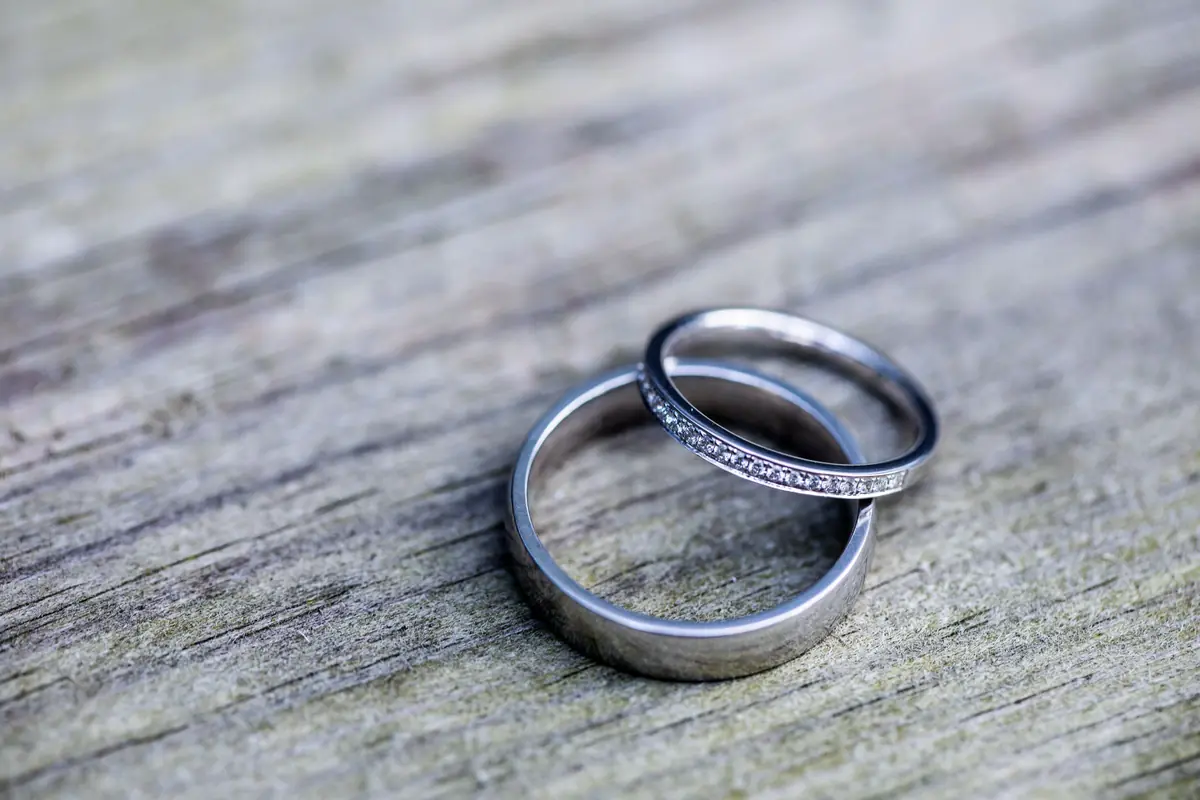
Platinum, palladium and white gold look almost identical in a ring box, but they are three different materials. White gold is real gold, usually 14K or 18K, alloyed with white metals and plated with bright rhodium. Platinum jewelry is usually 90 to 95 percent platinum and is by far the heaviest of the three. Palladium jewelry is usually 95 percent palladium, a platinum group metal that looks like platinum but weighs little more than half as much.
You can usually tell them apart from the stamp inside the band (14K or 585 and 750 for white gold, PT950 or PLAT for platinum, PD950 or PALL for palladium), from how heavy the piece feels for its size, and from how it has worn. A buyer confirms with an XRF analyzer, which reads the metal directly in a few seconds. Below are the marks, the physical differences, the tests, and how each metal is valued, since each one is priced against its own market.
What each metal is made of
White gold
White gold starts as gold, which is naturally yellow, and is alloyed with metals that bleach the color: palladium, nickel, silver, zinc or manganese. Even so, most white gold alloys still have a faint yellow or grey cast, so nearly all white gold jewelry is electroplated with rhodium, a very white, very hard platinum group metal. That plating is what you see on a new white gold ring. The gold content follows the karat exactly as it does in yellow gold: 14K white gold is 58.5 percent gold and 18K white is 75 percent.
Nickel white gold is harder and cheaper to make but causes skin reactions in some people. Palladium white gold avoids that problem and is common in better European pieces.
Platinum
Platinum jewelry is mostly platinum. In the United States the most common alloy is 950, meaning 95 percent platinum, with the balance usually ruthenium, iridium or cobalt for hardness. Japanese jewelry often uses 900 or 850. Platinum is naturally white, so it is not usually plated, though some jewelers rhodium plate it for a brighter finish.
Palladium
Palladium is a sister metal to platinum, also naturally white and also used in jewelry without plating. Palladium jewelry is typically 950 fineness. It was used widely in American jewelry during the Second World War, when platinum was reserved for military use, and returned in the 2000s as a lighter, less expensive alternative to platinum for wedding bands.
Reading the marks
Start with a 10x loupe on the inside of the band, the back of a pendant or the clasp. The table covers what you are likely to find.
| Mark | Metal | Content |
|---|---|---|
| 14K, 585 (white piece) | White gold | 58.5% gold |
| 18K, 750 (white piece) | White gold | 75% gold |
| PLAT, PT, PLATINUM, 950 PT, PT950 | Platinum | 95% platinum |
| 900 PT, PT900, 900 PLAT | Platinum | 90% platinum |
| 850 PT, PT850 | Platinum | 85% platinum |
| IRIDPLAT, 10% IRID PLAT | Platinum iridium alloy (older American pieces) | About 90% platinum, 10% iridium |
| PD950, 950 PD, 950 PALL, PALL | Palladium | 95% palladium |
| 925, STERLING | Sterling silver | 92.5% silver, not gold or platinum |
| TUNGSTEN, TC, TI, TITANIUM, COBALT, 316L | Base metal bands | No precious metal value |
The US Federal Trade Commission jewelry guides govern how platinum can be marked. An item may be called simply “platinum” only if it is at least 950 parts per thousand pure platinum. Pieces at 850 or 900 must show that number before “Plat” or “Pt.” Alloys with 500 to 850 parts per thousand platinum have to list their full composition, for example “585 Pt. 415 Co.,” and anything below 500 cannot be called platinum at all. The same guides list the platinum group metals, including palladium, with the abbreviations “Pall.” or “Pd.”
Many engagement rings combine metals. A yellow gold band may carry a platinum head that holds the diamond, marked something like “14K & PLAT” or “18K/PT.” Art Deco pieces often pair a platinum top with an 18K gold back. These are fine pieces, but the metals are weighed and valued separately.
The weight test anyone can do
The most reliable home clue is density. Platinum is extraordinarily heavy. Pure platinum is about 21.4 grams per cubic centimeter, and 950 platinum jewelry sits around 20 to 21. Compare:
- 950 platinum: about 20 to 21 g/cm³
- 18K white gold: about 14.5 to 16 g/cm³
- 14K white gold: about 12.5 to 14.5 g/cm³
- 950 palladium: about 12 g/cm³
- Sterling silver: about 10.4 g/cm³
Two rings of identical size and shape will therefore weigh very differently. If a platinum band weighs 7 grams, the same band in 18K white gold would weigh about 5.3 grams, in 14K white gold about 4.6 grams, and in palladium only about 4.1 grams. If you have a matched pair, say a platinum engagement ring and a band of unknown metal with similar dimensions, weighing both on a gram scale tells you a lot.
One trap: tungsten carbide wedding bands are also heavy, and they are grey white. They are usually stamped TUNGSTEN or TC, cannot be resized, and are very hard. They have no precious metal value.
How each metal wears
Years of wear leave different signatures, and a buyer reads them before running any test.
- White gold loses its rhodium plating over time, first on the underside of the band and the high points. A yellowish or greyish tinge appears where the plating has thinned. Jewelers re-plate white gold every year or two for this reason. A yellow tinge on the palm side of a white ring is a strong hint it is white gold.
- Platinum does not wear away in the same way. Scratches push metal aside rather than removing it, and over time the surface develops a soft grey sheen collectors call a patina. Polishing restores the shine. Platinum rings often look more worn on the surface but have lost little weight.
- Palladium wears much like platinum but is softer in some alloys and scratches more readily. It also keeps its white color without plating.
Repairs leave clues too. Jewelers solder platinum with platinum solders at very high temperatures, and a sizing seam on a platinum band is often almost invisible. A white gold band that has been sized may show a faint yellow line at the seam once the rhodium wears, because gold solder sits under the plating. Neither clue is proof on its own, but together with weight and stamps they usually point the right way.
Tests a buyer uses
XRF analysis
X-ray fluorescence is the standard tool for white metals because it shows exactly which elements are present and in what proportion. A 14K white gold ring might read about 58 percent gold, 20 to 25 percent copper, with nickel or palladium and zinc. A 950 platinum ring reads about 95 percent platinum and 5 percent ruthenium or cobalt. A palladium ring reads about 95 percent palladium. The rhodium plating on white gold shows up too, but it is so thin it barely registers. Buyers of New York tests platinum and palladium by XRF analysis in front of the customer and says the result takes seconds.
Acid testing
Acid works for white gold, which reacts to karat acids much like yellow gold once the rhodium is filed through. Platinum resists the acids used for gold, and specialized platinum test solutions exist, but they are slower and less clear than XRF. For that reason, most buyers who regularly handle platinum rely on XRF.
Density and specific gravity
When a reading looks unusual, weighing the piece in air and in water gives its specific gravity, which separates platinum from everything else on the list very clearly.
How each metal is valued
Here is where the three really part ways. White gold is valued against the gold price; platinum against the platinum price; palladium against the palladium price. Those three markets move independently. Over the past few decades platinum has at times traded at roughly twice the price of gold, and at other times well below it. Palladium spent several years trading above gold, driven by demand for catalytic converters, and has since fallen back. Buyers of New York’s own platinum page notes that gold has recently outpaced platinum, leaving platinum at a discount to gold. Check the live spot price of each metal on the day you sell.
The formula is the same for all three: weight × purity × spot price of that metal ÷ 31.1035 to convert to grams, then the buyer’s percentage. A worked example shows why weight and price both matter. These numbers are hypothetical: assume gold at $3,000 an ounce and platinum and palladium each at $1,000 an ounce.
| Same ring in | Weight | Purity | Metal melt value |
|---|---|---|---|
| 950 platinum | 7.0 g | 95% | About $214 |
| 18K white gold | 5.3 g | 75% | About $383 |
| 14K white gold | 4.6 g | 58.5% | About $260 |
| 950 palladium | 4.1 g | 95% | About $125 |
In this scenario the 18K white gold version is worth the most, because gold is priced three times higher than platinum. If platinum were priced above gold, as it has been in the past, the platinum ring would come out ahead. This is why “platinum is always worth more” is not a safe assumption, and why the metal has to be identified before anyone can quote a number.
What this means for engagement rings and wedding bands
Most of the white metal pieces sellers bring in are bridal jewelry, and the center stone usually matters more than the band. Diamonds and gemstones are evaluated separately from the metal. With the stones removed, the band and setting are weighed and tested, and the metal portion is priced as above. A platinum head on a yellow gold band is separated in the same way, so each metal is paid at its own rate.
Signed pieces from major houses can be worth more than their metal. A platinum band from a well known jeweler with its original box and papers may resell as jewelry rather than as metal. Mention any signature before the piece is weighed.
Palladium outside the jewelry box
Palladium also turns up in dental alloys, in bullion coins and bars, and in catalytic converters. Pale grey dental crowns are often palladium based, which our post on dental gold value explains. Buyers of New York’s palladium page notes that catalytic converters need a call ahead so an assay evaluation can be arranged.
What to bring, and how the metal is identified
Bring the pieces, any receipts or appraisals that state the metal, and a valid government issued photo ID. You do not need to know what the metal is. At Buyers of New York, platinum and palladium are identified by XRF analysis in front of you, white gold is tested for karat, and everything is weighed on DCA certified scales before an offer is made. There is no charge for testing and no obligation to sell.
We are at 30 W. 47th Street, Suite 8006, New York, NY 10036, open Monday through Friday from 10am to 6pm, with walk-ins welcome. Call (212) 642-4345 for large lots or estates. You can read about how we price white metals on our platinum buying page, and if you are unsure whether a ring is platinum or white gold, bring it in for a free XRF check before deciding anything.
More questions sellers ask
Is white gold real gold?
Yes. White gold is a real gold alloy, usually 14K or 18K, mixed with white metals and plated with rhodium. It is priced on its gold content like yellow gold of the same karat.
Why does my white gold ring look yellow underneath?
The rhodium plating has worn thin. The alloy below has a faint yellow or grey cast. Re-plating restores the color and does not change the metal value.
What does IRIDPLAT mean?
It marks a platinum alloy with about 10 percent iridium, common in older American jewelry. It is platinum jewelry and is priced on its platinum content.
Is a tungsten ring worth anything as metal?
No. Tungsten carbide bands are heavy and grey white but have no precious metal value. They are usually stamped TUNGSTEN or TC.