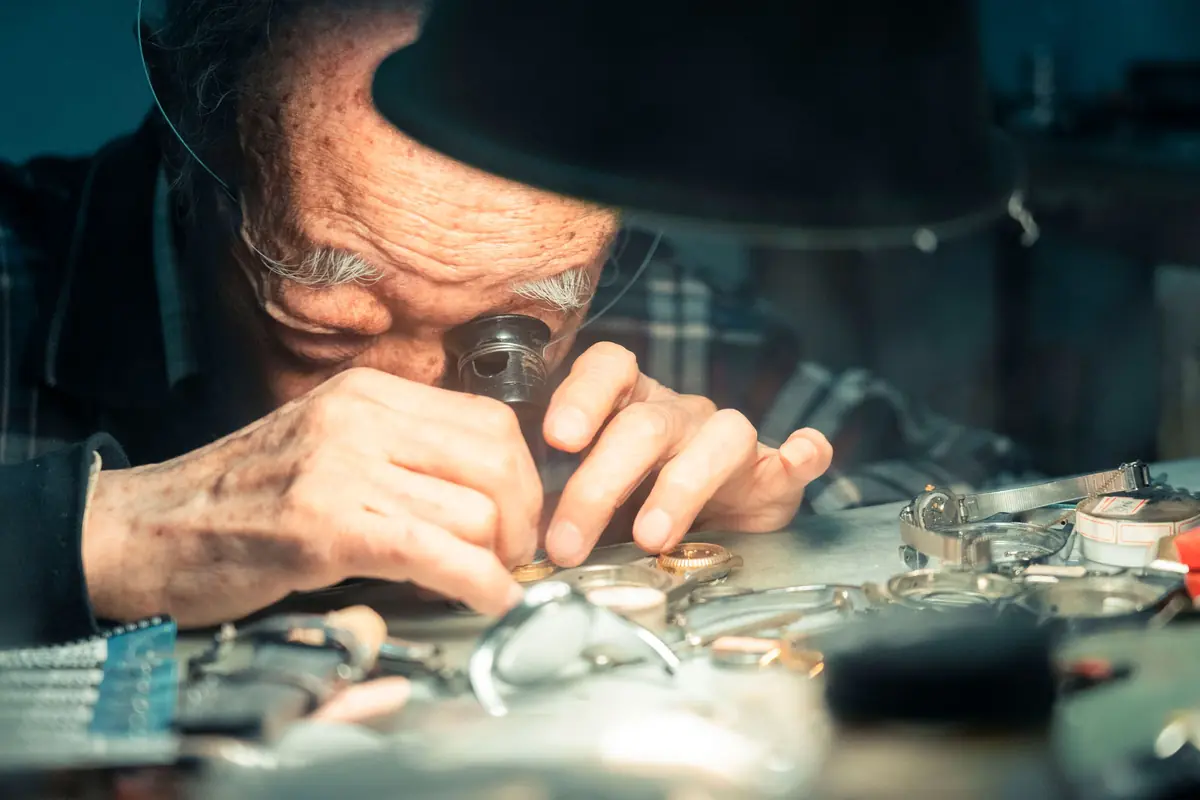
No, you should not polish a luxury watch before selling it, and in most cases you should not have it serviced either. Polishing removes metal from the case and bracelet, softens the sharp edges and finishes that collectors pay for, and cannot be undone. A buyer will lower the offer for a heavily polished watch, not raise it.
Servicing is a closer call but usually leads to the same answer. A professional buyer already prices the cost of any needed service into the offer, often at less than a retail customer would pay for the same work, so a seller rarely gets the cost of a service back. For vintage watches, a service can do actual harm if original parts are replaced along the way. The best move in almost every case is to bring the watch exactly as it is.
What polishing does to a watch case
A luxury watch case is not one finish. Most steel and gold sports watches combine brushed surfaces, with fine parallel grain, and high polished surfaces, often separated by a crisp line or a narrow bevel. On a Rolex Submariner of the five digit reference era, the lugs have chamfered edges that catch the light. On an Audemars Piguet Royal Oak, the alternating brushed and polished surfaces of the octagonal bezel and integrated bracelet are a defining part of the design and require skilled hand finishing.
Polishing works by removing a thin layer of metal. Done once by a skilled hand, the loss is small. Done repeatedly, or done badly on a wheel, it rounds off edges, blurs the line between brushed and polished areas, thins the lugs, softens engravings and can distort the shape of the case. Collectors describe the result as soft or overpolished, and they price it down.
Buyers of New York’s own guidance on Audemars Piguet watches makes the point directly: the Royal Oak’s combination of brushed and polished surfaces is extraordinarily difficult to restore authentically, and a polished Royal Oak loses the sharp transitions that define the design. Original, unpolished case and bracelet surfaces are worth significantly more than a polished watch that only looks new. More on how that plays out on specific references is on the Audemars Piguet page.
Scratches versus a polished case: how buyers see it
Owners often assume that desk scratches on a clasp or bracelet will cost them more than a polish would. In the secondary market it usually works the other way. Light scratches are surface marks that a buyer expects on a worn watch and can deal with later if needed. A polished case has lost metal, which is permanent. An unpolished case with honest wear is almost always worth more than the same case after a polish, especially on steel sports models and anything vintage.
When a watch is evaluated, the case is looked at under good light and magnification: the sharpness of the lug edges and bevels, the crispness of the brushed grain, the thickness of the lugs, the depth of any case engravings and the condition of the bracelet’s end links and clasp. Those details tell a trained eye whether a case is original or refinished, regardless of how shiny it looks.
Bracelets tell their own story. Stretch between the links, a loose clasp or worn end links are normal on a watch that has been worn daily, and none of them is fixed by polishing. A polishing session on a bracelet can actually make wear more obvious, because it rounds the edges of each link while leaving the play between them. Gold watches add one more cost: every polish removes a little gold, and on a precious metal case and bracelet that is metal the owner paid for. The honest condition of a watch, scratches included, is what a buyer wants to see, because it is the condition the buyer can trust.
Should you service a watch before selling
A full service, with the movement taken apart, cleaned, lubricated, adjusted and reassembled, along with gaskets and a water resistance test, is real work and costs real money. At a brand’s own service center, a full service on a luxury watch commonly costs a significant sum, more for chronographs and complicated movements, and the watch is usually away for several weeks or longer.
A buyer looks at a watch that needs service and deducts what the service will cost the buyer, which is often less than the retail price for the same work. Here is a worked example with hypothetical numbers:
- A watch that would bring $8,000 in good running order needs a full service.
- The buyer’s cost to have it serviced is $700, so the offer as it stands is around $7,300.
- If the owner pays $1,000 for a brand service first and waits two months, the offer might rise to $8,000 or slightly more if fresh brand service paperwork helps resale.
- The owner has spent $1,000 and two months to gain roughly $700 to $900.
The numbers change from watch to watch, but the pattern is consistent: servicing first rarely makes the seller money, and it adds delay and the risk of changes the seller did not ask for. Our general watch FAQ says the same thing: a watch that needs service still has substantial value, the cost of service is factored into the offer, and the watch should not be serviced before coming in, especially if it is vintage.
What brand service can change without you noticing
The less obvious risk of servicing before a sale is what else happens during the service. A full brand service often includes refinishing the case and bracelet unless the owner specifically asks for no polishing. On older watches, service centers also commonly replace parts that are worn, out of production or no longer meet their standards, such as dials, hands, bezel inserts, crowns and crystals, with current service parts.
On a modern watch that matters little. On a vintage watch it can matter enormously. An original dial with aged tritium lume, faded bezel insert or period hands is often a large part of a vintage watch’s value, and replacing them with new service parts can turn a collector piece into a much more ordinary one. Buyers of New York’s guidance on vintage Rolex Explorers puts it this way: an untouched 1016 with an honest dial is worth more than a freshly serviced, polished one. The Explorer page covers why originality outweighs function on those references.
If a watch must be serviced for personal use, ask in writing for no case or bracelet polishing and for all replaced parts to be returned to you, and keep them with the watch.
Independent repairs and aftermarket parts
Independent watchmakers range from excellent to poor, and the difference is not always visible from outside. Two outcomes reduce value at sale time. The first is aftermarket parts: non-original crowns, crystals, bezels, dials, hands or bracelets, sometimes fitted without the owner knowing. The second is undocumented work that leaves the buyer unsure what was done. A buyer who sees a non-original part has to price in the cost of sourcing a genuine replacement, which can be considerable for discontinued components.
Aftermarket diamond dials and bezels added to a steel watch are a particular case. They are common, but most buyers value the watch as if the parts had to be replaced with originals, so the added stones usually add little or nothing at resale.
When a repair before selling does make sense
There are a few situations where acting before a sale is reasonable:
- Moisture under the crystal. Condensation or water inside a watch can rust the movement and damage the dial quickly. Do not wait. Bring the watch in or have it seen by a qualified watchmaker right away, and ask that only the moisture be dealt with.
- A broken crystal. A cracked crystal lets dust and moisture in and can scratch the dial or hands. A crystal replacement is a small job, but if you plan to sell soon, it is often better to bring the watch in as it is and let the buyer handle it.
- A recent brand service already done. If the watch was serviced at a brand center recently for its own sake, the service paperwork adds value. Bring it.
Outside those cases, the safest choice is to leave the watch alone and let the buyer price what is there.
What a buyer checks on the movement
A watch does not need to be serviced for a buyer to know its mechanical condition. At the counter, the reference, serial, movement, case, dial and bracelet are all checked in front of you. On the movement side, that usually means checking whether the watch runs and winds smoothly, whether the crown screws down and sets the time and date correctly, whether chronograph pushers start, stop and reset, and how the watch performs on a timing machine, which reads its rate, amplitude and beat error in a minute or two.
Those readings tell the buyer whether the watch is running well, running but due for service, or in need of repair, and that feeds directly into the offer. A watch that runs fast or slow is still bought; the service cost is simply part of the math.
Safe ways to prepare a watch for sale
There is a short list of things that help and do no harm:
- Wipe the case, crystal and bracelet with a dry, soft microfiber cloth to remove fingerprints and dust.
- Avoid polishing cloths impregnated with compound. They are designed to remove metal and will dull brushed surfaces.
- Do not open the caseback, swap straps or bracelets, or adjust anything inside.
- Gather the box, papers, booklets, tags, extra links and any service records. How much each part of a set adds is covered in how much box and papers add when selling a watch.
- If any original parts were replaced in the past and you still have them, such as an old dial, bezel insert or bracelet, bring them too.
That last point is easy to overlook and can be worth a great deal on older pieces. The way condition, originality and completeness combine into a price is covered further in how pre-owned luxury watches are priced.
What to bring and how to reach us
Bring the watch exactly as it is, scratched, running slow or stopped, with whatever came with it and any original parts that were removed. Bring a government issued photo ID. Most watch evaluations take 15 to 20 minutes, and payment is made the same day, in cash or by same-day wire.
Buyers of New York is at 30 W. 47th Street, Suite 8006, in the Diamond District, with an elevator to the 8th floor. Walk-ins are welcome Monday through Friday, 10am to 6pm, and for vintage or significant pieces, calling ahead at (212) 642-4345 makes sure the right specialist is available. You can read more about how we evaluate condition and originality across Rolex, Patek Philippe, Audemars Piguet and other brands on our luxury watch page.
More questions sellers ask
Will scratches on my watch lower the offer?
Light scratches are expected on a worn watch and usually cost far less than people fear. They are surface marks a buyer can deal with later. A polished case, by contrast, has permanently lost metal and sharp edges, which tends to cost more.
Can an overpolished case be restored?
Some specialists rebuild worn cases by adding metal with laser welding and refinishing it. Collectors generally regard this as restoration rather than originality, and it does not bring a watch back to the value of an original unpolished case.
Does a watch need to be running to be sold?
No. Watches that run slow, stop or do not run at all are still bought. The buyer checks the movement, estimates the cost of service or repair and factors it into the offer.
Is it worth replacing a scratched crystal before selling?
Usually not, unless the crystal is cracked and letting dust or moisture in. A buyer can replace a crystal at trade cost, so the repair rarely adds more to the offer than it costs.
What should I ask for if I do have my watch serviced?
Ask in writing for no polishing of the case and bracelet, and for every replaced part to be returned to you. Keep the old parts and the service paperwork with the watch.